If you’re researching hydraulic presses for puzzle manufacturing, you’ve probably asked yourself: what tonnage hydraulic press do I actually need for a 1000-piece jigsaw puzzle?
It’s a deceptively simple question with a surprisingly specific answer. After digging through manufacturer specifications, engineering data, and real-world production setups, here’s the bottom line:
A 1000-piece jigsaw puzzle typically requires a hydraulic press with 500 to 700 tons of cutting force.
But that range leaves plenty of room for confusion. Why the spread? What determines whether you need 500 tons or 700 tons? And why on earth does cutting cardboard require that much force in the first place?
Let’s break it all down.
The Short Answer: 500 to 700 Tons
Most industrial puzzle manufacturers use presses in the 500–700 ton range for 1000-piece puzzles. Here’s what the major manufacturers actually specify:
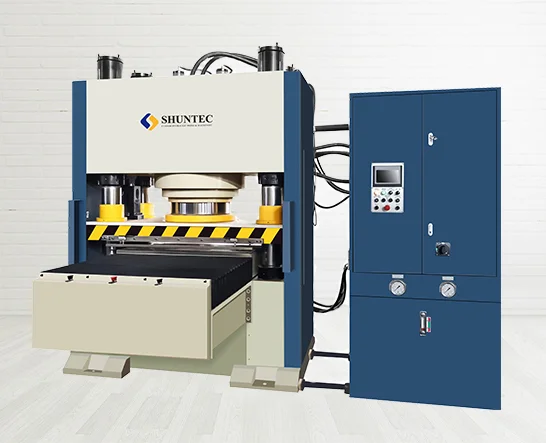
- Shuntec builds a dedicated 600-ton four-post servo-hydraulic press specifically for 1000-piece jigsaw puzzle die cutting.
- JHS Machine states that a 1000-piece puzzle typically requires a 700-ton hydraulic press.
- HG Cutting Systems notes that 500 tons can cut 1000 pieces in a single pass.
- Jianlong offers models ranging from 300 to 1000 tons for puzzle die-cutting applications.
So if you see numbers anywhere from 500 to 700 tons, you’re in the right ballpark. But let’s dig into why these numbers are so high—and what factors might push you toward the upper or lower end of that range.
Why Does a Cardboard Puzzle Need 500+ Tons of Force?
This is the question that stumps most people new to puzzle manufacturing. It’s just cardboard, right? How hard can it be to cut?
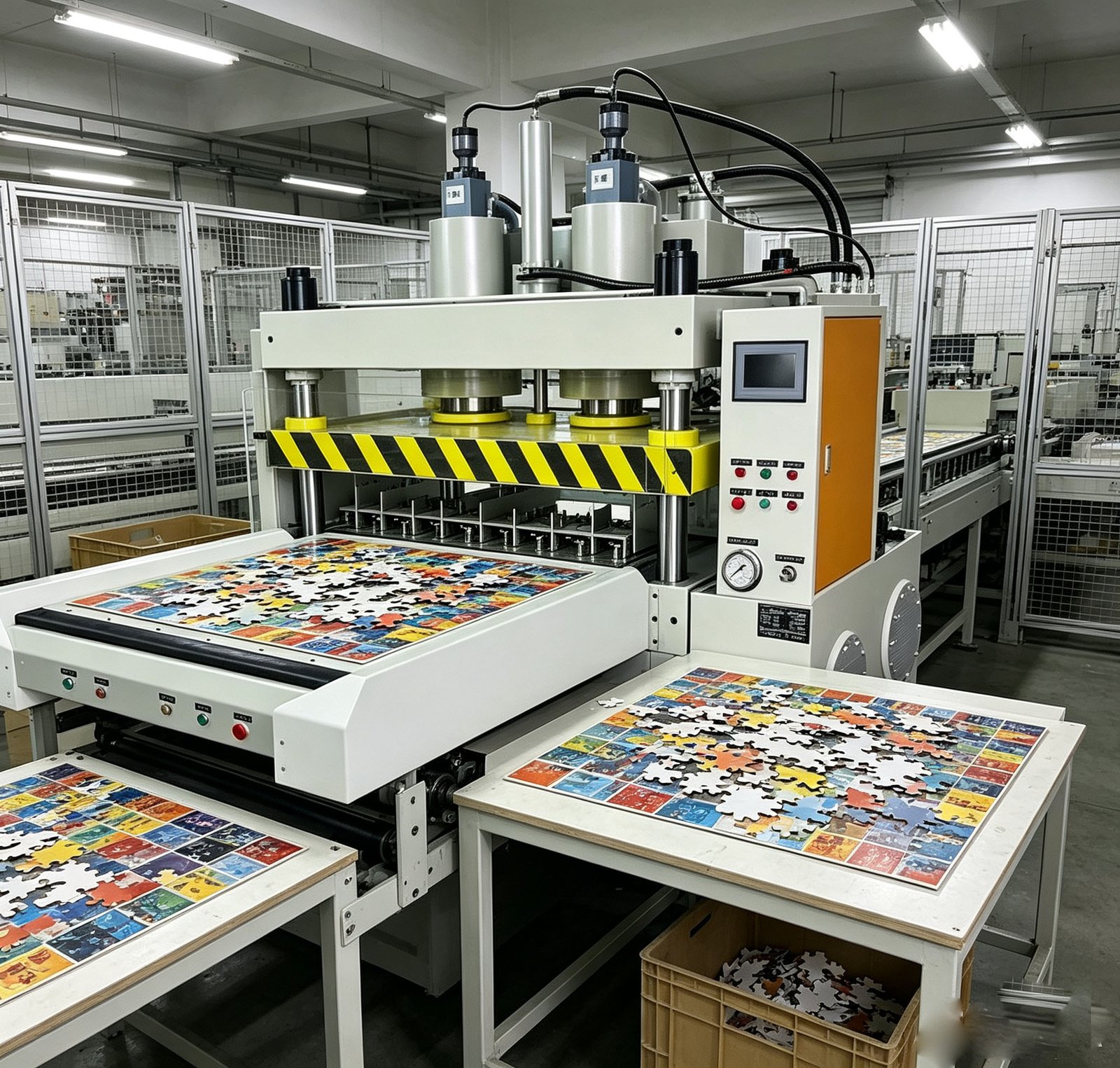
The answer lies in the steel rule die—the flat tool that contains hundreds of sharp steel blades arranged in the puzzle’s interlocking pattern. When the press comes down, those blades must penetrate the puzzle board simultaneously, across the entire surface area.
Here’s what’s really happening:
- A 1000-piece puzzle die contains roughly 1000 individual cutting blades, plus the perimeter cut
- The total length of all those cutting edges can be hundreds of feet
- Each inch of blade needs enough force to slice through laminated cardboard
- The press must deliver that force evenly across the entire die surface to avoid incomplete cuts or damaged edges
Think of it this way: you’re not just cutting one line—you’re cutting a thousand interconnected lines all at once, with perfect precision. That takes serious power.
For context, one manufacturer’s specification notes that cutting 2mm thick paper puzzle material requires approximately six tons of force per meter of cutting die. Multiply that by the total cutting perimeter of a 1000-piece puzzle, and you quickly arrive at hundreds of tons.
Key Factors That Affect the Tonnage You Need
Not all 1000-piece puzzles are created equal. Several variables can shift your tonnage requirement up or down:
1. Material Thickness and Density
Standard puzzle boards range from about 1.75mm to 2mm thick. But premium puzzles often use thicker, denser board—some are “18% thicker than industry average”. Thicker material requires more force to cut cleanly.
Different board types also matter. Standard cardboard puzzles require moderate cutting force, while thick greyboard or premium laminated products may need significantly higher pressure.
2. Puzzle Size (Overall Dimensions)
A 1000-piece puzzle isn’t a standardized size. They typically range from about 50×70cm to 76×50cm. Larger surface area means a larger die, which means more cutting edge length—and more required tonnage.
3. Material Type
- Paper/cardboard puzzles: 500–700 tons
- Wooden puzzles: May require higher tonnage depending on wood thickness
- Plastic/EVA foam puzzles: Much lower—as little as 30–40 tons for EVA foam toys
4. Single-Pass vs. Multi-Pass Cutting
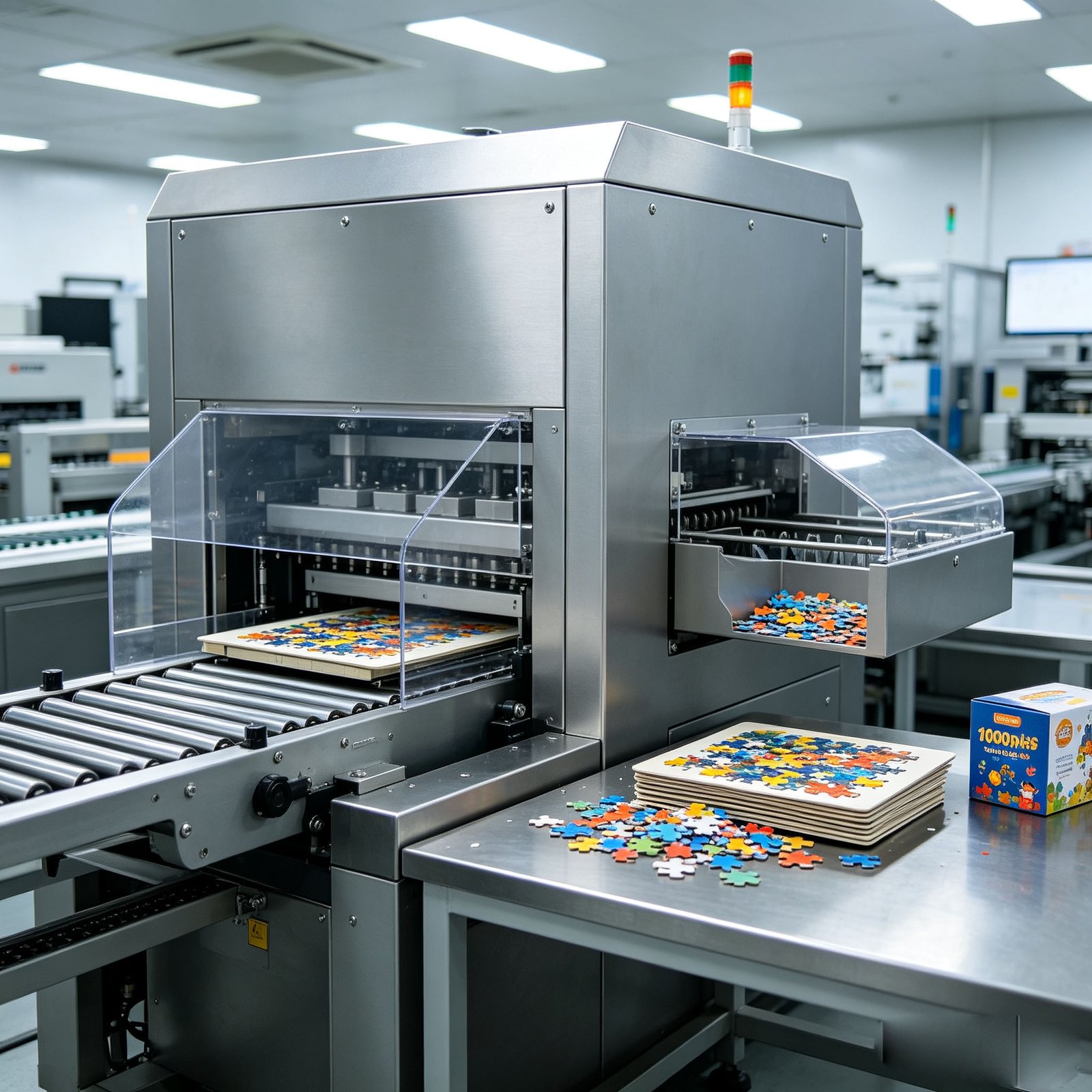
Some manufacturers cut 1000-piece puzzles in a single press cycle (one pass). Others may use two passes for larger or denser puzzles. Single-pass cutting requires higher tonnage but is faster and more efficient for high-volume production.
5. Die Complexity
Intricate puzzle piece shapes with tight tolerances require more precise—and sometimes more forceful—cutting to ensure clean edges and proper interlocking.
Tonnage Guidelines by Puzzle Size
Based on manufacturer data, here’s a rough guide:
| Puzzle Size | Typical Tonnage |
|---|---|
| Small/children’s puzzles (100–500 pieces) | 120–300 tons |
| 500-piece puzzles | 180–500 tons |
| 1000-piece puzzles | 500–700 tons |
| 1500–2000-piece puzzles | 800–1200 tons |
JHS Machine specifies that 2000-piece puzzles require approximately 1200 tons. Shuntec offers presses ranging from 600 to 1200 tons for puzzles from 500 to 2000 pieces.
For adult 1000-piece puzzles, manufacturers generally recommend 300 to 800 tons, with 500 tons being the most common entry point.
Small-Scale vs. Industrial Production
It’s worth noting that the 500–700 ton figures apply to industrial-scale production—the kind where you’re cutting puzzles by the thousands.
If you’re a hobbyist, small-batch producer, or artisan making puzzles on a smaller scale, your needs are different. Smaller hydraulic presses in the 25–200 ton range can work for low-volume production, especially with smaller puzzle sizes or softer materials.
For example:
- 25–40 tons: Small EVA foam puzzles, children’s toys
- 120–180 tons: 500-piece cardboard puzzles, smaller formats
- 150 tons: Auto-cutting systems with 35″×39″ bed sizes
- 300–500 tons: Entry-level 1000-piece production
But for commercial-grade 1000-piece puzzle manufacturing—especially if you want to cut in a single pass with clean, dust-free edges—you really do need to be in the 500+ ton range.
Modern Press Technology: It’s Not Just About Tonnage
Raw tonnage is important, but it’s not the whole story. Modern puzzle presses have evolved significantly, and the best machines offer features that matter just as much as the force rating:
Servo-Hydraulic Systems
Traditional hydraulic presses are being replaced by servo-hydraulic systems that offer:
- ±1% pressure repeat accuracy
- 30–60% lower energy consumption
- Adjustable speeds throughout the stroke
- Programmable parameters via touchscreen interface
Precision Control
Modern presses use closed-loop digital control systems with pressure and position transducers. This means the press doesn’t just apply force—it applies exactly the right force, in exactly the right place, every single time.
Four-Post Construction
Industrial puzzle presses use four-post tie-rod frame structures that maximize rigidity and minimize deflection. This ensures the pressure is distributed evenly across the entire puzzle surface, which is critical for clean, consistent cuts.
Worktable Size
Tonnage isn’t useful if your press can’t accommodate your puzzle size. For 1000-piece puzzles, look for worktables around 850×800mm or larger. The 500-ton models typically feature 1200×900mm or larger tables.
What About Cutting Force vs. System Pressure?
When comparing presses, you’ll see two different numbers:
- Cutting force (tonnage): The actual force the press applies to the material—this is what matters for your puzzle
- System pressure (MPa/PSI): The hydraulic fluid pressure in the system
These are related but not the same. A press might have a system pressure of 25 MPa and deliver 500 tons of cutting force. The relationship depends on the cylinder size and mechanical advantage.
For puzzle buying decisions, focus on tonnage (cutting force), not system pressure. That’s the number that tells you whether the press can actually cut your puzzles.
Common Mistakes When Choosing a Puzzle Press
1. Underestimating Tonnage Requirements
This is by far the most common mistake. New puzzle manufacturers often think a 200-ton press will handle 1000-piece puzzles because “it’s just cardboard.” It won’t. You’ll end up with incomplete cuts, torn edges, and a lot of wasted material.
2. Ignoring Worktable Size
A 500-ton press with a table that’s too small for your puzzle sheets is useless. Always check the table dimensions and ensure they exceed your maximum puzzle size with room for registration marks and waste margins.
3. Overlooking Die Compatibility
Your press must be compatible with your steel rule dies. Check the daylight opening (the space between the ram and the bed), stroke length, and mounting system.
4. Forgetting About Production Speed
If you’re running a commercial operation, cycle time matters. A 700-ton press might cut beautifully but only produce 5 puzzles per hour, while a 600-ton servo-hydraulic press might produce 7–10 per minute. Choose based on your volume needs.
Cost Considerations
Industrial hydraulic presses in the 500–700 ton range are significant investments. Here’s what affects the price:
- Tonnage: Higher tonnage = higher cost
- Technology: Servo-hydraulic systems cost more but save energy long-term
- Brand: Established manufacturers command premium pricing
- Customization: Shuttle tables, safety systems, and custom features add cost
- Shipping and installation: These are heavy machines—25 tons or more
That said, the puzzle market has grown substantially, and manufacturers now offer a range of options from entry-level 500-ton models to premium 1000-ton systems.
Frequently Asked Questions
Can I use a 300-ton press for 1000-piece puzzles?
Possibly, but it depends on your material and puzzle size. Some manufacturers offer 300-ton models for puzzle die-cutting, but you’d likely be limited to thinner materials or smaller formats. For standard 1000-piece cardboard puzzles, 500 tons is the safer bet.
What about wooden puzzles?
Wooden puzzles generally require higher tonnage than cardboard, depending on wood thickness and density. Some manufacturers offer specialized wooden puzzle presses. Consult with the press manufacturer about your specific material.
Do I need a servo-hydraulic press?
Not necessarily, but the benefits are substantial: better precision, lower energy costs, less noise, and programmability. If you’re setting up a commercial operation, the ROI on servo-hydraulic technology is hard to ignore.
How do I calculate exact tonnage for my puzzle?
The engineering formula for die-cutting tonnage is: P = L × T × S / 2000, where P is press capacity in tons, L is total cut length in inches, T is material thickness in inches, and S is shear strength in psi. For puzzle applications, manufacturers typically use empirical data from similar products rather than calculating from scratch.
Final Recommendation
If you’re buying a hydraulic press specifically for 1000-piece jigsaw puzzle production:
- Start at 500 tons as your minimum
- 700 tons gives you more flexibility with materials and puzzle sizes
- Choose a four-post servo-hydraulic press for precision and efficiency
- Ensure the worktable accommodates your largest puzzle sheet with room to spare
- Work with an established manufacturer who understands puzzle die-cutting specifically
The puzzle industry has standardized around the 500–700 ton range for good reason—it’s the sweet spot where you get clean, consistent cuts without overpaying for capacity you don’t need.
And remember: the right press isn’t just about tonnage. It’s about precision, consistency, speed, and reliability. A 600-ton servo-hydraulic press with ±1% accuracy will serve you better than a 700-ton conventional press with sloppy tolerances.
Choose wisely, and your puzzles will cut cleanly, fit perfectly, and keep your customers coming back for more.