
Puzzle die cutting is one of the most critical precision processes in industrial puzzle production. The cutting stage directly affects puzzle piece fit, edge smoothness, artwork alignment, and the overall user experience. Even a small cutting deviation can lead to loose connections, damaged edges, or inconsistent puzzle assembly quality. For manufacturers producing puzzles at commercial scale, maintaining stable cutting accuracy is essential for reducing defects and improving production consistency.
Modern puzzle factories typically use hydraulic die cutting systems to cut hundreds or even thousands of interlocking pieces from printed puzzle boards in a single operation. The structure of the cutting die, machine pressure stability, material consistency, and registration accuracy all influence the final cutting result. As demand for premium puzzles continues to grow, many manufacturers are investing in more advanced cutting technologies and more reliable industrial puzzle manufacturing machines to improve production quality and operational efficiency.
What Is Puzzle Die Cutting?
Definition of Puzzle Die Cutting
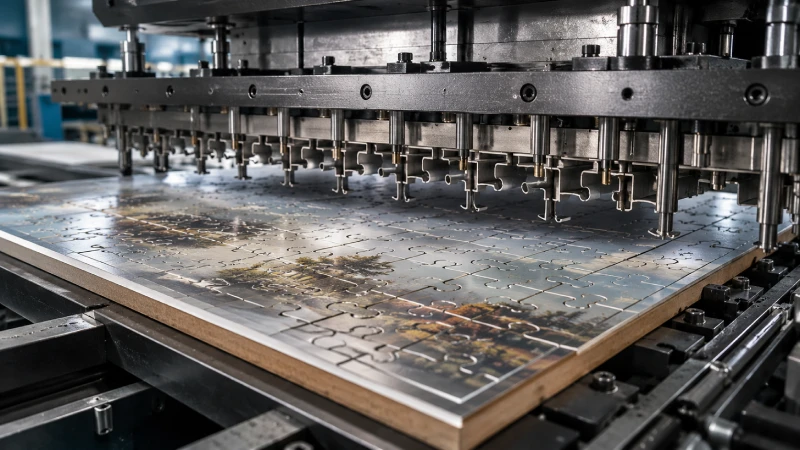
Puzzle die cutting is the industrial process used to cut printed puzzle boards into individual interlocking puzzle pieces using specially designed cutting dies. In large-scale production, manufacturers place the laminated puzzle board beneath a steel rule die and apply strong hydraulic pressure to complete the cutting operation in a single press cycle. The die contains hundreds or thousands of precisely shaped cutting blades that create the final puzzle pattern.
Unlike standard paperboard cutting, puzzle die cutting requires extremely high dimensional accuracy because every piece must connect smoothly with surrounding pieces. Even slight inconsistencies in blade positioning or cutting depth can affect how the puzzle assembles. This is especially important for premium puzzles with complex piece patterns, tight tolerances, or large piece counts.
Why Die Cutting Is Critical in Puzzle Production
Die cutting directly determines the final quality of the puzzle product. Clean cutting edges help reduce dust, improve piece separation, and create a better user experience during assembly. Accurate cutting also ensures the printed artwork aligns correctly across connected pieces without visible offset issues.
For industrial manufacturers, stable puzzle die cutting improves production consistency, reduces waste, and minimizes customer complaints related to loose-fitting or damaged pieces. As puzzle designs become more detailed and production volumes continue to increase, cutting precision has become one of the most important quality control factors in modern puzzle manufacturing.
How Industrial Puzzle Die Cutting Works
Positioning the Printed Puzzle Board
Before the cutting process begins, the printed and laminated puzzle board must be accurately positioned beneath the cutting die. Registration alignment is critical because the cutting pattern must match the printed artwork precisely. If the board shifts during feeding or positioning, the final puzzle image may appear misaligned after assembly.
Industrial puzzle manufacturers typically use alignment marks and positioning systems to maintain stable feeding accuracy. For high-piece-count puzzles, even a small registration error can create noticeable image offset problems between connected pieces. Consistent positioning also helps reduce material waste and improves production repeatability across large production batches.
Hydraulic Press Cutting Operation
Once the puzzle board is correctly aligned, the hydraulic press applies downward pressure onto the cutting die. The die contains hundreds or thousands of steel rule blades arranged in a specific interlocking puzzle pattern. During a single cutting stroke, the blades penetrate the laminated board and form the individual puzzle pieces simultaneously.
Hydraulic systems are widely used because they provide stable and evenly distributed cutting pressure across the entire puzzle surface. This is especially important for large-format puzzles where uneven force distribution can lead to incomplete cuts or inconsistent piece quality. Many modern industrial puzzle manufacturing machines are designed with precision hydraulic control systems to improve cutting consistency and reduce defects.
Piece Separation and Waste Handling
After cutting is completed, the puzzle board is removed from the press and separated from the surrounding waste edges. Manufacturers must carefully handle the freshly cut pieces to avoid tearing, edge damage, or delamination. Proper waste removal also helps maintain clean puzzle edges and reduces excess dust generation during production.
In many factories, die cutting is closely connected to the broader cardboard puzzle production process, where material quality, lamination stability, and moisture control all influence final cutting performance.
Types of Puzzle Cutting Dies
Steel Rule Dies
Steel rule dies are the most widely used cutting solution in industrial puzzle manufacturing. These dies are constructed by inserting sharpened steel blades into a precision-cut wooden die board according to the required puzzle pattern. The blades form the interlocking shapes that create individual puzzle pieces during the hydraulic cutting process.
One major advantage of steel rule dies is their flexibility. Manufacturers can produce custom puzzle patterns, different piece counts, and various puzzle sizes while maintaining relatively low tooling costs. Steel rule dies are also suitable for medium- and high-volume production because they provide stable cutting performance and relatively fast die replacement during production changeovers.
Rotary Cutting Dies
Rotary cutting dies are commonly used in high-speed continuous converting industries, although they are less common in rigid puzzle board manufacturing. Instead of using a vertical pressing motion, rotary dies cut materials through continuous rolling contact.
For certain thin-material puzzle products or lightweight educational puzzles, rotary systems may improve production speed and feeding efficiency. However, traditional hydraulic flatbed cutting systems are generally preferred for thicker cardboard puzzles because they provide stronger and more uniform cutting pressure across the entire board surface.
Laser-Cut Die Boards
Modern puzzle die manufacturers increasingly use laser-cut die boards to improve production precision. Laser processing allows highly accurate blade slot positioning, which helps maintain tighter dimensional tolerances throughout the die structure.
Compared with conventional manual die board production, laser-cut systems improve pattern consistency and reduce alignment errors between adjacent puzzle pieces. This is particularly important for high-piece-count puzzles where small deviations can accumulate across the cutting layout and affect overall assembly quality.
Custom Puzzle Piece Patterns
Puzzle manufacturers often use different die patterns depending on the target market and product category. Traditional random-cut puzzles create varied interlocking shapes that improve assembly difficulty and user engagement. Grid-style patterns are sometimes used for children’s puzzles or educational products where simpler piece organization is preferred.
Large-piece puzzle dies are also common in products designed for children or senior users. In premium puzzle markets, some manufacturers develop highly irregular or artistic cutting patterns to differentiate their products and create a more unique assembly experience. The design and engineering behind these specialized puzzle cutting dies play a major role in overall puzzle quality and production stability.
Hydraulic Die Cutting Process for Puzzles
Hydraulic Pressure Distribution
Hydraulic systems are widely used in industrial puzzle die cutting because they can deliver stable and evenly distributed pressure across large cutting surfaces. During operation, the hydraulic press applies force uniformly onto the cutting die, allowing all puzzle pieces to be cut simultaneously in a single pressing cycle.
Uniform pressure distribution is especially important for large-format puzzles and high-piece-count products. If the cutting force is uneven, some sections of the puzzle board may be fully cut while other areas remain partially connected. This can lead to incomplete cuts, rough edges, or damaged puzzle pieces during separation. Stable hydraulic pressure also helps extend die lifespan by reducing localized blade stress and uneven wear.
Cutting Stroke Control
The cutting stroke refers to the downward movement distance of the press during the cutting operation. Precise stroke control is critical because the die blades must penetrate the puzzle board completely without applying excessive compression to the material.
If the cutting stroke is too shallow, some puzzle pieces may remain partially attached to the surrounding board. On the other hand, excessive stroke depth can accelerate blade wear, deform the puzzle board, and increase dust generation during production. Modern hydraulic cutting systems often use adjustable stroke settings to improve cutting consistency across different puzzle materials and thicknesses.
Pressure Calibration for Different Materials
Different puzzle boards require different pressure settings depending on their thickness, density, and surface lamination structure. Standard cardboard puzzles generally require moderate cutting force, while thick greyboard puzzles or premium laminated products may need significantly higher pressure levels.
Manufacturers must carefully calibrate hydraulic pressure to match the material specifications of each production batch. Proper calibration helps improve cutting quality, reduce material damage, and maintain consistent piece separation performance. In large-scale production environments, stable hydraulic control has become one of the key factors affecting overall puzzle cutting accuracy and manufacturing efficiency.
Key Factors That Affect Puzzle Cutting Accuracy
Die Manufacturing Precision
The accuracy of the cutting die itself is one of the most important factors influencing final puzzle quality. Every blade inside the die must be positioned according to strict dimensional tolerances to ensure all puzzle pieces fit together correctly after cutting. Even small deviations in blade bending or placement can create inconsistent interlocking shapes and assembly problems.
Modern die manufacturers often use CNC processing and laser-cut die boards to improve structural precision. These technologies help maintain stable blade positioning across complex puzzle layouts, especially for high-piece-count puzzles where accumulated dimensional errors can become more noticeable.
Material Thickness Consistency
Puzzle board consistency also plays a major role in cutting accuracy. Variations in cardboard thickness, greyboard density, or lamination quality can affect how the material responds to hydraulic cutting pressure. Softer areas may compress more easily, while denser sections may require additional cutting force.
Moisture content is another important consideration. Excessively dry boards may produce rough edges and dust, while overly humid materials can deform during cutting. Maintaining stable environmental conditions and consistent material sourcing helps manufacturers achieve more predictable cutting performance.
Machine Pressure Stability
Hydraulic pressure stability directly affects cutting uniformity across the entire puzzle board. If pressure distribution becomes uneven, some areas may experience incomplete cuts while others receive excessive force. Over time, worn hydraulic components or poorly calibrated systems can increase pressure fluctuations and reduce cutting consistency.
Industrial manufacturers usually perform routine maintenance and pressure calibration to ensure the cutting force remains stable during long production runs. Consistent pressure control also helps extend die lifespan and reduce unnecessary blade wear.
Registration Accuracy
Registration accuracy refers to the alignment between the printed artwork and the cutting die. If the printed sheet is not positioned correctly beneath the die, the image may appear offset after the puzzle is assembled. This issue becomes particularly visible in puzzles with detailed artwork, fine lines, or panoramic images.
To improve registration consistency, many manufacturers use positioning marks, automated feeding systems, and alignment sensors during the cutting process. Accurate registration not only improves visual quality but also reduces rejection rates during quality inspection.
Operator Setup and Maintenance
Even with advanced machinery, operator setup remains an important part of puzzle die cutting accuracy. Incorrect die installation, improper pressure adjustment, or insufficient maintenance can quickly reduce cutting quality. Regular inspections, blade condition monitoring, and calibration procedures help maintain stable production performance and reduce unexpected defects during operation.
Common Puzzle Die Cutting Defects
Incomplete Cuts
Incomplete cutting is one of the most common problems in industrial puzzle production. This defect occurs when the die blades fail to fully penetrate the puzzle board, leaving some pieces partially attached to the surrounding material. Incomplete cuts can slow down downstream handling and increase the risk of piece tearing during separation.
Several factors may cause this issue, including insufficient hydraulic pressure, incorrect cutting stroke settings, or worn cutting blades. Uneven material thickness can also prevent certain areas from being fully cut during the same press cycle. Regular pressure calibration and die inspection are important for reducing incomplete cutting problems.
Burrs and Rough Edges
Burrs and rough cutting edges usually appear when the cutting blades lose sharpness or when excessive material compression occurs during the cutting process. Poor edge quality not only affects the appearance of the puzzle pieces but can also create assembly issues and increase dust generation inside the packaging.
Manufacturers often monitor blade wear closely and replace damaged sections of the die before edge quality begins to deteriorate significantly. Stable hydraulic pressure and consistent material quality also help minimize rough-edge defects.
Piece Tearing or Delamination
Puzzle pieces may tear or separate unevenly if the cardboard structure is weak or if excessive pressure is applied during cutting. Laminated puzzle boards are especially sensitive to improper pressure settings because the surface paper layer can detach from the board core during piece separation.
Poor material bonding, excessive moisture, or aggressive waste removal handling may also contribute to delamination problems. To reduce these risks, manufacturers typically optimize both material selection and cutting pressure according to the specific puzzle structure.
Misaligned Puzzle Patterns
Misalignment defects occur when the printed artwork does not match the cutting pattern correctly. After assembly, the image may appear shifted between adjacent pieces, creating visible gaps or distorted graphic continuity.
This issue is usually caused by feeding inaccuracies, unstable registration systems, or improper positioning before cutting. High-precision alignment control is particularly important for puzzles with detailed artwork or panoramic images where even small deviations become highly visible.
Excessive Dust Generation
Dust generation is another common issue during puzzle die cutting, especially when processing dry or brittle cardboard materials. Excessive dust can contaminate equipment, reduce production cleanliness, and affect final product quality.
Blade friction, dull cutting edges, and unstable cutting pressure often increase dust formation during operation. Many industrial manufacturers use routine cleaning systems and controlled environmental conditions to reduce dust accumulation and improve production stability.
How to Improve Puzzle Cutting Precision
Use High-Precision Die Manufacturing
Improving die quality is one of the most effective ways to increase puzzle cutting precision. High-precision dies produced with CNC machining and laser-cut die boards can maintain tighter dimensional tolerances and more stable blade positioning across complex puzzle patterns.
Accurate blade alignment helps ensure consistent interlocking shapes throughout the entire puzzle layout. For high-piece-count puzzles, even small improvements in die manufacturing precision can significantly reduce assembly issues and product rejection rates.
Optimize Hydraulic Pressure Settings
Correct hydraulic pressure calibration is essential for maintaining stable cutting quality. Different puzzle materials require different pressure levels depending on board thickness, density, and lamination structure. Excessive pressure may deform the material or accelerate blade wear, while insufficient pressure can result in incomplete cuts.
Manufacturers often perform pressure testing during production setup to determine the optimal cutting conditions for each puzzle type. Stable pressure control also improves cutting consistency during long production runs and helps reduce unexpected defects.
Maintain Blade Sharpness
Blade condition directly affects edge quality and cutting accuracy. Dull blades increase material compression during cutting, which can lead to rough edges, excessive dust, and inconsistent piece separation. Over time, worn blades may also cause incomplete cuts or tearing defects.
Routine blade inspection and scheduled replacement programs are important for maintaining stable production quality. Many industrial manufacturers track die usage cycles to determine when maintenance or blade replacement is required before cutting quality begins to decline.
Improve Material Quality Consistency
Stable material quality plays a major role in precision puzzle cutting. Variations in cardboard thickness, density, or moisture content can cause inconsistent cutting performance across different production batches. Poor-quality laminated boards may also increase the risk of delamination during piece separation.
To improve consistency, manufacturers typically work with stable material suppliers and maintain controlled storage environments for puzzle boards. Moisture control systems are also commonly used to prevent excessive dryness or humidity from affecting cutting performance.
Implement Routine Calibration
Regular machine calibration helps maintain long-term cutting accuracy and production stability. Hydraulic systems, alignment sensors, and feeding mechanisms should be inspected and adjusted periodically to prevent gradual precision loss over time.
Routine calibration also reduces waste rates, minimizes customer complaints related to poor puzzle fit, and helps prevent unexpected downtime caused by unstable cutting performance. In modern puzzle manufacturing, preventive maintenance has become an important part of maintaining consistent production quality and operational efficiency.
Choosing the Right Puzzle Die Cutting Machine
Cutting Size Capacity
One of the first factors manufacturers should evaluate is the cutting size capacity of the machine. Different puzzle products require different board dimensions, and large-format puzzles often need wider cutting areas to accommodate high-piece-count layouts. Machines with insufficient cutting capacity may limit production flexibility or require multiple cutting operations for larger puzzles.
Manufacturers producing various puzzle sizes typically prefer equipment that supports flexible die dimensions and multi-up cutting layouts. This improves production efficiency and allows faster adaptation to different customer requirements.
Hydraulic Force Requirements
Hydraulic force capacity directly affects the machine’s ability to cut different puzzle materials consistently. Thin cardboard puzzles generally require lower cutting pressure, while thick greyboard or premium laminated puzzles may need significantly higher force levels for complete penetration.
Choosing a machine with stable hydraulic performance helps maintain consistent cutting quality across long production runs. Manufacturers should also consider future product expansion when selecting hydraulic capacity, especially if they plan to produce thicker or more complex puzzle products later.
Registration and Alignment Features
Accurate registration systems are essential for maintaining proper alignment between the printed artwork and the cutting die. Modern puzzle die cutting machines often include positioning sensors, alignment guides, and automated feeding systems to improve cutting precision.
High-quality registration control reduces image offset problems and helps maintain consistent puzzle appearance after assembly. This becomes especially important for puzzles with detailed artwork, panoramic images, or high piece counts where even minor alignment errors are highly visible.
Die Compatibility and Changeover Efficiency
Production flexibility is another important consideration when selecting puzzle die cutting equipment. Manufacturers that produce multiple puzzle designs often require quick die replacement and efficient setup procedures to reduce downtime during product changeovers.
Machines designed for fast die installation and stable positioning can improve operational efficiency and reduce setup-related cutting errors. Many manufacturers also integrate advanced industrial puzzle manufacturing machines with automated alignment and hydraulic control systems to achieve more stable production quality and higher long-term efficiency.
FAQ
What is the best die type for cardboard puzzles?
Steel rule dies are generally considered the best solution for industrial cardboard puzzle production. They offer a good balance between cutting precision, production efficiency, tooling flexibility, and manufacturing cost. Steel rule dies can also support various puzzle sizes, piece counts, and custom interlocking patterns while maintaining stable cutting quality during large-scale production.
Why do puzzle pieces sometimes not fit correctly?
Poor puzzle fit is usually caused by cutting accuracy problems. Common reasons include inaccurate die manufacturing, unstable hydraulic pressure, material thickness variation, or registration misalignment between the printed artwork and the cutting pattern. Over time, worn cutting blades can also affect piece consistency and reduce assembly quality.
How often should puzzle cutting dies be replaced?
The lifespan of a puzzle cutting die depends on production volume, board material hardness, hydraulic pressure settings, and maintenance quality. In industrial production, manufacturers typically inspect blade sharpness and cutting quality regularly rather than waiting for complete die failure. Some high-volume factories may perform partial blade replacement or die maintenance after specific production cycles to maintain stable cutting performance.
What causes incomplete puzzle cuts?
Incomplete cuts are commonly caused by insufficient hydraulic pressure, incorrect cutting stroke settings, dull blades, or uneven material thickness. If certain areas of the puzzle board receive less cutting force than others, some pieces may remain partially attached after cutting. Regular calibration and pressure adjustment help reduce this issue.
Are hydraulic presses better for puzzle die cutting?
Hydraulic presses are widely preferred for industrial puzzle die cutting because they provide stable and evenly distributed pressure across the entire cutting surface. This improves cutting consistency, especially for large-format puzzles and thick laminated boards. Hydraulic systems also offer better control over cutting stroke depth and pressure adjustment compared with many mechanical cutting methods.
How can manufacturers reduce cutting defects?
Manufacturers can reduce cutting defects by improving die precision, maintaining stable hydraulic pressure, controlling material consistency, and performing regular machine calibration. Routine blade inspection and preventive maintenance programs also help maintain cutting quality and reduce waste during long production runs.
Conclusion
Puzzle die cutting is one of the most important precision processes in industrial puzzle manufacturing because it directly affects piece fit, edge quality, artwork alignment, and overall customer experience. Stable cutting performance depends on multiple factors working together, including die manufacturing accuracy, hydraulic pressure consistency, material quality, and machine calibration. Even small variations in these areas can lead to visible cutting defects and reduced product quality.
As puzzle designs become more complex and production standards continue to rise, manufacturers are placing greater emphasis on precision cutting technologies and reliable hydraulic systems. High-quality dies, proper maintenance procedures, and accurate registration control all contribute to better production stability and lower defect rates during large-scale manufacturing.
For companies looking to improve puzzle production quality, investing in advanced industrial puzzle manufacturing machines and well-engineered cutting systems can help increase operational efficiency, reduce waste, and deliver a more consistent final product to the market.
