
Puzzle manufacturing does not end when puzzle pieces are cut and separated. The final packaging stage plays an equally important role in ensuring that customers receive complete, undamaged, and professionally presented products.
A puzzle with perfect printing and cutting quality can still generate customer complaints if pieces are missing, boxes are damaged, or packaging components are incorrectly assembled. For this reason, modern manufacturers invest significant effort into developing reliable packaging workflows that maintain consistency from production floor to retail shelf.
Today’s industrial puzzle packaging operations involve a series of coordinated steps including sorting, counting, bagging, boxing, sealing, inspection, and shipping preparation. These processes help manufacturers reduce packaging errors while maintaining product quality standards across large production volumes.
Many companies integrate specialized puzzle packaging equipment into their production facilities to improve packaging accuracy and workflow efficiency. Understanding how these systems work provides valuable insight into one of the most critical stages of industrial puzzle production.
What Happens During the Puzzle Packaging Process?
The packaging stage begins once puzzle pieces have completed the manufacturing and separation processes. At this point, individual pieces must be prepared for final retail packaging.
A typical industrial packaging workflow includes:
- Collection of finished puzzle pieces
- Sorting and cleaning
- Piece counting
- Bagging
- Box filling
- Box sealing
- Quality inspection
- Carton packing and shipment preparation
Although the workflow appears straightforward, each step requires strict quality control. Packaging errors can result in customer dissatisfaction, product returns, and damage to brand reputation.
Unlike earlier manufacturing stages that focus primarily on creating puzzle pieces, the packaging process focuses on ensuring product completeness and presentation quality. Every box leaving the factory must contain the correct components and meet predefined quality standards.
As puzzle brands expand their product lines and production volumes, packaging accuracy becomes increasingly important for maintaining customer trust.
Puzzle Sorting Process Before Packaging
Before puzzle pieces can be counted and packed, manufacturers must prepare them for packaging operations.
Collecting Finished Puzzle Pieces
Puzzle pieces arrive at the packaging department after completing manufacturing processes. Depending on the factory layout, pieces may be transferred manually, by conveyor systems, or through automated material handling equipment.
At this stage, operators ensure that pieces from different production batches remain properly separated. Maintaining clear batch identification prevents product mix-ups later in the packaging process.
Removing Waste and Defective Pieces
Even after manufacturing is complete, small amounts of paper dust, cardboard fragments, or packaging debris may remain mixed with puzzle pieces.
Manufacturers typically perform cleaning procedures to remove unwanted materials before packaging begins.
Quality control personnel may also identify visibly damaged pieces, such as:
- Bent pieces
- Torn pieces
- Surface defects
- Contaminated components
Removing defective parts before packaging helps maintain product consistency.
Sorting by Puzzle SKU
Many factories produce multiple puzzle designs simultaneously. Packaging teams must ensure that each puzzle design remains separated throughout the packaging process.
Sorting systems may use:
- Batch labels
- Barcode tracking
- Production order numbers
- Color-coded containers
Proper SKU management prevents incorrect pieces from entering the wrong packaging line and ensures accurate order fulfillment.
Piece Counting Systems Used in Puzzle Packaging
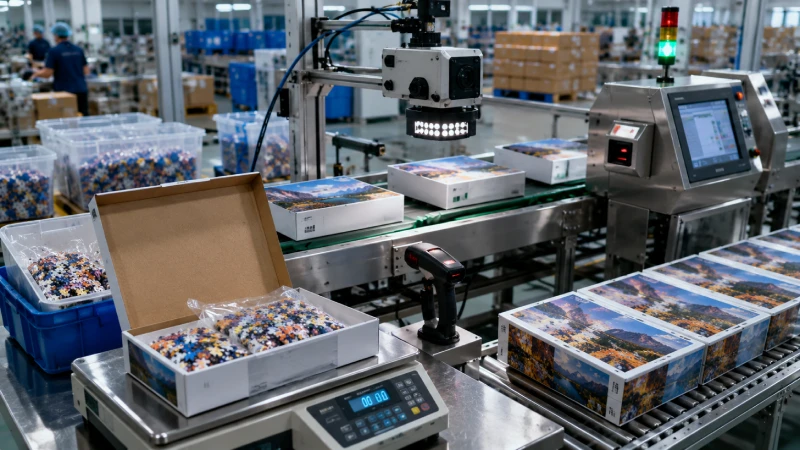
One of the most important packaging tasks is verifying that each box contains the correct number of puzzle pieces.
Missing pieces remain one of the most common reasons customers contact puzzle manufacturers. Consequently, counting accuracy is a major focus of packaging operations.
Why Accurate Counting Is Critical
A single missing piece can render a puzzle incomplete and unusable.
For manufacturers, counting errors can lead to:
- Customer complaints
- Product returns
- Replacement shipments
- Increased customer service costs
- Brand reputation issues
Accurate counting therefore serves both quality and customer satisfaction objectives.
Manual Counting Methods
Smaller manufacturers and specialty puzzle producers sometimes rely on manual counting procedures.
Workers may:
- Count pieces by hand
- Use counting trays
- Separate pieces into predetermined quantities
Manual methods offer flexibility but can become time-consuming when handling larger production volumes.
Human fatigue and repetitive work may also increase the likelihood of counting mistakes.
Automatic Counting Systems
Larger facilities frequently implement automated counting solutions to improve consistency.
Common technologies include:
Vision-Based Counting
Camera systems analyze puzzle pieces passing through inspection areas and calculate piece quantities using image recognition technology.
Weight Verification Systems
Because puzzle sets have predictable weight ranges, manufacturers can compare package weights against target values.
Unexpected weight variations may indicate:
- Missing pieces
- Additional pieces
- Missing inserts
- Packaging errors
Sensor-Based Counting
Sensors can detect individual items moving through packaging equipment, providing real-time count verification.
These systems help manufacturers maintain higher accuracy levels while supporting larger production volumes.
Facilities involved in industrial puzzle manufacturing often combine multiple verification methods to minimize packaging errors.
Manual vs Automatic Puzzle Packaging
Puzzle manufacturers use different packaging approaches depending on production scale, labor availability, and product requirements.
Manual Packaging Workflow
In manual packaging operations, workers perform most packaging tasks by hand.
Typical activities include:
- Filling bags
- Inserting components
- Loading boxes
- Closing cartons
- Visual inspection
Manual packaging provides flexibility for short production runs and customized products.
However, output speed and consistency depend heavily on operator performance.
Semi-Automatic Packaging Systems
Semi-automatic systems combine machine assistance with human oversight.
Examples include:
- Assisted counting stations
- Conveyor-fed packaging lines
- Automated bag sealing equipment
Operators remain involved in key decisions while machines handle repetitive tasks.
Many medium-sized puzzle manufacturers adopt this approach because it balances productivity and flexibility.
Fully Automatic Packaging Lines
Large-scale producers increasingly use automated packaging systems.
These lines may perform:
- Piece feeding
- Counting
- Bagging
- Box loading
- Sealing
- Inspection
Automation helps standardize packaging quality while reducing variability between production shifts.
Choosing the Right Packaging Method
No single packaging method is ideal for every manufacturer.
Decision factors often include:
- Production volume
- Product variety
- Labor availability
- Packaging complexity
- Quality requirements
High-volume operations typically prioritize consistency and throughput, while smaller producers may value flexibility and customization.
Box Filling and Box Sealing Systems
After counting is completed, puzzle components move into final retail packaging.
Puzzle Box Loading Process
Most puzzle products contain more than just puzzle pieces.
Additional components may include:
- Instruction sheets
- Reference posters
- Promotional materials
- Product information cards
All components must be inserted correctly before boxes are closed.
Manufacturers often use standardized loading procedures to ensure consistency across production batches.
Box Closing Methods
Box closing can be performed manually or through automated equipment.
Manual methods typically involve workers folding and securing boxes by hand.
Automated systems use mechanical devices to position and close boxes at higher speeds.
Regardless of the method used, packaging appearance must remain consistent across all units.
Carton and Retail Packaging Standards
Retail packaging serves both protective and marketing functions.
Manufacturers strive to maintain:
- Uniform box dimensions
- Clean appearance
- Proper alignment
- Consistent presentation
High-quality packaging helps strengthen consumer confidence and improves shelf appeal.
Common Box Sealing Technologies
Several sealing methods are commonly used in puzzle packaging operations.
Adhesive Sealing
Glue-based systems create secure closures while maintaining a clean package appearance.
Tape Sealing
Tape remains a popular option for shipping cartons and bulk packaging applications.
Hot Melt Systems
Hot melt adhesives provide strong and reliable seals for high-speed packaging environments.
The appropriate sealing method depends on packaging design and production requirements.
Packaging Quality Control Procedures
Quality control continues throughout the packaging process.
Rather than relying on a single inspection point, manufacturers typically implement multiple verification stages.
In-Line Packaging Inspection
During packaging operations, inspectors monitor:
- Box condition
- Label placement
- Package appearance
- Packaging integrity
Early detection allows operators to correct issues before large quantities of products are affected.
Weight Verification Systems
Weight checking remains one of the most effective quality control tools in puzzle packaging.
By comparing actual package weight against expected values, manufacturers can quickly identify abnormalities.
Weight verification may reveal:
- Missing pieces
- Missing inserts
- Incorrect packaging materials
- Packaging assembly errors
Random Sampling Procedures
Many factories conduct routine sampling throughout production.
Inspectors randomly select finished products and verify:
- Piece count
- Packaging condition
- Component completeness
- Label accuracy
Sampling helps validate overall packaging performance.
Final Shipment Approval
Before products leave the facility, final inspections verify compliance with company quality standards.
Documentation may include:
- Production records
- Inspection reports
- Packaging checklists
- Batch traceability information
These procedures help ensure accountability throughout the packaging process.
Many issues associated with puzzle production defects can be identified and corrected during final packaging inspections.
How Manufacturers Prevent Missing Puzzle Pieces
Preventing missing pieces remains a top priority for puzzle producers.
Common Causes of Missing Pieces
Several factors may contribute to incomplete puzzle sets:
- Counting errors
- Sorting mistakes
- Packaging interruptions
- Human error
- Material handling problems
Understanding these causes allows manufacturers to develop effective prevention strategies.
Multi-Step Verification Systems
Rather than relying on a single checkpoint, manufacturers often use layered verification systems.
Typical verification stages include:
- Piece counting
- Weight checking
- Visual inspection
- Final package review
Multiple checkpoints significantly reduce the likelihood of packaging errors reaching customers.
Traceability and Batch Control
Modern production facilities maintain detailed batch records.
Traceability systems help manufacturers:
- Track production history
- Investigate complaints
- Identify recurring issues
- Improve quality management
If a problem is discovered after shipment, batch records make it easier to locate affected products.
Shipping Protection Methods for Finished Puzzles
Packaging responsibilities continue even after retail boxes are sealed.
Products must remain protected during storage, transportation, and distribution.
Protecting Retail Boxes During Transportation
Retail puzzle boxes can be damaged by:
- Compression
- Impact
- Moisture exposure
- Improper stacking
Protective packaging helps minimize transportation-related damage.
Carton Packing Standards
Finished puzzle boxes are typically packed into larger shipping cartons.
Manufacturers organize cartons to:
- Maximize space efficiency
- Improve handling
- Reduce movement during transit
Consistent carton packing standards also simplify warehouse operations.
Warehouse and Export Preparation
Before shipment, manufacturers verify:
- Product labels
- Barcode accuracy
- Carton identification
- Shipment documentation
Proper preparation helps ensure smooth distribution and delivery processes.
Common Packaging Problems and Solutions
Even well-designed packaging systems can experience occasional issues.
| Problem | Cause | Solution |
|---|---|---|
| Missing pieces | Counting errors | Automated verification systems |
| Damaged boxes | Poor handling | Improved carton protection |
| Mixed puzzle designs | Sorting mistakes | Better batch tracking |
| Weak seals | Sealing inconsistency | Regular seal inspection |
| Missing inserts | Packaging oversight | Multi-point verification |
Continuous monitoring and process improvement help manufacturers reduce these issues over time.
FAQ About Puzzle Packaging
How are puzzle pieces counted before packaging?
Manufacturers use manual counting, sensor-based counting, vision systems, or weight verification methods to confirm piece quantities before packaging.
What is the most common cause of missing puzzle pieces?
Counting errors and packaging mistakes are among the most common causes of incomplete puzzle sets.
Are puzzle packaging lines automated?
Many industrial manufacturers use semi-automatic or fully automatic packaging lines, while smaller facilities may still rely on manual packaging methods.
How is packaging quality checked?
Quality checks typically include visual inspections, weight verification, random sampling, and final shipment approval procedures.
What type of sealing is used for puzzle boxes?
Puzzle manufacturers commonly use adhesive sealing, tape sealing, or hot melt systems depending on packaging requirements.
How are puzzles protected during shipping?
Protective cartons, proper stacking methods, warehouse controls, and transportation packaging standards help reduce shipping damage.
Conclusion
The puzzle packaging process is a critical stage that directly affects product quality and customer satisfaction. From sorting and counting to box sealing and shipment preparation, every step must be carefully managed to ensure complete and professionally packaged products.
Modern manufacturers increasingly rely on systematic packaging procedures, automated verification systems, and rigorous quality control practices to reduce errors and maintain consistency. Effective packaging not only protects puzzle products during transportation but also helps strengthen brand reputation and customer trust.
For manufacturers seeking to improve production efficiency and packaging reliability, investing in advanced puzzle packaging equipment can play an important role in supporting long-term operational success.
