
Starting a puzzle manufacturing business can be a promising opportunity for entrepreneurs, OEM startups, toy factory investors, and industrial buyers who want to enter a product category with flexible design possibilities and scalable production potential. Jigsaw puzzles are used in toys, education, gifts, promotional products, museum merchandise, and private label retail programs. However, building a profitable puzzle factory requires more than simply buying machines. Before investing in puzzle manufacturing machinery, business owners need to understand the full setup process, including market positioning, factory layout, equipment planning, material sourcing, staffing, production workflow, quality control, and cost management.
A successful puzzle manufacturing business is built around three core decisions: what market you want to serve, what production capacity you need, and how much automation your factory should adopt. This guide explains the key business and operational factors to consider before starting a puzzle production operation.
Market Opportunities in the Puzzle Manufacturing Business
Puzzle manufacturing serves several customer groups, which makes it attractive for both new manufacturers and existing toy or printing companies looking to expand their product range. The demand does not come from one single market. Instead, puzzle products are used across different commercial channels.
Toy brands often require regular production of children’s puzzles, family puzzles, educational puzzles, and seasonal designs. Educational publishers may need puzzles for learning programs, classroom activities, and early childhood development products. Gift companies and souvenir brands use puzzles as customized products for tourism, museums, cities, cultural events, and corporate gifts. Promotional product companies may also order puzzles for campaigns, exhibitions, and branded merchandise.
Another opportunity comes from OEM and private label buyers. Many brands want to sell puzzles but do not own a factory. These buyers need reliable manufacturers who can produce consistent quality, support custom artwork, control lead time, and deliver finished goods according to retail standards. For a new factory, this means there are multiple entry points into the market, from small custom orders to larger OEM programs.
The puzzle business can also be flexible in terms of product positioning. A factory can produce low-cost promotional puzzles, mid-range retail puzzles, children’s educational puzzles, premium gift puzzles, or customized photo puzzles. This flexibility allows startups to begin with a focused niche and expand after production capacity becomes stable.
Choose Your Business Model Before Planning the Factory
Before selecting equipment or renting factory space, you should define the business model clearly. Different business models require different investment levels, production systems, staffing plans, and sales strategies.
An OEM puzzle manufacturing model means producing puzzles for other brands. The customer usually provides artwork, packaging requirements, product specifications, and order quantities. This model can be profitable when the factory has stable quality control, good production planning, and the ability to handle repeat orders.
A private label model is slightly different. In this case, the factory may help customers create puzzle products under their own brands. Buyers may need support with product size selection, packaging options, sample development, and order planning. This model requires stronger customer service and product development capability.
A custom puzzle business focuses on personalized or small-batch orders. These may include photo puzzles, event puzzles, promotional puzzles, or limited-edition designs. The advantage is flexibility, but the challenge is higher order complexity and more frequent changeovers.
An industrial puzzle production model focuses on larger-volume production for established brands, distributors, and retailers. This model usually requires stronger equipment capacity, better production scheduling, trained operators, and more organized quality systems. If your target is large-volume production, factory planning should be more systematic from the beginning.
Factory Space Requirements for Puzzle Manufacturing
Factory planning has a direct impact on production efficiency, labor cost, and delivery performance. Even if the first production scale is not large, the layout should support smooth material flow and future expansion.
A basic puzzle factory usually needs several functional areas. The first is raw material storage, where greyboard, printed sheets, adhesives, films, boxes, and other materials are stored in a clean and organized environment. The second area is printing or printed sheet receiving. Some factories handle printing in-house, while others outsource printing and receive printed sheets from a partner supplier.
The production area may include mounting or lamination, puzzle cutting, sorting, inspection, and packaging. Each process should be arranged in a logical sequence to reduce unnecessary movement. Finished products should then move to a finished goods warehouse before shipment.
For a small workshop, the space may be simple and compact. This setup is suitable for custom puzzles, low-volume production, or early-stage testing. A medium-size factory needs more organized material storage, dedicated production zones, and better workflow control. An industrial factory requires wider production aisles, larger storage capacity, safety spacing around equipment, and room for automation.
One common mistake is planning only for current orders. A better approach is to reserve space for future machines, additional operators, larger material inventory, and improved packaging or inspection areas. Puzzle manufacturing can become inefficient very quickly if raw materials, semi-finished products, and finished goods are mixed in the same space.
Equipment Investment for a Puzzle Manufacturing Business
Equipment investment is one of the most important decisions in starting a puzzle factory. The right equipment should match your business model, product range, production volume, and budget.
At a basic level, puzzle manufacturing may involve printing coordination, mounting or lamination equipment, puzzle cutting equipment, cutting dies, sorting tables or sorting systems, inspection tools, and packaging equipment. Some factories outsource printing at the beginning to reduce investment. Others build a more complete production setup if they already have stable orders or experience in paper product manufacturing.
The main question is whether to start with semi-automatic or automatic equipment. Semi-automatic equipment is often suitable for startups because it allows lower initial investment and more flexibility for different product sizes or small-batch orders. It can be a practical choice when order volume is not yet stable.
Automatic equipment is more suitable for factories with higher output requirements, repeat orders, and standardized products. When production volume grows, manual handling can become a bottleneck. In that case, automated puzzle production systems can help reduce labor dependency, improve consistency, and support more predictable production scheduling.
However, automation should not be purchased only because it looks advanced. A startup should avoid buying machines based only on maximum capacity. The better question is: what production volume can your sales pipeline actually support? Equipment should match expected order quantity, puzzle sizes, changeover frequency, labor availability, and factory management capability.
When selecting equipment suppliers, consider installation support, operator training, spare parts availability, technical guidance, and machine compatibility with your product range. A reliable supplier should help you choose equipment based on production needs rather than simply recommending the largest machine.
Raw Material Sourcing and Supplier Planning
Stable material sourcing is essential for puzzle manufacturing because material quality affects cutting results, product appearance, durability, and customer satisfaction. A puzzle factory should not treat materials as a simple purchasing issue. It should build a reliable supplier system from the beginning.
Common materials used in puzzle production include greyboard or cardboard, printed paper, adhesive, surface film or coating, inner bags, packaging boxes, and inserts. For a deeper overview of material choices, you can refer to the guide on puzzle manufacturing materials.
When choosing suppliers, focus on consistency. Board thickness should be stable, printed sheets should match production requirements, adhesives should be suitable for the process, and packaging materials should protect the product during storage and delivery. Supplier lead time is also important. If materials arrive late, production schedules will be disrupted even if the factory has enough machine capacity.
Startups should also pay attention to minimum order quantity, payment terms, delivery reliability, and quality documentation. Low material prices may look attractive, but unstable materials can increase waste, rework, and customer complaints. In puzzle manufacturing, material cost control should be balanced with production stability.
Staffing Requirements for a Puzzle Factory
A puzzle factory needs more than machine operators. Even a small or medium-size operation requires clear roles and responsibilities. A basic team may include a production manager, machine operators, tooling or die support staff, quality inspectors, packaging workers, warehouse staff, and sales or customer service personnel.
The production manager is responsible for scheduling, workflow coordination, output control, and problem prevention. Machine operators need to understand safe operation, production discipline, basic adjustment, and daily maintenance. Quality inspectors check materials, production results, piece count, appearance, and packaging accuracy.
Packaging workers are also important, even though packaging is not the main technical process. Incorrect counting, wrong boxes, missing inserts, or poor labeling can cause serious customer complaints. Warehouse staff must separate raw materials, semi-finished products, and finished products clearly.
Training is critical before mass production. Workers should understand standard operating procedures, safety rules, quality requirements, and order tracking methods. For startups, many problems happen not because the equipment is poor, but because the team lacks consistent process control. A trained team can reduce waste, improve delivery performance, and support better customer confidence.
Production Workflow Planning
A business-level puzzle production workflow usually follows this sequence: order confirmation, artwork confirmation, material preparation, printing or printed sheet receiving, mounting, cutting, sorting, inspection, packaging, warehousing, and shipment.
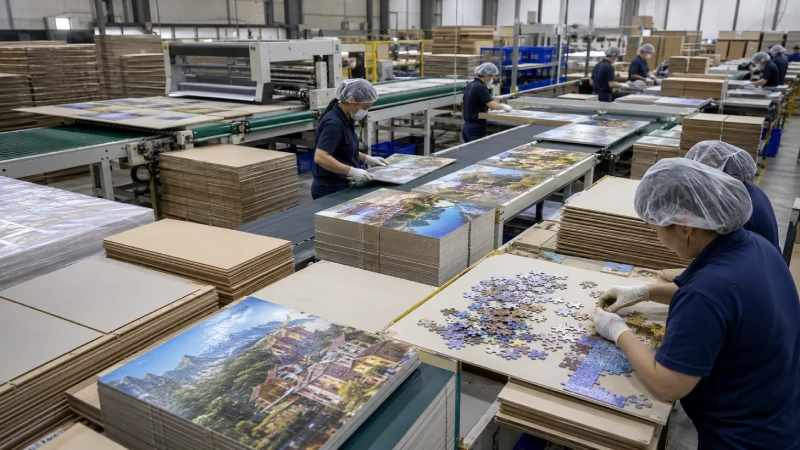
The workflow should be planned before production begins. If the factory layout is poor, materials may move back and forth unnecessarily. If order tracking is unclear, operators may mix batches or delay urgent jobs. If inspection is only done at the end, defects may not be discovered until too much material has already been processed.
Workflow planning also affects profitability. A factory with good flow can produce more with the same equipment and labor. A factory with poor flow may lose time in waiting, movement, rework, and communication errors. For puzzle manufacturing startups, the goal is not only to buy machines but to build a process that can repeat stable results.
Production capacity should be planned around real orders. Consider daily output targets, product size range, piece count variation, batch changeover time, manual handling requirements, and seasonal demand. For example, a factory serving gift and retail customers may face higher demand before holidays. An OEM factory may need to meet strict delivery schedules for brand customers.
A practical startup should begin with a manageable product range. Too many sizes, designs, and packaging styles can increase complexity before the team is ready. Once the workflow becomes stable, the factory can expand its product options and production capacity.
Quality Control Setup for a New Puzzle Manufacturing Business
Quality control should be built into the production process rather than treated as a final inspection step. Puzzle buyers usually care about accurate piece count, clean appearance, proper image alignment, stable packaging, and consistent product quality.
A good QC system starts with incoming material inspection. Greyboard, printed sheets, adhesives, and packaging materials should be checked before production. During mounting, operators should confirm alignment and surface condition. During cutting, the factory should check whether the puzzle pieces are cleanly formed and whether the image position is acceptable.
After cutting, sorting and piece count checks are important. Missing pieces are one of the most serious complaints in puzzle products. Packaging checks should confirm that the correct puzzle, box, insert, label, and quantity are used. Final random inspection should be done before products move to the finished goods warehouse.
For startups, quality records are helpful. They allow the factory to track problems, identify weak points, and communicate professionally with buyers. A simple checklist can be enough at the beginning, but it should be used consistently. As the factory grows, more structured QC procedures can be added.
The purpose of QC is not only to reject defective products. It is to reduce waste, prevent customer complaints, and improve repeat order potential. In OEM manufacturing, quality consistency is one of the strongest reasons buyers stay with a supplier.
Cost Considerations and Investment Planning
Starting a puzzle manufacturing business requires careful cost planning. The main startup costs usually include factory rent, renovation, equipment purchase, tooling and dies, raw material inventory, packaging materials, labor, utilities, maintenance, sample development, and marketing.
Some costs are fixed, while others change with production volume. Fixed costs may include rent, basic salaries, machine depreciation, and administrative expenses. Variable costs include paperboard, printed sheets, adhesives, packaging, labor hours, shipping, and production waste.
To estimate unit cost, a factory should consider puzzle size, piece count, material thickness, printing method, packaging style, order quantity, labor level, and scrap rate. Larger orders usually reduce unit cost because setup time and material purchasing can be spread across more pieces. However, larger orders also require stronger cash flow and inventory control.
One investment mistake is buying equipment before confirming the target product range. Another mistake is underestimating tooling cost. Different puzzle sizes and piece patterns may require different dies, which should be included in the investment plan.
Startups should also avoid ignoring training cost and material waste. During early production, trial runs and mistakes are normal. Budget should include sample development, operator training, and process adjustment. A factory that plans only for machine cost may face cash flow pressure before stable orders arrive.
Sales, Quotation, and Order Management Setup
A puzzle manufacturing business needs a clear quotation and order management process. Buyers usually ask about MOQ, available puzzle sizes, piece count options, custom printing, packaging choices, sample lead time, mass production lead time, and quality control procedures.
To quote accurately, the factory should collect key information from the buyer. This includes puzzle size, piece count, material requirements, order quantity, packaging style, artwork status, delivery terms, and quality expectations. Without this information, the quotation may be inaccurate and production planning may become difficult later.
A sample process is also important. Samples help confirm image quality, product structure, cutting results, packaging, and customer expectations before mass production. For OEM and private label buyers, sample approval is often a necessary step before placing larger orders.
Startups should create standard quotation templates, order confirmation forms, sample approval records, and production instructions. These documents reduce communication errors and make the factory look more professional to buyers.
When Should You Invest in Automation?
Automation can improve efficiency, but it should be introduced at the right stage. A factory may need automation when order volume becomes stable, labor cost increases, quality becomes inconsistent, or manual handling slows down delivery.
Automation is especially useful when the factory produces repeated product sizes or large batches. It can help reduce human error, improve output consistency, and make production planning more predictable. However, automation is not always the best first step for every startup.
Semi-automatic production may be better for early-stage businesses, highly customized orders, limited budgets, or unstable order volume. If customers frequently request different sizes, packaging styles, and small batches, a flexible setup may be more practical than a fully automated line.
The best investment strategy is to match automation with real demand. A factory should first understand its order pattern, customer requirements, labor structure, and production bottlenecks. Once the business reaches a stable level, upgrading to industrial puzzle production machines can help increase capacity and improve long-term competitiveness.
Step-by-Step Checklist for Starting a Puzzle Manufacturing Business
Starting a puzzle manufacturing business becomes easier when the process is broken into practical steps.
First, define your target market and business model. Decide whether you want to focus on OEM orders, private label production, custom puzzles, educational puzzles, promotional puzzles, or retail supply.
Second, decide your product range. This includes puzzle sizes, piece count options, material grade, packaging style, and order quantity range.
Third, estimate your investment budget. Include machines, factory space, dies, materials, labor, training, samples, and marketing.
Fourth, plan factory space and production flow. Separate raw materials, production areas, inspection areas, packaging areas, and finished goods storage.
Fifth, select suitable production equipment. Choose machines based on your expected order volume, product type, and growth plan.
Sixth, source stable material and packaging suppliers. Focus on quality consistency, lead time, and cost control.
Seventh, build and train your team. Make sure operators, inspectors, and packaging workers understand their responsibilities.
Eighth, create SOPs and QC standards. A repeatable process is essential for stable manufacturing.
Ninth, produce samples and test small batches before accepting larger orders.
Tenth, develop sales channels, quotation templates, and order management systems.
Finally, improve efficiency before expanding capacity. Growth should be based on stable production, not only new orders.
FAQ About Starting a Puzzle Manufacturing Business
How much does it cost to start a puzzle manufacturing business?
The cost depends on factory size, equipment level, automation requirements, material inventory, tooling, labor, and whether printing is handled in-house or outsourced. A small startup may begin with a more flexible semi-automatic setup, while an industrial factory requires a larger investment in equipment, space, staffing, and production systems.
What machines are needed to manufacture puzzles?
A puzzle factory may need equipment for mounting or lamination, puzzle cutting, sorting, inspection, counting, and packaging. The exact machine combination depends on production volume, product size, piece count, and automation level. For a complete equipment overview, business owners can review suitable puzzle manufacturing machinery before making an investment decision.
Is puzzle manufacturing suitable for small startups?
Yes, puzzle manufacturing can be suitable for small startups if the business model is focused and investment is controlled. Many startups begin with custom puzzles, low-volume OEM orders, or outsourced printing. The key is to avoid over-expansion before production quality, order flow, and customer demand become stable.
Should I start with custom puzzles or OEM production?
Custom puzzles are more flexible and may require lower initial volume, but they often involve more order handling and frequent design changes. OEM production can scale better, but it usually requires stronger quality control, delivery management, and buyer communication. The best choice depends on your sales channels, budget, and operational capability.
What is the biggest challenge in puzzle manufacturing?
The biggest challenge is balancing quality consistency, production efficiency, material control, and delivery reliability. A factory must control piece count, image alignment, cutting quality, packaging accuracy, and production scheduling at the same time. Strong workflow planning and QC systems are essential.
When should a puzzle factory upgrade to automatic production?
A factory should consider automation when order volume becomes stable, manual labor creates bottlenecks, quality consistency becomes harder to maintain, or customers require faster delivery. Automation should follow business demand, not replace careful production planning.
Conclusion: Build the Business Around Demand, Workflow, and Scalable Equipment
Starting a puzzle manufacturing business requires clear planning across market positioning, factory space, equipment investment, material sourcing, staffing, workflow, quality control, and cost management. A profitable puzzle factory is not built only by purchasing machines. It is built by matching production capacity with real customer demand and creating a reliable operating system.
For startups, the best approach is to begin with a clear product range, stable suppliers, trained staff, and scalable equipment. As orders grow, the factory can improve workflow and gradually increase automation. If you are planning a new puzzle factory or upgrading from manual production, choosing the right puzzle manufacturing machinery can help you build a more efficient, scalable, and reliable production operation.
