
In industrial puzzle production, achieving consistent cutting accuracy is crucial for producing high-quality puzzles that fit together perfectly. Minor deviations in die alignment, pressure application, or material consistency can lead to mismatched pieces, increased scrap, and costly production delays.
Improving puzzle cutting accuracy not only enhances the finished product’s quality but also streamlines workflow and minimizes material waste. By focusing on precise die alignment, consistent pressure, sharp blades, machine calibration, and rigorous quality inspection, manufacturers can maintain tight tolerances and reliable production standards.
Implementing these best practices ensures your puzzles meet the high expectations of customers while reducing operational inefficiencies. For manufacturers looking to upgrade their equipment, puzzle production machines offer the precision and repeatability necessary for industrial-scale operations.
Why Cutting Accuracy Matters
Cutting accuracy directly impacts the puzzle’s fit, appearance, and structural integrity. When tolerances are too loose, puzzle pieces may fall apart easily or fail to lock correctly. Conversely, overly tight cuts can make assembly difficult and lead to warped or damaged pieces. Maintaining precise cutting tolerances is essential for:
- Product quality: Accurate cuts ensure that pieces interlock perfectly, providing a satisfying user experience.
- Material efficiency: Fewer miscuts mean reduced waste, lowering overall production costs.
- Operational efficiency: Consistent cutting reduces rework and downtime caused by error correction.
By prioritizing cutting accuracy, manufacturers reinforce their brand’s reputation for high-quality puzzles. Investing in industrial die cutting process expertise helps teams understand how precision cutting directly affects end-product reliability and customer satisfaction.
Die Alignment
Die alignment is a cornerstone of precise puzzle cutting. Misaligned dies can lead to incomplete cuts, jagged edges, or irregular piece shapes. Proper alignment ensures that each puzzle piece matches the intended design specifications.
Understanding Die Placement
- Accurate placement of the cutting die relative to the material ensures all cuts are consistent.
- Even minor offsets can amplify errors across multiple cuts, affecting the overall puzzle integrity.
Techniques for Accurate Alignment
- Use visual guides or laser alignment systems to position dies precisely on the material.
- Employ jigs or custom fixtures to maintain repeatable die placement for batch production.
- Verify alignment before each production run to avoid cumulative errors.
Optimizing die alignment improves overall productivity and reduces the need for post-cut finishing. Linking knowledge of puzzle cutting tooling helps operators understand how die design interacts with material properties to maintain precision.
Pressure Control
Consistent pressure is critical for producing clean cuts without damaging the puzzle material. Uneven pressure can result in partial cuts, rough edges, or deformations that compromise piece integrity.
Consistent Press Force
- Establish a standardized force setting suitable for the board or material used.
- Adjust press settings according to material thickness, density, and laminate layers.
Monitoring Systems
- Integrate sensors or gauges to measure pressure in real-time.
- Ensure automated feedback systems alert operators if pressure deviates from specifications.
Maintaining uniform pressure across the die prevents over-penetration or incomplete cuts, safeguarding both material and tooling.
Material Consistency
Material variations significantly influence cutting accuracy. Differences in thickness, density, or moisture content can alter how a die interacts with the board.
- Inspect raw materials for uniform thickness and density before cutting.
- Store materials in controlled environments to prevent swelling or warping.
- Standardize material batches to reduce variations between production runs.
Attention to material consistency ensures that even the most precisely aligned dies achieve predictable results.
Blade Sharpness
Sharp blades are essential for clean, precise cuts. Dull or worn blades increase cutting force requirements and produce rough edges.
- Implement a regular blade maintenance schedule, including sharpening and inspection.
- Monitor blade wear visually or through production test cuts.
- Replace blades proactively to avoid compromising cut quality.
Using sharp, high-quality blades reduces stress on the die and material, ensuring smooth, accurate cuts throughout production.
Machine Calibration
Regular machine calibration ensures that cutting equipment operates within the specified tolerances.
- Adjust press alignment, stroke depth, and die engagement to match design requirements.
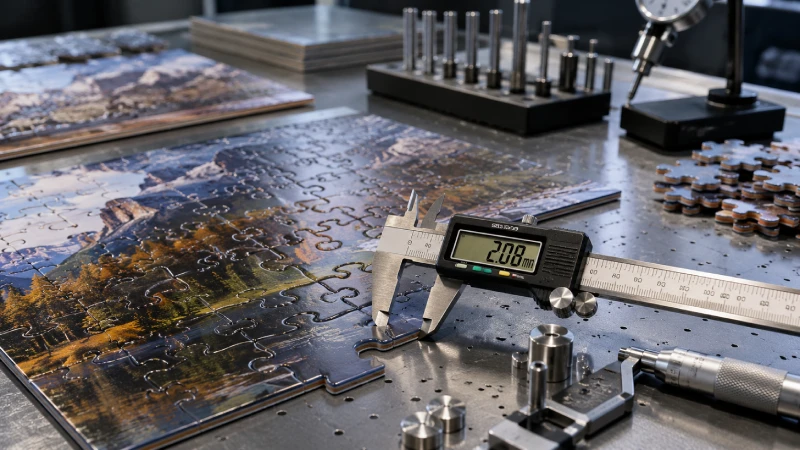
- Use precision tools and calibration blocks to verify machine accuracy.
- Maintain a preventive maintenance schedule to identify and correct mechanical drift over time.
Proper calibration extends equipment life while preserving cutting consistency across all batches.
Quality Inspection
Rigorous quality inspection allows manufacturers to catch deviations before products leave the production line.
Visual and Dimensional Checks
- Examine finished pieces for edge smoothness, proper interlocking, and overall shape.
- Use calipers, templates, or digital scanners to measure tolerances accurately.
Statistical Process Control (SPC)
- Track production data to monitor consistency over time.
- Detect trends indicating misalignment, pressure issues, or material inconsistencies early.
Integrating quality inspection into daily operations reduces scrap rates and ensures each puzzle meets customer expectations.
Common Precision Issues
Even experienced manufacturers encounter common precision challenges, including:
- Misaligned dies: Caused by improper setup or fixture wear.
- Uneven pressure: Resulting from incorrect press calibration or inconsistent material.
- Material variability: Thickness or density variations affecting cut quality.
- Blade wear or damage: Leading to jagged edges or incomplete cuts.
Troubleshooting these issues promptly maintains production efficiency and preserves product quality.
FAQ
What is the typical tolerance for industrial puzzle cutting?
Most industrial puzzles maintain cutting tolerances within ±0.1–0.3 mm depending on die design and material.
How often should dies be recalibrated?
Dies should be checked and recalibrated at the start of each production batch or after significant production hours.
Can blade sharpness affect cutting speed?
Yes. Dull blades require more force and reduce cutting speed, often causing edge imperfections.
How can misalignment be detected early?
Use test cuts, alignment templates, or digital scanning tools before full-scale production to detect offsets.
