
Introduction
Cardboard puzzles are manufactured through a highly coordinated industrial workflow that combines precision printing, board mounting, die cutting, inspection, and packaging. As global demand for custom jigsaw puzzles continues to grow across the toy, educational, and promotional industries, manufacturers must maintain consistent production quality while handling large-volume orders efficiently.
The production process begins with digital artwork preparation and high-resolution printing, followed by laminating the printed image onto thick cardboard puzzle board. After the material is stabilized, the puzzle sheets move through precision cutting stages that create interlocking puzzle pieces with accurate fit and clean edges. The finished pieces are then separated, inspected, counted, and packaged before shipment.
Each stage in the workflow directly affects the final product quality. Poor print alignment can impact cutting accuracy, while unstable board materials may lead to warped puzzle pieces or weak interlocking performance. For this reason, many factories integrate specialized puzzle manufacturing machines and automated handling systems to improve production consistency and reduce defects during large-scale manufacturing.
Overview of the Industrial Cardboard Puzzle Manufacturing Workflow
Industrial cardboard puzzle manufacturing follows a structured multi-stage workflow designed to maintain production efficiency, print consistency, and puzzle piece accuracy. Although different manufacturers may use slightly different production layouts, most factories follow a similar process that starts with artwork preparation and ends with final packaging and shipment.
The workflow typically begins with prepress file preparation and high-resolution printing. After printing, the paper sheets are laminated and mounted onto thick cardboard puzzle board to create a stable material structure suitable for die cutting. Once the mounted sheets are fully cured and stabilized, they move into the cutting stage where interlocking puzzle patterns are formed. The cut puzzle sheets are then separated into individual pieces, cleaned, inspected, and prepared for packaging.
Workflow coordination is critical because every stage directly influences downstream production quality. Poor printing registration can affect cutting alignment, while unstable mounting conditions may cause board warping during die cutting. Inconsistent handling between stages can also increase dust contamination, damaged pieces, or packaging errors.
To improve workflow stability and reduce production defects, many manufacturers integrate specialized industrial puzzle production equipment into their manufacturing process. Proper production coordination helps factories maintain consistent puzzle quality, reduce waste, and improve large-scale production efficiency.
Step 1: Preparing Puzzle Artwork and Print Files
The cardboard puzzle manufacturing process starts with artwork preparation and print file setup. This stage plays a critical role in determining the final visual quality, cutting accuracy, and production consistency of the finished puzzle. Even small errors during prepress preparation can create alignment problems later in the manufacturing workflow.
Most puzzle manufacturers prepare artwork files using high-resolution CMYK color formats to ensure accurate color reproduction during industrial printing. The image resolution must remain sharp enough to preserve fine details after the puzzle pieces are cut into hundreds or thousands of small sections. Color management is also important because inconsistent color calibration can lead to noticeable differences between production batches.
In addition to image preparation, manufacturers must carefully plan puzzle layout positioning on the print sheet. This includes bleed areas, registration marks, cut line alignment, and packaging artwork coordination. Proper positioning helps maintain accurate alignment between the printed image and the later die cutting stage.
Prepress accuracy directly affects manufacturing efficiency and product quality. Poor file setup may cause printing shifts, cutting misalignment, blurred images, or uneven borders on finished puzzle pieces. These problems can increase material waste and reduce customer satisfaction.
For OEM puzzle manufacturers handling large-volume production, standardized artwork preparation procedures help maintain production consistency while reducing errors throughout the entire manufacturing workflow.
Step 2: Printing the Puzzle Image onto Paper Sheets
After the artwork files are finalized, the manufacturing process moves into the printing stage. Industrial puzzle printing focuses on producing sharp image detail, accurate color reproduction, and stable sheet alignment before the material enters lamination and die cutting processes.
Most large-scale cardboard puzzle manufacturers use offset printing because it provides high print consistency and cost efficiency for bulk production. Digital printing may also be used for short production runs, custom puzzles, or sample development. Regardless of the printing method, maintaining stable image registration across the entire sheet is essential for later cutting accuracy.
During production, manufacturers monitor several important printing factors, including ink density, drying consistency, color calibration, and paper stability. Uneven ink application or poor drying conditions can lead to smudging, color variation, or surface defects that become highly visible after the puzzle is cut into pieces.
Printing quality directly affects the final puzzle experience. Sharp image detail improves puzzle assembly visibility, while accurate registration helps ensure that the die cutting pattern aligns correctly with the printed artwork. Even minor printing shifts can create uneven borders or image distortion on finished puzzle pieces.
Industrial puzzle printing also requires careful environmental control. Temperature and humidity fluctuations may affect paper expansion and sheet stability, increasing the risk of alignment errors during downstream manufacturing stages. For this reason, many factories implement standardized print inspection procedures before moving materials into board mounting and lamination operations.
Step 3: Laminating and Mounting the Printed Sheet onto Cardboard
Once the printed sheets pass inspection, they move into the lamination and board mounting stage. This process transforms the printed paper into a durable puzzle board structure that can withstand die cutting, packaging, transportation, and repeated consumer use.
Lamination is commonly applied to protect the printed surface from scratches, moisture, and color fading. Manufacturers may use gloss, matte, or specialty finishes depending on the product style and target market. A stable laminated surface also improves print durability during the later cutting and handling stages.
After lamination, the printed sheet is mounted onto thick cardboard puzzle board using industrial adhesive systems. During this process, manufacturers must carefully control adhesive distribution, bonding pressure, and drying conditions to maintain a flat and stable board structure. Uneven pressure or inconsistent adhesive application can create bubbles, weak bonding areas, or surface deformation.
Most cardboard puzzles use greyboard or recycled paperboard materials because they provide sufficient rigidity while maintaining cost efficiency for large-scale production. Premium puzzle products may use thicker board materials to improve puzzle feel and interlocking strength.
Board stability is extremely important because warped or unstable sheets can create serious problems during die cutting. Poorly mounted materials may lead to inaccurate cuts, bent puzzle pieces, or inconsistent interlocking performance. To reduce these risks, manufacturers often implement curing and flatness inspection procedures before the mounted boards move into the cutting stage.
Maintaining consistent mounting quality helps improve downstream production stability while reducing waste, defects, and packaging issues.
Step 4: Die Cutting the Puzzle Pieces
After the mounted puzzle boards are fully stabilized, they move into the die cutting stage where the printed sheets are transformed into individual interlocking puzzle pieces. This is one of the most critical stages in cardboard puzzle manufacturing because cutting precision directly affects puzzle assembly quality, piece fit, and overall customer experience.
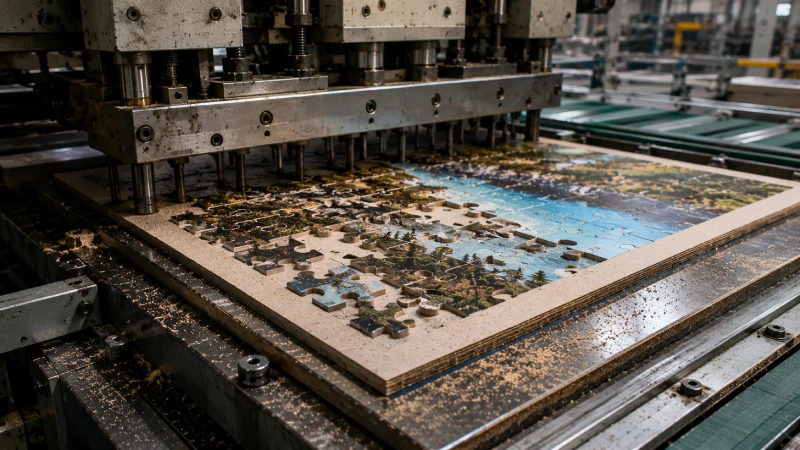
Most industrial puzzle manufacturers use steel rule die cutting to create the puzzle pattern. During this process, the mounted board passes through a precision cutting system where a custom die presses into the material to form interlocking shapes. The cutting pattern must align accurately with the printed artwork to maintain consistent borders and image continuity across all puzzle pieces.
Puzzle manufacturers may use different cutting styles depending on the product design and target market. Ribbon-cut patterns create more uniform piece shapes, while random-cut patterns generate more varied puzzle piece structures that increase assembly difficulty. The chosen pattern can influence puzzle complexity, user experience, and production efficiency.
Maintaining stable cutting pressure and alignment is essential during production. Excessive pressure may damage the board structure or bend puzzle pieces, while insufficient pressure can create incomplete cuts that make piece separation difficult. Manufacturers also monitor cutting tolerance, edge cleanliness, and dust generation throughout the process.
Poor die cutting quality can lead to loose-fitting pieces, damaged edges, or inaccurate interlocking performance. These problems not only reduce puzzle quality but can also increase customer complaints and product returns. For this reason, many factories implement inline inspection procedures to verify cutting consistency before the puzzles move into separation and packaging stages.
For a more detailed explanation of industrial cutting methods, manufacturers often reference the puzzle die cutting process used in large-scale puzzle production.
Step 5: Separating, Sorting, and Inspecting Puzzle Pieces
Once the die cutting process is completed, the puzzle sheets move into the separation and inspection stage. At this point, manufacturers must carefully separate the interlocked pieces, remove production debris, and verify product quality before packaging begins.
During separation, the cut puzzle board is broken apart so the individual pieces can detach cleanly from the sheet. This process must be controlled carefully because excessive force may damage piece edges, weaken interlocking tabs, or create bent corners. Manufacturers aim to maintain smooth piece separation while minimizing stress on the cardboard structure.
After separation, factories typically perform dust removal and surface cleaning procedures. Cardboard puzzle production naturally generates paper fibers and cutting dust during die cutting, and these particles can affect packaging cleanliness and product appearance. Dust control is especially important for premium puzzle products where surface quality and presentation standards are higher.
The inspection stage is one of the most important quality control steps in the entire manufacturing workflow. Manufacturers check for missing pieces, incomplete cuts, print defects, surface scratches, and irregular piece shapes. Some factories also verify color consistency and interlocking performance through sample assembly testing.
Consistent inspection procedures help reduce customer complaints and improve OEM production reliability. Missing pieces or damaged puzzle sections can seriously affect the end-user experience and damage brand reputation in the retail market.
By implementing standardized sorting and inspection processes, puzzle manufacturers can improve packaging accuracy, reduce defect rates, and maintain more stable production quality across large-volume manufacturing operations.
Step 6: Packaging Finished Cardboard Puzzles
After the puzzle pieces pass inspection, the production workflow moves into the packaging stage. Industrial puzzle packaging is designed not only to protect the product during transportation, but also to ensure retail presentation quality, accurate piece counts, and consistent customer experience.
Most cardboard puzzle products include several packaging components, such as the puzzle box, sealed puzzle pieces, reference posters, and instruction sheets. Depending on the product category, manufacturers may also include promotional inserts, barcode labels, or protective inner trays. All packaging materials must remain consistent with the puzzle size, piece count, and retail branding requirements.
The packaging workflow usually begins with counting and bagging the puzzle pieces. Accurate counting is extremely important because missing pieces are one of the most common quality issues in the puzzle industry. After bagging, the pieces are inserted into the printed puzzle box together with any additional materials. The completed boxes may then pass through shrink wrapping, labeling, carton packing, and palletizing stages before shipment.
Packaging quality directly affects product protection and retail appearance. Poor box alignment, weak sealing, or damaged packaging materials can reduce shelf appeal and increase the risk of shipping damage. Manufacturers also monitor barcode accuracy and carton labeling to support warehouse management and export logistics.
For large-scale production environments, many factories standardize their puzzle packaging workflow to improve packaging consistency, reduce manual errors, and maintain stable production efficiency across different puzzle product lines.
Step 7: Final Quality Control and Shipping Preparation
Before cardboard puzzles are shipped to distributors, retailers, or OEM clients, manufacturers perform final quality control and shipping preparation procedures. This stage helps ensure that the finished products meet packaging standards, transportation requirements, and customer quality expectations.
Final inspection typically includes carton verification, barcode checking, packaging integrity inspection, and batch identification review. Manufacturers may also perform weight verification to confirm that the correct number of puzzle pieces and packaging materials are included inside each box. These checks help reduce the risk of missing components, labeling errors, or shipment inconsistencies.
After inspection, the finished puzzle products move into warehouse preparation and logistics handling. Puzzle cartons are usually stacked onto pallets and secured for transportation. Moisture protection is particularly important because cardboard materials can deform if exposed to excessive humidity during storage or shipping. For export orders, manufacturers may also follow additional packaging standards related to international transportation and retail compliance.
Proper shipping preparation plays an important role in protecting product quality throughout the supply chain. Damaged cartons, unstable pallet loading, or poor warehouse conditions can negatively affect retail presentation and customer satisfaction after delivery.
Many large-scale puzzle manufacturers implement standardized final inspection and logistics procedures to improve shipment consistency, reduce returns, and support long-term OEM production reliability. Stable quality control at the final stage helps ensure that the completed puzzles arrive in good condition and maintain consistent product standards across different production batches.
Common Production Challenges in Cardboard Puzzle Manufacturing
Cardboard puzzle manufacturing involves multiple interconnected production stages, and small inconsistencies in one process can quickly affect downstream product quality. To maintain stable production efficiency and reduce defects, manufacturers must carefully control printing accuracy, board stability, cutting precision, and packaging consistency throughout the workflow.
One of the most common production problems is print alignment error. If the printed artwork shifts slightly during printing or mounting, the die cutting pattern may no longer align correctly with the image. This can create uneven borders, distorted piece graphics, or visible cutting inconsistencies on the finished puzzle.
Board warping is another major challenge in cardboard puzzle production. Changes in humidity, uneven adhesive distribution, or unstable drying conditions may cause the mounted board to bend or deform. Warped materials often create cutting pressure problems and can reduce puzzle interlocking accuracy after production.
Manufacturers also frequently monitor die cutting consistency. Excessive cutting pressure may damage puzzle edges, while insufficient pressure can leave incomplete cuts that make piece separation difficult. Dust generation during cutting is another issue because cardboard fibers can affect packaging cleanliness and inspection accuracy.
Packaging errors can also impact final product quality. Incorrect piece counts, damaged boxes, or poor sealing may lead to customer complaints and higher return rates. For OEM puzzle brands, packaging consistency is especially important for retail presentation and brand reliability.
To reduce these production risks, many factories implement standardized workflow procedures, environmental control systems, inline inspections, and production calibration processes. Stable workflow management helps manufacturers improve product consistency while reducing material waste and operational downtime.
How Industrial Workflow Optimization Improves Puzzle Production Efficiency
As puzzle manufacturers handle larger production volumes and more customized product orders, workflow optimization has become increasingly important in industrial cardboard puzzle manufacturing. Efficient production coordination helps factories improve output stability, reduce defects, and maintain more consistent product quality across different puzzle formats and piece counts.
One major advantage of workflow optimization is the reduction of unnecessary manual handling between production stages. Stable material transfer between printing, mounting, die cutting, inspection, and packaging helps reduce board damage, alignment errors, and production delays. Streamlined workflows also improve production speed while lowering labor intensity during high-volume manufacturing.
Consistent workflow management also improves production accuracy. When printing alignment, board stability, and cutting calibration remain controlled throughout the process, manufacturers can reduce waste and maintain more reliable interlocking performance in finished puzzles. This becomes especially important for OEM puzzle brands that require stable quality across repeated production batches.
Production efficiency is also closely linked to material utilization. Poor coordination between manufacturing stages may increase rejected sheets, packaging mistakes, or downtime caused by alignment corrections. Optimized workflows help reduce these interruptions while improving overall production consistency.
To support large-scale manufacturing operations, many factories integrate specialized puzzle manufacturing machines and automated handling systems into their production environment. Rather than focusing only on individual machines, modern puzzle factories increasingly prioritize full workflow coordination to improve efficiency, reduce operational risk, and maintain stable industrial production performance.
Conclusion
Cardboard puzzle manufacturing is a highly coordinated industrial process that combines printing, board mounting, die cutting, inspection, and packaging into a continuous production workflow. Every manufacturing stage directly affects the final puzzle quality, from image sharpness and cutting precision to interlocking performance and packaging consistency.
Maintaining stable production conditions is essential for reducing defects and improving large-scale manufacturing efficiency. Problems such as print misalignment, board warping, incomplete cuts, or packaging errors can quickly affect customer satisfaction and increase production waste. For this reason, many puzzle manufacturers implement standardized quality control procedures throughout the entire workflow.
As global demand for custom and OEM puzzle products continues to grow, factories are increasingly focused on improving production stability, reducing manual handling, and optimizing workflow coordination. Modern production environments often integrate specialized industrial puzzle production equipment to support more consistent manufacturing performance across different puzzle styles and production volumes.
By understanding how cardboard puzzles are manufactured, production managers and industrial buyers can better evaluate manufacturing quality, workflow efficiency, and long-term production reliability within industrial puzzle manufacturing operations.
FAQ
What material is used to make cardboard puzzles?
Most cardboard puzzles are manufactured using greyboard or recycled paperboard materials because they provide good rigidity, stable cutting performance, and cost efficiency for large-scale production. The printed image is usually laminated and mounted onto the board to improve durability and surface protection. Premium puzzle products may use thicker board materials to create stronger interlocking performance and a more durable finished product.
How are puzzle pieces cut so accurately?
Industrial puzzle manufacturers typically use steel rule die cutting systems to create precise interlocking puzzle patterns. The mounted puzzle board passes through a cutting stage where controlled pressure forms the individual puzzle pieces. Accurate alignment between the printed artwork and the cutting pattern is critical because even small positioning errors can affect image consistency and puzzle assembly quality.
Why do some puzzle pieces fit better than others?
Puzzle piece fit quality is heavily influenced by board stability, cutting precision, and production consistency. Poor die cutting calibration, unstable cardboard materials, or excessive board warping may create loose-fitting or damaged pieces. High-quality puzzle manufacturing processes focus on maintaining stable cutting tolerance and accurate interlocking performance throughout production.
What causes puzzle board warping during production?
Board warping is commonly caused by uneven adhesive application, unstable humidity conditions, or inconsistent drying during the mounting process. Warped puzzle boards can affect die cutting accuracy and reduce puzzle assembly quality. Many factories use environmental control systems and curing procedures to maintain board stability before cutting begins.
How do manufacturers check for missing puzzle pieces?
Manufacturers typically implement inspection and counting procedures during the separation and packaging stages. Some factories use weight verification systems or manual inspection methods to confirm correct piece counts before sealing the packaging. Final quality control checks help reduce missing-piece complaints and improve customer satisfaction.
How are puzzles packaged in industrial production?
After inspection, the puzzle pieces are counted, bagged, inserted into printed boxes, and sealed for shipment. Additional materials such as posters or instruction sheets may also be included depending on the product design. Large-scale factories often standardize their packaging workflow to improve consistency, reduce errors, and maintain retail presentation quality.
