
Problems in Puzzle Manufacturing: Causes, Solutions, and Quality Control Guide
Puzzle manufacturing is a highly specialized production process that combines printing, lamination, die cutting, separation, counting, and packaging operations. While modern equipment has significantly improved production efficiency, manufacturers still face a wide range of quality problems that can affect product consistency, customer satisfaction, and overall profitability.
Even small deviations in cutting accuracy, adhesive application, or packaging procedures can lead to defective products and increased waste. For large-scale puzzle producers, identifying the root causes of production defects is essential for maintaining quality standards and reducing operational costs.
Manufacturers seeking long-term puzzle manufacturing solutions understand that troubleshooting production problems is just as important as investing in advanced equipment. By establishing effective quality control procedures and preventive maintenance programs, puzzle factories can reduce downtime, improve product consistency, and achieve higher production efficiency.
Why Quality Problems Occur in Puzzle Manufacturing
Puzzle production involves multiple manufacturing stages, each of which contributes to the final product quality. A defect introduced during one process can become much more visible after subsequent operations.
For example, slight registration errors during printing may become obvious after die cutting. Similarly, uneven adhesive application during lamination may not be noticed until pieces begin separating after packaging.
Another challenge is that many defects develop gradually rather than appearing suddenly. Die wear, sensor drift, and mechanical looseness often worsen over time, making them difficult to detect without regular inspections.
The financial impact of poor quality can be substantial. Manufacturers may experience:
- Increased material waste
- Higher labor costs
- Production delays
- Customer returns
- Brand reputation damage
Understanding the root causes of these problems allows manufacturers to implement corrective actions before defects become widespread.
Burrs and Rough Puzzle Piece Edges
One of the most common complaints in puzzle manufacturing involves rough puzzle piece edges. Customers expect puzzle pieces to separate smoothly and fit together precisely. Excessive burrs reduce product quality and create a poor user experience.
Common Symptoms
Manufacturers frequently observe:
- Frayed edges
- Excess paper fibers
- Rough cutting surfaces
- Difficult piece separation
Main Causes
Dull Cutting Dies
Over time, cutting knives lose their sharpness. Instead of producing clean cuts, worn dies tear fibers and create rough edges.
Insufficient Cutting Pressure
If cutting pressure is too low, the die may not fully penetrate the board material, leaving partially cut fibers attached.
Thick or Dense Board Materials
Certain puzzle boards require higher cutting force. Using the same settings across different materials often results in poor cutting quality.
Die Alignment Problems
Misaligned dies distribute cutting force unevenly, creating burrs in specific areas of the sheet.
Troubleshooting Solutions
Manufacturers should:
- Inspect cutting dies regularly
- Monitor knife wear
- Optimize cutting pressure
- Verify die alignment
- Match cutting parameters to material specifications
Factories looking to improve puzzle cutting quality often discover that routine die maintenance delivers immediate improvements in edge quality.
Misaligned Puzzle Pieces and Inaccurate Cuts
Accurate registration is critical in puzzle production. Even small deviations can create noticeable alignment issues that affect both appearance and assembly performance.
Common Symptoms
- Puzzle images do not align properly
- Piece shapes vary across the sheet
- Visible gaps appear between pieces
- Inconsistent fit during assembly
Main Causes
Registration Errors
Improper positioning between printed artwork and cutting dies can cause the image to shift relative to the cut lines.
Material Feeding Issues
Uneven feeding introduces positional variations throughout production.
Machine Vibration
Excessive vibration can reduce cutting precision and gradually affect alignment.
Incorrect Tool Installation
Improper die setup can create dimensional inaccuracies across the entire production run.
Corrective Actions
Manufacturers should:
- Recalibrate registration systems
- Verify feeding accuracy
- Tighten mechanical components
- Check die mounting procedures
- Monitor alignment during production
Implementing regular calibration routines helps maintain consistent cutting accuracy and minimizes waste.
Weak Lamination and Board Separation Problems
Lamination quality directly affects puzzle durability. Poor bonding between printed paper and backing board can result in product failure during use.
Common Symptoms
- Peeling surfaces
- Layer separation
- Air bubbles
- Warping
Main Causes
Insufficient Adhesive Application
Applying too little adhesive weakens the bond between layers.
Uneven Glue Distribution
Inconsistent adhesive coverage creates localized weak spots.
Incorrect Pressing Pressure
Insufficient pressure prevents full adhesive contact across the board.
Environmental Conditions
Humidity and temperature fluctuations can significantly affect adhesive performance.
Solutions
Manufacturers can reduce lamination failures by:
- Optimizing glue application rates
- Monitoring adhesive viscosity
- Improving pressure consistency
- Controlling workshop humidity
- Conducting regular bond-strength testing
Early detection of lamination defects prevents large quantities of defective products from reaching later production stages.
Die Wear and Tooling Failure
Die cutting tools are among the most critical components in puzzle manufacturing. As production volume increases, tooling wear becomes unavoidable.
Why Die Wear Occurs
High Production Volumes
Millions of cutting cycles gradually dull cutting edges.
Abrasive Materials
Some puzzle boards accelerate knife wear due to higher density and fiber content.
Poor Storage Conditions
Improper storage can lead to corrosion, deformation, and premature deterioration.
Signs of Die Wear
Manufacturers should watch for:
- Increasing burr formation
- Incomplete cuts
- Edge distortion
- Rising scrap rates
- Increased cutting pressure requirements
Maintenance Recommendations
Scheduled Inspections
Routine inspections help identify wear before quality issues become severe.
Sharpening Programs
Regular sharpening extends die life and maintains cutting consistency.
Replacement Planning
Establishing replacement intervals reduces unexpected downtime.
Proper Storage
Dies should be stored in clean, dry environments to prevent corrosion and damage.
Effective tooling management improves production stability and reduces long-term operating costs.
Slow Production Speed and Efficiency Loss
Production efficiency is a major concern for industrial puzzle manufacturers. Reduced output often indicates deeper operational issues that require attention.
Common Symptoms
- Lower throughput
- Frequent machine stoppages
- Excessive setup time
- Production bottlenecks
Root Causes
Material Feeding Delays
Manual feeding systems can limit production capacity.
Operator Dependency
Inconsistent operator performance often creates variability in production speed.
Improper Setup Procedures
Extended changeover times reduce available production hours.
Maintenance Neglect
Worn components and dirty systems frequently cause unexpected stoppages.
Optimization Strategies
Manufacturers can improve efficiency through:
- Standardized setup procedures
- Preventive maintenance programs
- Operator training
- Improved material handling systems
- Performance monitoring
Continuous improvement efforts often produce significant gains in productivity without major capital investments.
Packaging Damage and Shipping Defects
A puzzle may leave production in perfect condition but still reach customers damaged due to packaging failures.
Common Packaging Problems
Crushed Boxes
Weak packaging materials can collapse during transportation.
Missing Pieces
Inadequate counting or packaging verification procedures may result in incomplete products.
Corner Damage
Insufficient protection allows cartons to deform during handling.
Poor Shrink Wrapping
Loose wrapping reduces package stability and appearance.
Root Causes
Common causes include:
- Weak carton materials
- Improper carton sizing
- Inconsistent packing procedures
- Rough transportation handling
Solutions
Manufacturers should implement:
- Packaging inspections
- Carton strength testing
- Automated counting systems
- Final package verification procedures
Strong puzzle packaging quality control programs significantly reduce customer complaints and product returns.
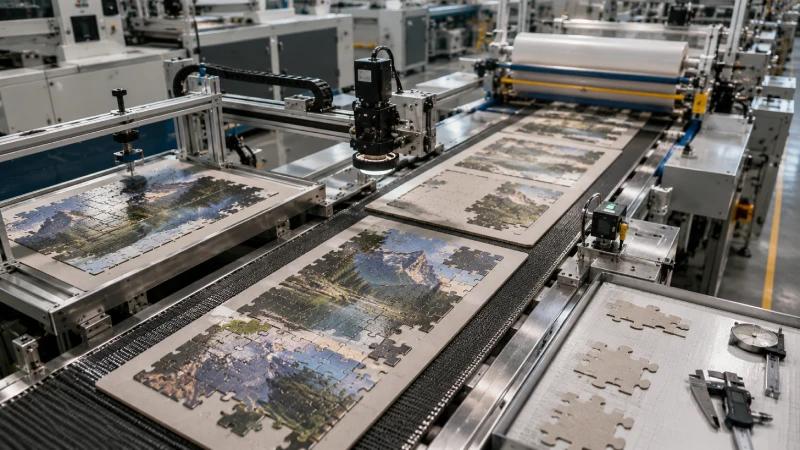
Quality Inspection Methods Used by Professional Puzzle Manufacturers
Quality inspection should occur throughout the production process rather than only at the final stage.
Incoming Material Inspection
Manufacturers should verify:
- Paper quality
- Board thickness
- Moisture content
- Adhesive specifications
Detecting material issues early prevents costly downstream defects.
In-Process Inspection
Cutting Accuracy Verification
Random samples should be measured regularly to confirm dimensional consistency.
Lamination Strength Testing
Bond strength tests help identify adhesive problems before mass production continues.
Visual Defect Inspection
Operators should monitor:
- Print quality
- Surface defects
- Edge conditions
- Registration accuracy
Final Product Inspection
Before shipment, manufacturers should inspect:
- Piece count accuracy
- Packaging integrity
- Visual appearance
- Assembly performance
Automated Inspection Technologies
Modern facilities increasingly utilize:
- Vision inspection systems
- Automated defect detection
- Barcode tracking systems
- Data-driven quality monitoring
These technologies improve detection accuracy while reducing inspection labor requirements.
Preventive Maintenance Practices That Reduce Manufacturing Defects
Many quality problems can be prevented through systematic maintenance programs.
Daily Maintenance
Operators should perform:
- Cleaning
- Lubrication
- Safety checks
- Pressure verification
Weekly Maintenance
Recommended activities include:
- Alignment inspection
- Sensor testing
- Fastener tightening
- Calibration verification
Monthly Maintenance
Manufacturers should conduct:
- Tooling inspections
- Wear analysis
- Component replacement reviews
- Performance evaluations
Benefits of Preventive Maintenance
Facilities with structured maintenance programs typically experience:
- Fewer breakdowns
- Better product consistency
- Reduced scrap rates
- Lower repair costs
- Improved equipment lifespan
Preventive Maintenance Checklist
| Inspection Area | Frequency |
|---|---|
| Cutting dies | Daily |
| Pressure settings | Daily |
| Feeding systems | Weekly |
| Sensors | Weekly |
| Alignment verification | Weekly |
| Tooling wear analysis | Monthly |
| Mechanical components | Monthly |
Building a Troubleshooting Program for Continuous Improvement
Successful puzzle manufacturers treat troubleshooting as an ongoing process rather than a reaction to isolated defects.
An effective troubleshooting system should include:
- Defect tracking
- Root cause analysis
- Corrective action procedures
- Performance monitoring
Key metrics often include:
- Scrap rate
- Downtime
- Tool life
- Production efficiency
- Customer complaint rate
By analyzing trends over time, manufacturers can identify recurring issues and implement long-term improvements rather than temporary fixes.
Defect Diagnosis Table
| Problem | Likely Cause | Recommended Action |
|---|---|---|
| Burrs | Die wear | Sharpen or replace die |
| Misalignment | Registration error | Recalibrate system |
| Delamination | Adhesive issue | Optimize glue application |
| Missing pieces | Packaging failure | Improve counting procedures |
| Slow production | Maintenance issues | Implement preventive maintenance |
| Box damage | Weak packaging | Upgrade packaging materials |
FAQ
Why do puzzle pieces have rough edges?
Rough edges are usually caused by worn cutting dies, insufficient cutting pressure, poor die alignment, or unsuitable material settings.
What causes puzzle pieces to misalign?
Misalignment typically results from registration errors, inaccurate material feeding, machine vibration, or improper die installation.
How often should puzzle cutting dies be replaced?
Replacement frequency depends on production volume, material type, and maintenance practices. Many manufacturers establish replacement schedules based on tool wear inspections rather than fixed production quantities.
Why does puzzle lamination fail?
Common causes include insufficient adhesive application, uneven glue distribution, incorrect pressing pressure, and environmental humidity issues.
How can manufacturers reduce missing-piece complaints?
Automated counting systems, barcode verification, and final package inspections significantly reduce packaging errors.
What is the most common quality issue in puzzle production?
Burr formation and cutting accuracy problems are among the most frequently reported defects because they directly affect puzzle appearance and user experience.
Conclusion
Quality problems in puzzle manufacturing rarely occur without warning. Most defects develop gradually through tooling wear, process variation, material inconsistencies, or inadequate maintenance practices.
By focusing on cutting accuracy, lamination quality, packaging integrity, and preventive maintenance, manufacturers can significantly reduce defects while improving productivity and customer satisfaction.
Ultimately, successful puzzle production depends not only on equipment capabilities but also on the ability to identify, troubleshoot, and prevent recurring quality issues. Manufacturers investing in effective quality management systems and professional puzzle manufacturing solutions are better positioned to achieve consistent product quality and long-term operational success.
