
Choosing the right stamping press manufacturer has a direct impact on production efficiency, part quality, tooling life, and long-term operating cost. Many buyers focus only on machine price, but the real difference often comes from the manufacturer’s engineering capability, customization experience, and ability to support your production after installation.
Industrial stamping presses are used in automotive, electronics, appliance, hardware, and heavy equipment manufacturing. However, not every manufacturer is suitable for every application. Some specialize in standard mechanical presses, while others focus on large hydraulic systems, high-speed precision lines, or fully customized production cells.
This guide explains the major types of stamping press manufacturers, what separates a strong manufacturer from an average one, and how to choose the right partner for your project.
What Types of Stamping Press Manufacturers Exist?
Not all stamping press manufacturers serve the same market. Before comparing suppliers, buyers should first understand which category of manufacturer best matches their production requirements.
Mechanical Press Manufacturers
Mechanical press manufacturers usually focus on high-volume production equipment for metal stamping operations. These companies typically provide standard-frame C-frame and H-frame presses in a wide tonnage range. Their products are common in automotive parts, appliance panels, brackets, and other repeat-production applications.
Manufacturers in this category often offer faster delivery times because they build standard machine platforms. They are generally a good fit when production speed and consistent output are more important than highly customized forming requirements.
Hydraulic Press Manufacturers
Hydraulic press manufacturers generally serve customers that require more flexibility, deeper forming, or larger workpieces. These manufacturers often build presses with higher customization levels, including different table sizes, longer strokes, and special tooling interfaces.
They are commonly selected for industries such as heavy equipment, kitchenware, large panels, aerospace components, and thick material forming. Compared with standard press builders, hydraulic press manufacturers usually provide more engineering involvement during the project stage.
High-Speed Press Manufacturers
High-speed press manufacturers specialize in precision production environments where extremely fast cycle rates are required. Their equipment is often used in electronics, motor laminations, connectors, terminals, and small precision metal components.
These manufacturers typically emphasize precision frames, high-speed feeding systems, and advanced control systems. Buyers looking for tight tolerances, stable long-term operation, and automated production lines usually work with this type of manufacturer.
Custom Press Manufacturers
Custom press manufacturers design machines around a specific product, process, or factory layout. Instead of selling a standard model, they engineer a complete solution based on the customer’s part drawing, material, production target, and available space.
A custom manufacturer may combine the press itself with decoilers, feeders, transfer systems, robots, scrap handling, safety systems, and complete automation. This type of manufacturer is often the best choice when standard machines cannot meet the required tonnage, stroke, bed size, or production workflow.
What Makes a Good Stamping Press Manufacturer?
The best stamping press manufacturer is not necessarily the company with the lowest price. A good manufacturer can help reduce downtime, shorten installation time, improve product quality, and provide better long-term support.
Strong Production Capability
A reliable manufacturer should have the ability to build presses consistently and at scale. This includes modern machining equipment, welding capability, precision assembly, and in-house quality control. Manufacturers with their own production facilities can usually maintain more stable quality and shorter lead times than companies that outsource most of the process.
You should also evaluate whether the manufacturer can handle the machine size you need. Some companies only build small standard presses, while others can produce large-capacity systems for heavy industrial applications.
Industry Experience
Experience matters because different industries have different requirements. A manufacturer that has built automotive stamping lines may not be the best choice for electronics or precision metal parts.
Look for a company with proven experience in your specific industry. Ask for similar project references, sample applications, or customer cases. A manufacturer that already understands your production process can usually provide a more suitable recommendation.
Engineering and Technical Support
A good manufacturer should provide more than just a machine quotation. They should help you evaluate tonnage, stroke, die height, table size, and production layout before production begins.
Strong engineering support may include:
- Press selection recommendations
- CAD layout drawings
- Foundation and installation guidance
- Tooling and automation integration advice
- Production line planning
This support is especially important if you are purchasing a press for a new product or factory.
Customization Ability
Many industrial applications require modifications beyond a standard machine. A strong manufacturer should be able to customize:
- Tonnage range
- Stroke length
- Table size
- Slide speed
- Feeding direction
- Safety systems
- Automation integration
If the manufacturer can only offer standard catalog models, the final machine may not match your actual production requirements.
Export and Global Service Experience
For international buyers, export experience is critical. A manufacturer with overseas project experience usually understands international electrical standards, shipping requirements, installation procedures, and remote support.
They should also be able to provide English technical documents, export packaging, commissioning support, and spare parts service for overseas customers.
Reliable After-Sales Support
After-sales service is often what separates a good manufacturer from a poor one. Industrial presses operate for many years, so buyers need a manufacturer that can provide long-term support.
A reliable company should offer:
- Spare parts supply
- Remote troubleshooting
- Maintenance guidance
- Training for operators
- Fast response time when problems occur
Without strong after-sales support, even a low-cost machine can become expensive due to downtime and repair delays.
Questions Buyers Should Ask Before Choosing a Manufacturer
Before selecting a stamping press manufacturer, buyers should ask detailed technical and project-related questions. This helps avoid purchasing a machine that is either undersized, oversized, or unsuitable for the application.
Can the Manufacturer Customize Tonnage and Stroke?
Many applications require a specific tonnage range and stroke length. A manufacturer should be able to recommend the correct configuration based on your part drawing, material thickness, and production volume.
If they only provide fixed standard models, the machine may not fit your process correctly.
Can They Provide CAD or Factory Layout Support?
The manufacturer should help you understand how the machine will fit into your factory. This usually includes CAD drawings, machine dimensions, foundation requirements, power supply information, and layout planning.
This is especially important when multiple machines, feeders, or automation systems are involved.
Can They Supply Automation Systems?
Many modern stamping lines require more than just the press itself. Ask whether the manufacturer can also provide:
- Decoilers
- Straighteners
- Servo feeders
- Transfer systems
- Robotic loading and unloading
- Conveyor systems
Buying a complete line from one manufacturer often simplifies installation and improves compatibility.
Do They Have Experience with Similar Parts?
A manufacturer that has already built machines for similar products can usually reduce risk and shorten development time. Ask whether they have experience with your industry, part size, material type, and production target.
What Kind of Support Is Included After Delivery?
Do not assume after-sales service is included automatically. Confirm whether the manufacturer provides installation support, operator training, spare parts, remote diagnosis, and response times for technical issues.
Stamping Press Manufacturer vs Supplier: What Is the Difference?
Many buyers use the terms “manufacturer” and “supplier” interchangeably, but they are not always the same.
A stamping press manufacturer builds the machine directly. They usually own the factory, engineering team, and production process. Because they design and manufacture the press themselves, they can often provide better customization, technical support, and direct communication.
A stamping press supplier, on the other hand, may simply resell machines from different factories. Suppliers can be useful if you want to compare several brands quickly or purchase equipment locally. However, they may have limited ability to modify the machine or provide detailed engineering support.
If your project requires special tonnage, a non-standard table size, integrated automation, or detailed technical consultation, working directly with a manufacturer is usually the better option.
Which Type of Manufacturer Is Best for Different Applications?
The best stamping press manufacturer depends largely on the industry and the type of parts you produce.
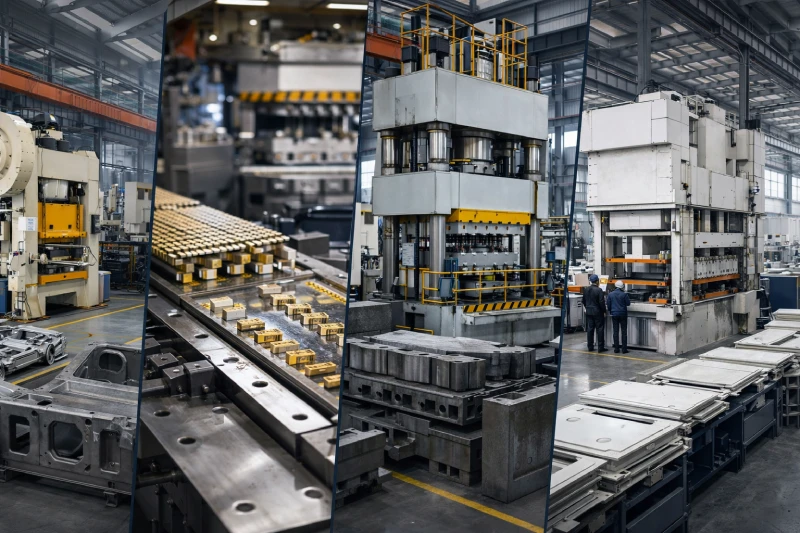
Automotive Applications
Automotive manufacturers often require high-volume production, large tonnage, and integrated automation. Mechanical press manufacturers and large custom press manufacturers are usually the best choice for this industry.
They can provide complete stamping lines with feeders, transfer systems, and robotic handling for body panels, brackets, and structural parts.
Learn more in our guide to automotive stamping press applications.
Electronics Applications
Electronics and precision component manufacturers typically need high-speed, high-accuracy equipment. High-speed press manufacturers are usually the best fit because they focus on small, precise parts and stable long-term production.
These manufacturers often provide advanced control systems and automation designed for terminals, connectors, laminations, and electronic components.
Related reading: stamping press for electronics manufacturing.
Heavy-Duty Applications
Heavy-duty industries such as construction equipment, steel products, and industrial machinery usually require large-capacity presses and reinforced machine frames. Hydraulic press manufacturers are often the preferred option because they can provide higher force, larger beds, and longer stroke requirements.
These projects may also require customized hydraulic systems and special tooling support.
Large-Part Applications
If you produce large panels, appliance housings, kitchen sinks, truck parts, or oversized metal components, a custom press manufacturer is often the best choice. These manufacturers can design a machine with the correct table size, opening height, and automation layout for large parts.
Standard press manufacturers may not be able to provide the bed size or working space required.
You can learn more in our article about stamping presses for large parts.
Request a Custom Stamping Press Recommendation
Choosing the right stamping press manufacturer starts with understanding your product requirements. The more information you provide, the easier it is to recommend the right machine.
Send us your part drawing, material information, and production target. Our engineering team can help you:
- Recommend the correct tonnage and stroke
- Evaluate whether a mechanical, hydraulic, or custom press is best
- Suggest automation and layout options
- Provide a customized machine proposal based on your application
Contact us today to get a stamping press solution designed specifically for your production line.
