
Manufacturers often assume that faster stamping is always better. In reality, choosing between high-speed stamping and conventional stamping depends on the part, annual volume, material thickness, tooling cost, and production goals.
High-speed stamping is designed for mass production of small, repeatable metal parts at extremely high stroke rates. Conventional stamping runs slower but offers more flexibility for larger, thicker, or more complex components.
If you are deciding whether to invest in a high-speed press or continue using conventional stamping equipment, this guide compares both processes in terms of speed, cost, precision, materials, and typical applications.
What Is the Difference Between High-Speed and Conventional Stamping?
High-speed stamping uses presses that typically operate between 300 and 1,500+ strokes per minute. These machines are built for continuous, high-volume production of small parts such as electrical terminals, connector pins, battery tabs, and electronic components.
Conventional stamping usually runs between 20 and 150 strokes per minute. It is commonly used for larger parts, thicker materials, and production environments where product designs or volumes change more frequently.
The biggest difference is not simply machine speed—it is production philosophy.
- High-speed stamping focuses on maximum throughput and lowest cost per part over very large production runs.
- Conventional stamping focuses on flexibility, broader material compatibility, and easier setup changes.
| Factor | High-Speed Stamping | Conventional Stamping |
|---|---|---|
| Typical Stroke Rate | 300–1,500+ SPM | 20–150 SPM |
| Best Part Size | Small, thin parts | Medium to large parts |
| Typical Production Volume | Very high | Low to medium |
| Tooling Complexity | High | Moderate |
| Best Use Case | Repeatable mass production | Flexible manufacturing |
Production Speed and Output Comparison
The main advantage of high-speed stamping is output. A high-speed press can produce several hundred thousand parts per shift, depending on part size and tooling design. For manufacturers producing electronic contacts or small precision components, this dramatically reduces labor cost and cost per piece.
By comparison, conventional stamping produces fewer parts per hour, but it is often more efficient for jobs that require:
- Frequent die changes
- Multiple material thicknesses
- Larger or heavier parts
- Lower annual volumes
| Production Factor | High-Speed Stamping | Conventional Stamping |
|---|---|---|
| Strokes Per Minute | 300–1,500+ | 20–150 |
| Output Per Shift | Extremely high | Moderate |
| Setup Frequency | Low | Higher |
| Best For | Long production runs | Mixed production |
However, faster is not always better.
If the die is not optimized, running at excessive speed can increase:
- Scrap rate
- Tool wear
- Maintenance downtime
- Material feeding problems
For example, a manufacturer producing 50,000 connector pins per day may benefit greatly from high-speed stamping. But a company making 5,000 different brackets each month may lose efficiency because setup changes and tooling adjustments take too much time.
The real question is not “Which process is faster?” but “Which process creates the highest overall efficiency for your production mix?”
Precision, Repeatability, and Part Quality
High-speed stamping is often associated with excellent repeatability. Because the process is designed for stable, continuous operation, it can maintain tight tolerances over millions of cycles.
This makes it ideal for:
- Electronic terminals
- Precision battery contacts
- Connector pins
- Thin-gauge stainless steel parts
- Small components with very tight dimensional requirements
When the die and feeding system are properly designed, high-speed stamping can produce highly consistent parts with minimal variation.
Conventional stamping, however, has an advantage when the part is more complicated.
For example, larger formed parts often require:
- Slower forming speed
- More press force
- Multiple forming stages
- Manual process adjustment
Conventional presses give operators more flexibility to adjust stroke length, dwell time, and forming parameters. This can improve quality for deep-drawn, bent, or structurally complex parts.
| Quality Factor | High-Speed Stamping | Conventional Stamping |
|---|---|---|
| Repeatability | Excellent | Good |
| Tight Tolerances | Best for small parts | Best for larger formed parts |
| Process Flexibility | Limited | High |
| Complex Forming Capability | Moderate | Strong |
In other words, high-speed stamping usually produces better consistency, while conventional stamping often produces better results for complex geometries.
Material Thickness and Part Compatibility
Material thickness is one of the most important factors when choosing between these two methods.
High-speed stamping works best with thin materials that feed easily through the die at high speed. Typical materials include:
- Copper
- Brass
- Thin stainless steel
- Aluminum
- Electrical contact alloys
These materials are commonly used in electronics, battery manufacturing, and electrical connectors.
Typical thickness range for high-speed stamping:
- Approximately 0.05–1.5 mm
Conventional stamping is usually the better choice for thicker or harder materials. Examples include:
- Structural steel
- Heavy-gauge stainless steel
- Automotive sheet metal
- Large aluminum panels
- Deep-drawn parts
Typical thickness range for conventional stamping:
- Approximately 1.5–6+ mm
| Material or Part Type | Recommended Process |
|---|---|
| Thin copper terminal | High-Speed Stamping |
| Battery tab | High-Speed Stamping |
| Connector pin | High-Speed Stamping |
| Automotive bracket | Conventional Stamping |
| Appliance housing panel | Conventional Stamping |
| Deep-drawn steel component | Conventional Stamping |
Tooling Cost, Maintenance, and Production Economics
One of the biggest differences between the two processes is the cost structure.
High-speed stamping typically requires:
- More sophisticated dies
- Higher precision tooling
- Advanced feeding systems
- Better lubrication systems
- More expensive presses
As a result, the upfront investment is significantly higher.
However, once production volume becomes very large, the cost per part drops quickly. The more parts you produce, the easier it becomes to justify the investment.
Conventional stamping is usually easier and cheaper to start with. Tooling costs are lower, setup is simpler, and the process works well for short production runs.
| Cost Factor | High-Speed Stamping | Conventional Stamping |
|---|---|---|
| Initial Machine Cost | High | Lower |
| Tooling Cost | High | Moderate |
| Maintenance Requirement | Higher | Lower |
| Cost Per Part at High Volume | Very Low | Higher |
| Best for Small Production Runs | No | Yes |
A useful way to think about the decision is production volume.
| Annual Production Volume | Better Choice | Reason |
|---|---|---|
| Under 100,000 parts | Conventional Stamping | Lower investment and more flexibility |
| 100,000–1,000,000 parts | Depends | Evaluate tooling and labor savings |
| Over 1,000,000 parts | High-Speed Stamping | Lowest cost per part |
For example, if you only produce 50,000 parts per year, the savings from high-speed production may never offset the cost of specialized tooling.
But if you produce 10 million electrical contacts annually, high-speed stamping is usually the most economical choice.
CTA: Not sure where your break-even point is? Send us your part drawing, material thickness, and annual production volume. Our engineers can recommend whether high-speed or conventional stamping will provide the lowest total production cost.
Typical Applications for Each Process
Although there is some overlap, the two methods are usually used in different industries and product categories.
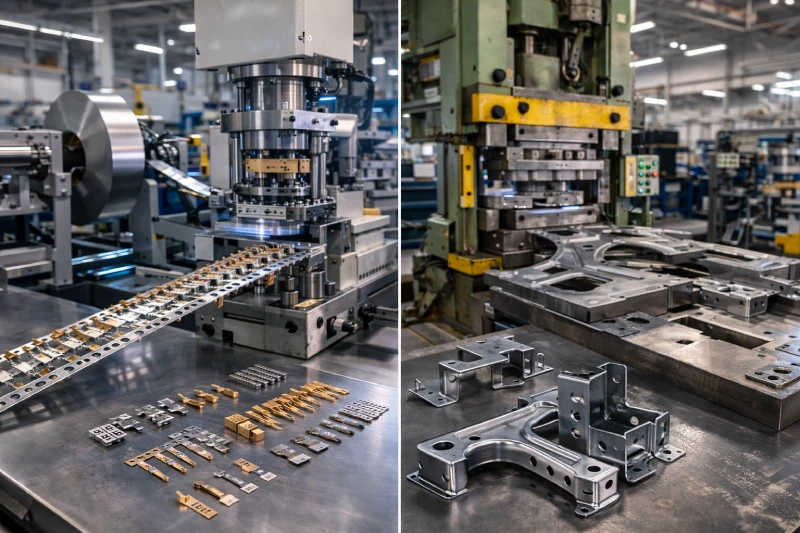
Typical High-Speed Stamping Applications
- Electrical terminals
- Connector pins
- Lead frames
- Battery tabs
- Precision shielding parts
- Consumer electronics components
- Small metal parts for medical devices
Typical Conventional Stamping Applications
- Automotive brackets
- Appliance panels
- Structural supports
- Heavy-duty industrial components
- Large metal housings
- Deep-drawn metal parts
| Industry | High-Speed Stamping | Conventional Stamping |
|---|---|---|
| Electronics | Connector pins, terminals | Large housings |
| Automotive | Small clips and contacts | Brackets and body parts |
| Medical | Small precision metal parts | Larger formed components |
| Appliances | Small clips and terminals | Outer panels and frames |
Many factories actually use both processes.
For example, an automotive manufacturer may use:
- High-speed stamping for small electrical connectors
- Conventional stamping for brackets, housings, and structural body parts
That is why the best solution is often based on the specific part rather than the overall industry.
How to Choose Between High-Speed and Conventional Stamping
When choosing between the two methods, ask yourself five questions:
- What is your annual production volume?
- How thick is the material?
- How complex is the part geometry?
- How important is low cost per part?
- How often will the design change?
Choose high-speed stamping if:
- Your annual volume is very high
- The part is small and repeatable
- The material is thin
- You need the lowest possible cost per part
- Tooling changes are rare
Choose conventional stamping if:
- Production volume is low or medium
- The part is large or thick
- Product designs change frequently
- You need more flexibility
- The geometry requires more forming control
| If Your Priority Is… | Best Choice |
|---|---|
| Lowest cost per part at high volume | High-Speed Stamping |
| Flexible manufacturing | Conventional Stamping |
| Small precision parts | High-Speed Stamping |
| Large or complex parts | Conventional Stamping |
| Lower upfront investment | Conventional Stamping |
Conclusion
There is no universal winner in the high-speed stamping vs conventional stamping debate.
High-speed stamping is the better choice for thin materials, small parts, and very large production volumes where low cost per part matters most.
Conventional stamping is the better choice for larger components, thicker materials, shorter production runs, and manufacturing environments that require flexibility.
The right process depends on your specific part design, annual volume, material, and budget.
If you are unsure which option is best, contact our engineering team with your drawings and production targets. We can help you choose the most efficient stamping process and recommend the right press system for your factory.
