
Puzzle quality begins long before the cutting process starts—it begins with the cutting die itself. In industrial puzzle production, the puzzle cutting die is the tooling responsible for creating every interlocking piece shape, ensuring consistent fit, clean edges, and repeatable production results. Whether manufacturing children’s puzzles, educational products, or high-piece-count jigsaw puzzles, die accuracy directly affects the final product quality.
A well-designed die helps manufacturers achieve precise cuts, minimize material waste, and maintain stable production performance over thousands of cycles. Conversely, poorly manufactured or worn tooling can lead to incomplete cuts, mismatched pieces, and increased maintenance costs. Understanding how puzzle cutting dies are designed, manufactured, and maintained is essential for companies investing in modern puzzle production machinery and seeking higher standards of puzzle cutting quality and efficiency.
What Is a Puzzle Cutting Die?
A puzzle cutting die is a specialized tooling system used to cut printed puzzle boards into individual interlocking puzzle pieces. It serves as the physical template that defines the shape, size, and arrangement of every puzzle piece produced during industrial manufacturing. Unlike digital cutting technologies used for prototypes or small production runs, puzzle cutting dies are designed for high-volume production where consistency and repeatability are critical.
The primary function of a puzzle cutting die is to transfer cutting force through precisely shaped steel blades, allowing the puzzle board material to be cut accurately in a single operation. Every knob, socket, curve, and edge found on a finished puzzle originates from the die design itself. As a result, the quality of the tooling has a direct impact on piece fit, edge cleanliness, and overall product quality.
Industrial puzzle cutting dies are engineered to withstand repeated production cycles while maintaining dimensional accuracy. Compared with consumer-grade craft dies, industrial dies use stronger materials, tighter manufacturing tolerances, and more sophisticated blade configurations. This ensures reliable performance when producing thousands or even millions of puzzle sets.
For puzzle manufacturers, the cutting die is not simply a tool—it is a precision-engineered asset that determines the consistency and quality of the final product.
Main Components of a Puzzle Cutting Die
A puzzle cutting die consists of several precisely engineered components that work together to achieve accurate and repeatable cutting performance. Each element plays a specific role in ensuring puzzle pieces are produced with consistent dimensions and clean edges.
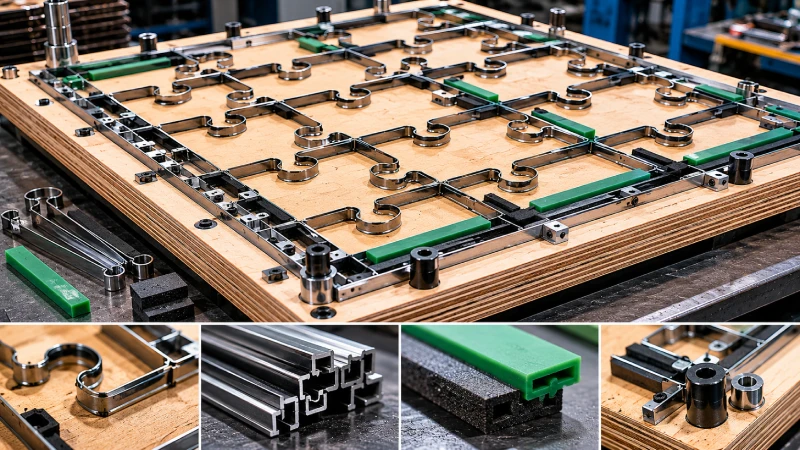
Die Board Structure
The die board serves as the foundation of the tooling assembly. Typically manufactured from high-quality plywood, the board is laser-cut to create narrow slots that match the puzzle pattern design. These slots hold the steel rule blades in position and provide the structural stability required during repeated cutting cycles. A well-manufactured die board helps maintain dimensional accuracy and prevents blade movement over time.
Steel Rule Blades
Steel rule blades are the actual cutting elements within the die. Made from hardened steel strips, these blades are formed into intricate puzzle piece shapes before being inserted into the die board. Blade height, thickness, and edge profile must be carefully selected to suit the puzzle material being cut. High-quality steel rules contribute directly to cleaner cuts, longer tool life, and improved cutting precision.
Ejection Rubber
Ejection rubber is installed alongside the cutting blades to assist material release after each cutting operation. When pressure is applied, the rubber compresses and then expands as the press opens, helping separate the puzzle board from the die. Properly positioned ejection rubber reduces material sticking, minimizes downtime, and improves overall production consistency.
Registration and Alignment Features
Industrial puzzle dies often incorporate alignment features that ensure accurate positioning during cutting. These components help maintain repeatability between production runs and prevent dimensional variation caused by misalignment. Consistent registration is essential for achieving uniform puzzle piece geometry and maintaining high-quality production standards.
How Steel Rule Puzzle Dies Are Manufactured
The performance and longevity of a puzzle cutting die depend heavily on the manufacturing process used to produce it. Modern steel rule puzzle dies are built through a series of precision-controlled steps designed to ensure accuracy, durability, and repeatable cutting performance.
Step 1 – Puzzle Pattern Design
The process begins with the creation of a digital puzzle layout using CAD software. Engineers design the piece pattern, interlocking geometry, and overall puzzle dimensions while considering manufacturing feasibility and cutting efficiency. The accuracy of this design stage directly affects the quality of the finished die.
Step 2 – Laser Cutting the Die Board
Once the design is finalized, a high-quality plywood die board is laser cut according to the digital pattern. Narrow slots are created to receive the steel rule blades. Precision during this stage is essential because even small dimensional deviations can affect blade positioning and cutting consistency.
Step 3 – Forming and Inserting Steel Rules
Hardened steel rule strips are shaped to match the puzzle pattern and carefully inserted into the laser-cut slots. Complex puzzle designs often require intricate bends and tight radii, making this one of the most skilled stages of die manufacturing.
Step 4 – Rubber Installation and Finishing
After the blades are installed, ejection rubber is positioned alongside the cutting rules. The rubber assists material release during operation and helps maintain production efficiency. Additional finishing and alignment checks are then performed.
Step 5 – Trial Cutting and Validation
Before entering production, the completed die undergoes trial cutting tests. Sample cuts are inspected for accuracy, edge quality, and piece fit to verify that the tooling meets manufacturing requirements.
How Puzzle Cutting Dies Actually Cut Puzzle Boards
Although a puzzle cutting die appears to be a relatively simple tooling assembly, its cutting action is based on a highly controlled mechanical process. The goal is to create thousands of accurately shaped puzzle pieces while maintaining consistent quality throughout production.
Pressure Transfer During Die Cutting
During operation, cutting force is applied from the press to the puzzle cutting die. As pressure increases, the sharpened steel rule blades penetrate the puzzle board material. The cutting force must be evenly distributed across the entire die surface to ensure all areas of the puzzle are cut consistently. Uneven pressure can result in incomplete cuts, excessive material deformation, or dimensional variation between puzzle pieces.
Separation of Puzzle Pieces
Once the blades penetrate the material, the puzzle board is sheared along the cutting lines defined by the die pattern. Unlike individual cutting operations, industrial puzzle dies cut the entire puzzle layout simultaneously. This allows manufacturers to achieve high levels of consistency while producing large quantities of identical puzzles. The quality of the cutting edge directly affects the cleanliness of the finished piece boundaries.
Maintaining Consistent Piece Geometry
Achieving uniform puzzle piece geometry requires more than sharp blades alone. Proper die construction, accurate alignment, and stable press conditions all contribute to repeatable results. Even minor tooling deviations can influence piece dimensions and interlocking performance. For manufacturers seeking greater process consistency, understanding the principles of industrial puzzle die cutting is essential for optimizing tooling performance and maintaining product quality over long production runs.
Cutting Blade Design and Why It Matters
The cutting blade is the most critical functional element of a puzzle cutting die. While the overall die structure provides support and positioning, it is the blade design that determines cutting quality, tool durability, and the final appearance of puzzle pieces. Even small differences in blade specifications can significantly affect production performance.
Blade Height Selection
Blade height must be selected according to the thickness of the puzzle board and the operating characteristics of the cutting press. If the blade is too low, incomplete cuts may occur. If it is too high, excessive pressure may be required, accelerating wear on both the die and the press. Proper blade height helps achieve clean cuts while maintaining stable production conditions.
Blade Thickness and Rigidity
Blade thickness influences both durability and cutting precision. Thicker steel rules generally provide greater rigidity and resistance to deformation, making them suitable for long production runs. However, excessively thick blades can reduce flexibility when forming complex puzzle patterns. Manufacturers must balance strength and precision when selecting blade specifications.
Interlocking Knob Design
The shape of each interlocking knob and socket is created by the blade profile. Well-designed interlocks improve puzzle assembly performance by providing secure piece engagement while maintaining a satisfying user experience. Consistent interlocking geometry also helps reduce fit-related quality issues.
Complexity vs Manufacturability
Highly intricate puzzle piece designs may enhance product uniqueness, but they also increase tooling complexity and manufacturing difficulty. Tight curves, small radii, and unusual piece shapes can accelerate blade wear and complicate die fabrication. Effective blade design balances visual complexity with practical manufacturing requirements, ensuring both production efficiency and long-term tooling reliability.
Factors That Affect Puzzle Cutting Precision
Achieving consistent puzzle quality requires more than a well-designed die. Puzzle cutting precision is influenced by multiple factors throughout the tooling and cutting process. Understanding these variables helps manufacturers maintain tighter tolerances, reduce defects, and improve overall production consistency.
Die Manufacturing Accuracy
Precision begins during die fabrication. The accuracy of laser-cut die board slots, steel rule forming, and blade positioning directly affects the final dimensions of puzzle pieces. Even small manufacturing deviations can alter interlocking geometry and create noticeable differences in piece fit. High-quality tooling manufacturers typically maintain strict tolerances to ensure repeatable cutting performance.
Material Thickness Variation
Puzzle boards are not always perfectly uniform in thickness. Variations in chipboard density, laminated paper layers, or adhesive distribution can influence how the material responds to cutting pressure. Inconsistent material thickness may result in uneven cut depth, increased blade stress, or occasional incomplete cuts.
Press Setup Conditions
Proper press setup is essential for maintaining precision. Factors such as pressure distribution, machine alignment, and cutting surface condition all affect the quality of the finished puzzle pieces. Uneven force across the die can lead to dimensional inconsistencies and accelerated tooling wear.
Tool Wear Over Time
As steel rule blades experience repeated cutting cycles, their cutting edges gradually become less sharp. Blade wear increases cutting resistance and can reduce dimensional accuracy. Regular inspection and maintenance help identify wear before it negatively impacts production quality.
Environmental Factors
Environmental conditions can also affect cutting precision. Changes in humidity and temperature may cause die boards and puzzle materials to expand or contract slightly. Over time, these dimensional changes can influence alignment and cutting consistency. Manufacturers seeking higher levels of puzzle cutting precision should implement proper tooling storage practices and maintain stable production environments whenever possible.
Common Puzzle Die Wear Problems
Like any production tooling, puzzle cutting dies experience wear over time. Continuous cutting cycles, material resistance, and environmental conditions gradually affect die performance. Identifying wear-related issues early helps manufacturers maintain cutting quality, reduce downtime, and extend tooling lifespan.
Dull Cutting Edges
One of the most common wear problems is blade edge dulling. As steel rule blades repeatedly penetrate puzzle board materials, their cutting edges gradually lose sharpness. Dull blades require greater cutting force and may produce incomplete cuts, rough edges, or increased material tearing. Regular inspections help detect blade wear before product quality is affected.
Blade Deformation
Excessive cutting pressure, improper handling, or accidental impacts can cause steel rule blades to bend or deform. Even slight blade distortion can alter puzzle piece dimensions and compromise interlocking accuracy. Deformed blades often create inconsistent cuts that become more noticeable during long production runs.
Die Board Damage
The die board itself is subject to wear and structural degradation. Repeated loading cycles, moisture exposure, and improper storage conditions can contribute to cracking, warping, or enlargement of blade slots. When the die board loses stability, blade positioning accuracy may also deteriorate.
Rubber Deterioration
Ejection rubber gradually loses elasticity after prolonged use. Hardened, cracked, or compressed rubber may fail to release material efficiently after cutting. This can increase material sticking, slow production rates, and place additional stress on the tooling system.
Registration Accuracy Loss
Over time, wear affecting blades, die boards, or alignment components can reduce registration accuracy. Small positioning errors may accumulate and lead to dimensional inconsistencies between production batches. Maintaining alignment integrity is essential for preserving puzzle piece consistency and overall product quality.
Puzzle Die Lifespan: How Long Does a Puzzle Cutting Die Last?
The lifespan of a puzzle cutting die can vary significantly depending on tooling quality, production volume, material characteristics, and maintenance practices. While there is no universal service life applicable to every die, understanding the factors that influence wear helps manufacturers plan maintenance schedules and replacement strategies more effectively.
Factors Influencing Lifespan
Several variables affect how long a puzzle die remains capable of delivering accurate cuts. These include steel rule quality, blade thickness, cutting pressure, puzzle board density, and environmental conditions. High-quality materials and proper operating practices generally contribute to longer service life and more consistent performance.
Typical Production Cycles
Industrial puzzle dies are designed to withstand repeated cutting operations over extended periods. Depending on the complexity of the design and the materials being processed, a well-maintained die may remain productive through thousands or even hundreds of thousands of cutting cycles. Production volume alone does not determine lifespan; operating conditions and maintenance quality are equally important.
When Should a Die Be Replaced?
Replacement becomes necessary when wear begins to affect cutting accuracy, piece fit, or production efficiency. Common indicators include recurring incomplete cuts, increased cutting force requirements, excessive blade deformation, or deteriorating registration accuracy. In some cases, individual components can be repaired or replaced. However, when overall tooling performance declines beyond acceptable limits, investing in a new die often becomes the most cost-effective solution.
Maintenance Requirements for Puzzle Cutting Dies
Proper maintenance is essential for preserving the performance, accuracy, and lifespan of a puzzle cutting die. Even high-quality tooling will experience gradual wear during normal operation. Establishing a structured maintenance program helps manufacturers maintain consistent cutting quality while reducing unexpected downtime and costly repairs.
Daily Maintenance Tasks
Routine maintenance should begin with daily visual inspections. Operators should check for material buildup, damaged blades, loose components, and signs of excessive wear. Removing paper dust, adhesive residue, and cutting debris helps prevent contamination from affecting cutting performance. Keeping the die clean also reduces unnecessary stress on the tooling assembly.
Periodic Maintenance
In addition to daily inspections, puzzle dies require scheduled maintenance at regular intervals. This may include verifying blade alignment, checking die board integrity, inspecting ejection rubber condition, and evaluating registration accuracy. Components showing early signs of wear can often be repaired or replaced before they affect production quality. Preventive servicing helps maintain dimensional consistency over longer production runs.
Proper Storage Procedures
Storage conditions play an important role in die longevity. Puzzle cutting dies should be stored in a clean, dry environment away from excessive humidity, temperature fluctuations, and direct physical impact. Protective covers or dedicated storage racks help prevent blade damage and preserve alignment accuracy when tooling is not in use.
Preventive Maintenance Benefits
A proactive maintenance strategy delivers long-term operational advantages. Regular inspections and timely repairs help extend tool life, improve cutting consistency, and reduce the risk of unexpected production interruptions. For manufacturers producing high volumes of puzzles, preventive maintenance is often one of the most effective ways to protect tooling investments and maintain stable product quality.
How to Choose a Reliable Puzzle Die Manufacturer
Selecting the right puzzle die manufacturer is an important decision for companies that depend on consistent cutting quality and long-term tooling performance. While pricing is often a consideration, factors such as engineering expertise, manufacturing accuracy, and technical support typically have a greater impact on overall production results.
Engineering Capability
A reliable manufacturer should possess strong design and engineering capabilities. This includes experience with CAD-based puzzle pattern development, steel rule forming techniques, and precision die board manufacturing. Advanced engineering resources help ensure that complex puzzle designs can be translated into accurate and durable tooling.
Experience with Puzzle Tooling
Puzzle dies present unique challenges compared to many other die-cutting applications. Manufacturers with specialized experience in puzzle tooling are often better equipped to optimize interlocking piece geometry, cutting performance, and tooling durability. Their expertise can help reduce development time and improve final product quality.
Quality Control Standards
Consistent quality requires robust inspection procedures throughout the manufacturing process. Reputable suppliers typically perform dimensional verification, blade positioning checks, and trial cutting tests before delivering finished tooling. These measures help identify potential issues before the die enters production.
After-Sales Support
Technical support remains valuable even after the die has been delivered. Manufacturers that offer maintenance guidance, repair services, replacement components, and tooling refurbishment support can help extend die lifespan and maintain cutting performance over time.
FAQs
What material is used for puzzle cutting dies?
Most industrial puzzle cutting dies use hardened steel rule blades mounted within a laser-cut plywood die board. The steel rules provide the cutting edges, while the die board serves as the structural framework that maintains blade positioning and dimensional accuracy.
How accurate are industrial puzzle cutting dies?
High-quality puzzle dies are manufactured to very tight tolerances. Accuracy depends on factors such as die board precision, blade forming quality, press setup, and ongoing maintenance. Properly maintained tooling can consistently produce puzzle pieces with highly repeatable dimensions.
How many cuts can a puzzle die perform?
There is no fixed number because lifespan varies according to material type, production volume, cutting pressure, and maintenance practices. Well-manufactured dies can often perform thousands or even hundreds of thousands of cutting cycles before major refurbishment or replacement becomes necessary.
Can damaged puzzle dies be repaired?
In many cases, yes. Individual steel rule blades, ejection rubber components, and certain alignment features can often be repaired or replaced. However, severe die board damage or extensive structural wear may make complete replacement a more practical solution.
How often should puzzle dies be maintained?
Basic inspections and cleaning should be performed daily during active production. More detailed maintenance procedures, including alignment verification and component inspection, should be scheduled periodically based on production volume and tooling usage.
What causes puzzle pieces to fit poorly?
Poor puzzle piece fit is commonly caused by blade wear, dimensional inaccuracies, die deformation, alignment problems, or inconsistent cutting conditions. Material variations and inadequate maintenance can also contribute to fit-related issues.
Are steel rule dies still the industry standard?
Yes. Steel rule dies remain the most widely used tooling solution for industrial puzzle production because they provide an effective balance of precision, durability, manufacturing flexibility, and cost efficiency. They are particularly well suited for medium- and high-volume puzzle manufacturing applications where repeatable cutting quality is essential.
Conclusion
Puzzle cutting dies are the foundation of high-quality puzzle production. From die board construction and steel rule blade design to maintenance practices and lifespan management, every aspect of the tooling influences cutting accuracy, piece consistency, and long-term manufacturing performance. Even the most advanced production equipment cannot compensate for poorly designed or worn tooling.
Manufacturers that invest in precision die manufacturing, routine maintenance, and proper storage procedures are better positioned to achieve cleaner cuts, longer tool life, and more reliable production results. Understanding how puzzle cutting dies work also makes it easier to identify wear-related issues before they impact product quality.
For companies planning new puzzle production projects or expanding existing operations, selecting the right tooling should be considered just as important as choosing the appropriate puzzle production machinery. Together, quality equipment and precision tooling create the foundation for efficient and consistent puzzle manufacturing.
