
Modern manufacturing often requires far more than a standard off-the-shelf press machine. Different products, production speeds, component sizes, and automation requirements mean that many factories need customized assembly solutions designed specifically for their process. Whether the application involves automotive parts, electronic components, heavy machinery, or precision industrial products, a custom assembly press can improve production consistency, reduce labor costs, and increase assembly accuracy.
However, selecting the right custom assembly press manufacturer is just as important as choosing the machine itself. A capable manufacturer can help optimize your production line, while an inexperienced supplier may create costly delays or performance problems. This guide explains when custom assembly presses are necessary, what can be customized, and how to choose the right manufacturing partner for your project.
When Do You Need a Custom Assembly Press?
Not every production process requires a custom-built press system. Standard assembly presses are suitable for many simple operations. However, certain manufacturing conditions make custom equipment the better long-term solution.
Non-Standard Part Sizes or Shapes
Many industrial components do not fit traditional press dimensions or tooling configurations. Large frames, asymmetrical components, deep housings, or fragile precision parts may require specially designed fixtures, custom tooling, or unique press structures.
For example, automotive transmission assemblies often involve complex alignment requirements that standard machines cannot handle efficiently. In these situations, manufacturers design customized fixtures and motion systems to ensure repeatable positioning accuracy.
Special Force Requirements
Some assembly processes require extremely high force, while others require very delicate and precisely controlled pressing operations. Standard presses may not provide the necessary flexibility.
Custom assembly presses can be engineered for:
- High-tonnage industrial assembly
- Low-force precision insertion
- Multi-stage pressing operations
- Variable force profiles
- Force-displacement monitoring
This level of customization helps prevent component damage and improves assembly quality consistency.
Automation Integration Requirements
Modern production lines increasingly rely on automation. Many factories need assembly presses integrated with:
- Robotic loading systems
- Vision inspection systems
- Conveyor systems
- Barcode scanning
- MES production monitoring
- Data collection software
A custom assembly press manufacturer can design the equipment to fit directly into the customer’s existing production environment, reducing integration complexity later.
What Can a Custom Assembly Press Manufacturer Customize?
One of the biggest advantages of working with a custom assembly press manufacturer is flexibility. Nearly every part of the machine can be modified to match production requirements.
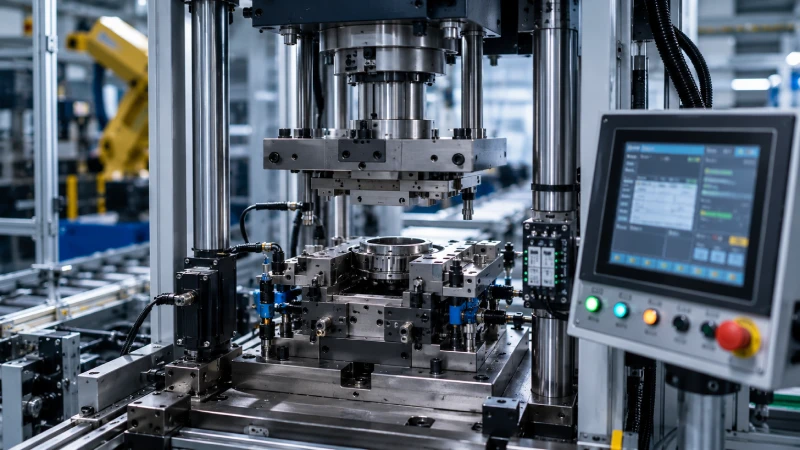
Force Capacity
Press force is one of the most important specifications. Manufacturers can customize machines from small precision presses to large heavy-duty hydraulic systems.
The required tonnage depends on:
- Material type
- Component dimensions
- Press-fit interference
- Assembly tolerance
- Production speed
Choosing the correct force capacity helps balance performance, cost, and energy efficiency.
Stroke Length
Different applications require different stroke distances. A shallow bearing insertion operation may only require a short stroke, while frame assembly applications may need significantly longer travel distances.
Custom stroke design improves cycle efficiency while reducing unnecessary machine movement.
Tooling Design
Tooling directly affects assembly precision and repeatability. Custom tooling may include:
- Multi-position tooling
- Quick-change systems
- Precision alignment tooling
- Floating tooling structures
- Anti-scratch surfaces
Good tooling design also improves maintenance efficiency and reduces downtime.
Fixtures and Workholding
Custom fixtures help secure parts during assembly operations. Proper fixture design improves:
- Alignment accuracy
- Operator safety
- Cycle consistency
- Changeover efficiency
For automated lines, fixtures may also include sensors or robotic interfaces.
PLC Systems and Sensors
Modern assembly presses increasingly rely on intelligent control systems. Manufacturers can customize:
- PLC brands
- HMI interfaces
- Servo motion systems
- Pressure sensors
- Linear position sensors
- Vision inspection systems
- Data collection functions
These features help manufacturers achieve better process control and quality traceability.
Key Factors to Consider When Choosing a Custom Manufacturer
Not all assembly press suppliers have the same engineering capabilities. Choosing the right partner requires evaluating more than just machine pricing.
Engineering Capability
A strong engineering team is essential for successful custom projects. The manufacturer should understand:
- Mechanical design
- Hydraulic or servo systems
- Industrial automation
- Safety standards
- Tooling integration
Experienced engineering teams can also help optimize the production process rather than simply building equipment based on drawings.
Industry Experience
Different industries have different assembly requirements. A manufacturer with automotive experience may better understand precision alignment and traceability, while another supplier may specialize in heavy industrial equipment.
Ask whether the supplier has experience with applications similar to yours.
Design and Technical Support
Good manufacturers support customers throughout the project lifecycle, including:
- Initial feasibility analysis
- 3D layout design
- Process optimization
- Sample testing
- Installation support
- Operator training
Early-stage engineering communication often determines whether the project succeeds smoothly.
Lead Time and Production Capacity
Custom equipment takes longer to build than standard machines. However, reliable manufacturers should still provide:
- Realistic project schedules
- Clear milestone planning
- Stable supply chain management
- Factory testing timelines
Extremely short promised lead times may indicate unrealistic planning.
After-Sales Service
Long-term technical support is critical for industrial equipment. Before selecting a supplier, evaluate:
- Spare parts availability
- Remote technical support
- On-site service capability
- Maintenance training
- Warranty terms
Reliable after-sales support reduces production downtime and protects long-term investment value.
Standard vs Custom Assembly Press
Choosing between a standard machine and a custom-built press depends on production complexity, budget, and automation requirements.
| Feature | Standard Assembly Press | Custom Assembly Press |
|---|---|---|
| Delivery Time | Faster | Longer |
| Initial Cost | Lower | Higher |
| Flexibility | Limited | High |
| Automation Compatibility | Basic | Advanced |
| Fixture Design | Generic | Application-specific |
| Process Optimization | Limited | Fully optimized |
| Future Scalability | Moderate | Excellent |
| Precision Control | Standard | Customizable |
Standard machines are often suitable for simple applications or small production volumes. However, custom assembly presses provide better long-term efficiency for complex or high-volume manufacturing environments.
For companies still comparing supplier types, it is also useful to read more about choosing an assembly press manufacturer before starting a custom equipment project.
Questions to Ask Before Starting a Custom Assembly Press Project
Before beginning a project, manufacturers and buyers should clearly define technical requirements. Asking the right questions early helps avoid costly changes later.
What Drawings or Samples Are Required?
Most custom press manufacturers will request:
- Part drawings
- Assembly tolerances
- CAD files
- Product samples
- Production flow information
Providing accurate technical data improves design accuracy and reduces development time.
How Long Does Development Take?
Custom press development timelines vary depending on project complexity. A typical project may include:
- Technical discussion
- Concept design
- Engineering approval
- Manufacturing
- Assembly and wiring
- Factory testing
- Shipment and installation
Simple projects may take several weeks, while large automated systems may require several months.
What Testing Will Be Provided?
Before shipment, manufacturers should perform factory acceptance testing (FAT). Common testing includes:
- Force accuracy testing
- Repeatability testing
- Sensor verification
- Safety testing
- Production simulation
Some suppliers also provide video testing reports or customer on-site inspection opportunities before delivery.
Can the System Be Expanded Later?
Production requirements often change over time. It is helpful to ask whether the machine design allows future upgrades such as:
- Additional automation modules
- Vision inspection systems
- Data collection functions
- Multi-station expansion
A scalable design protects future production flexibility.
Conclusion
A custom assembly press can significantly improve production efficiency, precision, and automation capability when standard equipment cannot meet process requirements. However, successful implementation depends heavily on choosing the right manufacturing partner.
The best custom assembly press manufacturers offer more than machine production — they provide engineering expertise, process optimization, automation integration, and long-term technical support. By carefully evaluating engineering capability, industry experience, customization flexibility, and service quality, manufacturers can build more reliable and efficient production lines for long-term growth.
If your production process involves specialized assembly requirements, working with an experienced custom assembly press manufacturer can help you achieve higher consistency, lower operating costs, and better manufacturing performance.
