
Choosing between a stamping press and a hydraulic press is one of the most important decisions in any metal forming operation. Both machines can produce high-quality parts, but they work in very different ways and are designed for different production goals.
In most industrial environments, a “stamping press” usually refers to a mechanical stamping press driven by a flywheel and crankshaft. A hydraulic press uses hydraulic cylinders to generate force. The result is a clear trade-off:
- A stamping press is usually faster and better for high-volume production.
- A hydraulic press provides more forming flexibility and full tonnage throughout the stroke.
The right choice depends on your part geometry, material thickness, production volume, tooling, and budget.
What Is the Difference Between a Stamping Press and a Hydraulic Press?
A mechanical stamping press creates force through a rotating flywheel connected to a crank mechanism. This design allows the ram to move extremely quickly and repeatedly, making it ideal for mass production.
A hydraulic press creates force through hydraulic fluid and cylinders. Instead of relying on a fixed mechanical stroke, the ram can move more slowly and with greater control.
The biggest difference is how force is delivered:
- A stamping press reaches maximum tonnage near the bottom of the stroke.
- A hydraulic press can apply full force during the entire stroke.
That difference has a major effect on which machine works best for different parts.
Stamping Press vs Hydraulic Press: Side-by-Side Comparison
| Factor | Stamping Press | Hydraulic Press |
|---|---|---|
| Speed | Very fast | Slower |
| Force Delivery | Maximum force near bottom of stroke | Full force through entire stroke |
| Stroke Length | Fixed and limited | Adjustable |
| Precision | Excellent for repetitive parts | Excellent for controlled forming |
| Best Material Thickness | Thin to medium sheet metal | Medium to thick materials |
| Tooling Flexibility | Lower | Higher |
| Energy Efficiency | Better in high-volume production | Better for variable production |
| Maintenance | Mechanical wear components | Hydraulic seals and fluid system |
| Initial Cost | Often lower | Often higher |
| Best For | Progressive dies, high-volume stamping | Deep drawing, forming, thick parts |
In simple terms, a stamping press is designed for speed and repeatability, while a hydraulic press is designed for force and flexibility.
Which Press Is Faster?
Speed is often the first factor manufacturers consider.
A mechanical stamping press can operate at extremely high strokes per minute. Depending on the machine and tooling, it may run anywhere from 30 to more than 1,000 strokes per minute. This makes it the preferred choice for:
- Automotive brackets and body panels
- Electronic terminals and connectors
- Progressive die applications
- High-volume metal stamping lines
For example, an automotive supplier producing hundreds of thousands of identical brackets each month will almost always choose a stamping press because of its short cycle time.
A hydraulic press is much slower because the ram movement is controlled by hydraulic pressure. However, that slower speed provides better control over the forming process.
| Production Need | Better Choice |
|---|---|
| High-speed mass production | Stamping Press |
| Controlled forming and shaping | Hydraulic Press |
If your operation depends on maximum output and minimum cycle time, a stamping press is usually the better investment.
For more information about high-volume production environments, link internally to: /stamping-press-for-automotive/
Which Press Delivers More Force?
While a stamping press is faster, a hydraulic press delivers force in a more useful way for certain applications.
A mechanical stamping press only reaches its maximum tonnage near the bottom dead center of the stroke. This is perfect for blanking, piercing, and simple forming operations where the part only needs high force at the end of the stroke.
A hydraulic press can deliver full tonnage during the entire stroke. That makes it more suitable for:
- Deep drawing
- Thick steel forming
- Large structural parts
- Complex shapes requiring constant pressure
For example, if you are forming a deep appliance housing or a large industrial enclosure, a hydraulic press can maintain even pressure as the metal is stretched and shaped.
| Part Type | Better Choice |
|---|---|
| Thin stamped brackets | Stamping Press |
| Thick steel panels | Hydraulic Press |
| Deep drawn containers | Hydraulic Press |
| Simple blanking operations | Stamping Press |
If you manufacture large or heavy-gauge parts, a hydraulic press often provides more reliable forming quality.
Which Press Is Better for Different Applications?
The best machine depends heavily on what you are producing.
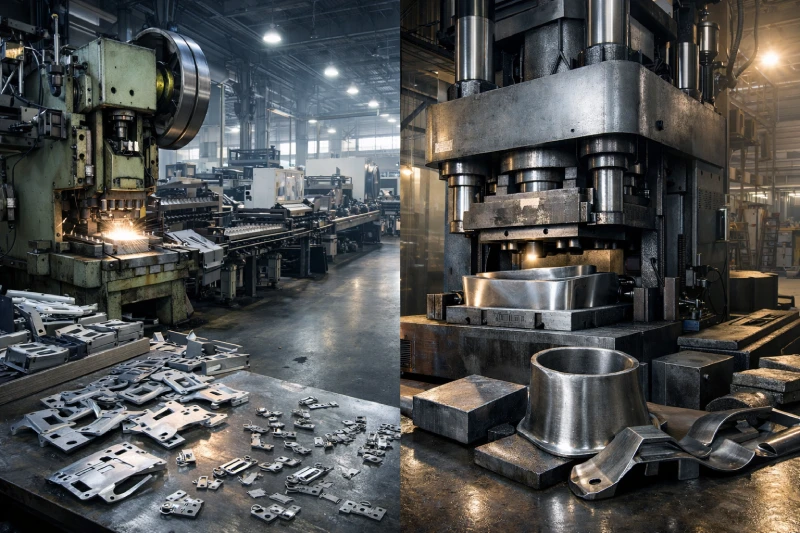
Automotive Parts
For automotive body panels, brackets, reinforcement parts, and progressive die stamping, a mechanical stamping press is usually the better choice. Automotive production depends on speed, repeatability, and low cost per part.
A stamping press is especially valuable when producing:
- Door brackets
- Seat frame components
- Small chassis parts
- Thin body panel sections
Electronics and Precision Components
A stamping press is also the preferred option for thin, precise components such as:
- Electrical terminals
- Connectors
- Lead frames
- Small electronic brackets
Because these parts require tight repeatability and very high production rates, a hydraulic press is usually unnecessary.
Deep Drawing and Complex Forming
A hydraulic press is typically the better choice for deep drawing and complex forming operations.
Typical examples include:
- Appliance housings
- Metal sinks
- Tanks and containers
- Large curved panels
- Heavy-duty enclosures
These parts require more control over the material flow during the stroke, which is exactly where hydraulic presses excel.
Low-Volume or Custom Production
If you produce many different parts in smaller quantities, a hydraulic press may offer more flexibility. Adjustable stroke length and pressure settings make it easier to switch between products.
By contrast, a stamping press delivers the greatest value when the same part is produced repeatedly at high volume.
| Application | Best Choice |
|---|---|
| Automotive mass production | Stamping Press |
| Electronics components | Stamping Press |
| Deep drawing | Hydraulic Press |
| Thick-material parts | Hydraulic Press |
| Low-volume custom work | Hydraulic Press |
| High-volume progressive die work | Stamping Press |
Cost Comparison: Which Press Is More Economical?
Machine cost is more than just the purchase price. You also need to consider energy consumption, tooling, maintenance, and cost per part.
A stamping press often has a lower cost per part in large production runs. Because it operates faster, the machine can produce more parts per hour and spread tooling and labor costs across larger volumes.
A hydraulic press may have a higher purchase price and slower cycle time, but it can reduce tooling complexity in some forming applications.
| Cost Factor | Stamping Press | Hydraulic Press |
|---|---|---|
| Initial Machine Cost | Lower to medium | Medium to high |
| Cost Per Part at High Volume | Lower | Higher |
| Energy Use in Continuous Production | Lower | Higher |
| Tooling Flexibility | Lower | Higher |
| Best ROI | Large production runs | Complex or variable parts |
If your factory produces the same part every day in large quantities, a stamping press is usually more economical.
If you need flexibility and frequently change part designs, a hydraulic press may provide better long-term value.
Maintenance and Reliability
Both machine types require regular maintenance, but the common issues are different.
Mechanical stamping presses typically require inspection of:
- Clutches and brakes
- Bearings
- Flywheel systems
- Crankshaft wear
Hydraulic presses require maintenance of:
- Hydraulic seals
- Cylinders
- Fluid cleanliness
- Pumps and hoses
Hydraulic presses may experience oil leaks or overheating if maintenance is neglected. Mechanical presses may suffer from wear in moving components after long-term high-speed use.
| Maintenance Issue | Stamping Press | Hydraulic Press |
|---|---|---|
| Common Failure Point | Clutch, brake, bearings | Seals, hoses, hydraulic fluid |
| Maintenance Frequency | Regular mechanical inspection | Regular hydraulic inspection |
| Easier to Diagnose | Usually yes | Sometimes more complex |
How to Choose Between a Stamping Press and a Hydraulic Press
Choose a stamping press if:
- You run high-volume production
- You need fast cycle times
- You use progressive dies
- Your materials are thin to medium thickness
- Your goal is the lowest possible cost per part
Choose a hydraulic press if:
- You need full tonnage through the entire stroke
- You form thick or difficult materials
- You manufacture deep drawn or complex parts
- You want adjustable stroke and pressure
- Your production is lower-volume or more varied
A simple decision matrix looks like this:
| If Your Priority Is… | Choose… |
|---|---|
| Speed and output | Stamping Press |
| Force and forming flexibility | Hydraulic Press |
| Lowest cost per part | Stamping Press |
| Large, thick, or complex parts | Hydraulic Press |
| Progressive die production | Stamping Press |
| Variable product mix | Hydraulic Press |
Which Press Is Right for Your Factory?
There is no universal winner in the stamping press vs hydraulic press debate.
A stamping press is the best choice when your factory depends on speed, repeatability, and high-volume production. A hydraulic press is the better solution when you need full force, adjustable stroke, and greater flexibility for complex parts.
Before choosing a machine, evaluate:
- Part geometry
- Material thickness
- Annual production volume
- Required cycle time
- Future product changes
The best press is the one that matches your actual manufacturing requirements—not simply the one with the highest tonnage or lowest price.
If you are comparing press options for a new production line, now is the time to review your part drawings, material specifications, and production targets with an experienced press supplier. The right decision can reduce cost per part, improve production efficiency, and prevent expensive tooling mistakes in the future.
