Introduction
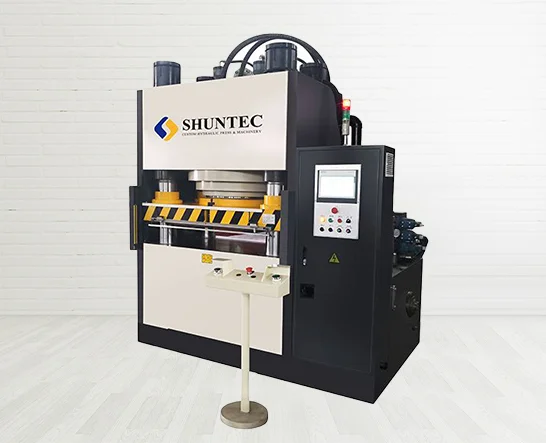
Modern manufacturing processes increasingly require press systems that combine high force with precise motion control. A servo press is an advanced industrial press that uses servo motor technology to control the movement, speed, and force of the press ram with high accuracy. Compared with conventional presses that operate with fixed motion patterns, servo presses allow engineers to program the pressing cycle for different materials and production requirements.
Because of this programmable control capability, servo presses are widely used in industries where precision forming and assembly are critical. Typical applications include automotive component manufacturing, battery production, metal stamping operations, and electronics assembly. In these processes, accurate control of force and position helps improve product quality while reducing material stress and tooling wear.
Another key advantage of servo press technology is its ability to create custom motion profiles. The press can move quickly during the approach stage, slow down near material contact, and apply controlled force during forming or assembly. This level of control improves manufacturing consistency and makes servo presses well suited for modern automated production environments.
What Is a Servo Press?
A servo press is an industrial press machine that uses a servo motor to control the movement of the press ram with high precision. Unlike conventional presses that rely on mechanical flywheels, hydraulic pressure, or pneumatic systems, a servo press uses digitally controlled motor systems to regulate motion, speed, and applied force throughout the pressing cycle. This design allows manufacturers to achieve highly accurate forming and assembly operations while maintaining consistent production performance.
In a typical servo press system, the servo motor drives the ram through a mechanical transmission such as a ball screw, crank mechanism, or hydraulic system depending on the press design. The motion of the ram is controlled through a programmable controller that continuously monitors parameters such as position, speed, and force. Because the system operates under closed-loop control, it can make real-time adjustments to ensure that the pressing process follows the exact motion profile required for the application.
One of the defining characteristics of a servo press is its ability to create custom motion profiles. Engineers can program different speeds and force levels at various stages of the stroke. For example, the press may move quickly during the initial approach, slow down near the contact point, and then apply precise forming force during the pressing phase. This capability improves forming accuracy and reduces the risk of material damage or tooling wear.
Servo presses are commonly used in manufacturing environments that demand high precision and repeatability. Typical applications include metal forming, precision assembly, electronic component pressing, and battery component production. In these processes, controlled force and accurate positioning are essential for achieving consistent product quality and stable production output.
To understand the mechanical and control principles behind these systems in more detail, see How a Servo Press Works, which explains the motion control and drive mechanisms used in modern servo press technology.
Types of Servo Press
Servo press technology can be implemented through different mechanical drive systems depending on the force requirements, motion characteristics, and industrial applications. In most industrial environments, servo presses are generally categorized into two main types: servo hydraulic presses and electric servo presses. Each type offers different advantages in terms of force capability, motion control, and suitable manufacturing processes.
Servo Hydraulic Press
A servo hydraulic press combines traditional hydraulic press architecture with modern servo motor control technology. Instead of using a constant-speed hydraulic pump, the system uses a servo motor to precisely control the hydraulic pump speed and oil flow. This allows the press to adjust pressure, ram speed, and position with far greater accuracy than conventional hydraulic presses.
Servo hydraulic presses are typically used in applications that require high forming force and stable pressure control. Industries such as automotive manufacturing, heavy metal forming, and battery component production often rely on this type of press because it can generate large tonnage while still maintaining controlled motion. The servo-controlled hydraulic system also improves energy efficiency by delivering hydraulic power only when needed.
Another advantage is the ability to handle complex forming operations that require consistent pressure over a longer stroke distance. This makes servo hydraulic presses suitable for deep forming, large component assembly, and high-force industrial applications.
Electric Servo Press
An electric servo press uses a servo motor to drive the press ram directly through mechanical transmission systems such as ball screws, roller screws, or crank mechanisms. Because the system does not rely on hydraulic fluid, it can deliver highly accurate motion control with fast response times and extremely repeatable positioning.
Electric servo presses are widely used in precision assembly and electronic component manufacturing, where accurate force control and micron-level positioning are critical. Industries such as electronics, medical device production, and precision component assembly often choose electric servo presses for their clean operation, low maintenance requirements, and high control accuracy.
Another key advantage is their ability to execute complex programmable motion profiles, allowing engineers to adjust pressing speed, force, and dwell time throughout the entire stroke. This makes electric servo presses particularly suitable for delicate forming and precision joining operations.
Industrial Applications Overview
Servo presses are widely used in modern manufacturing industries that require precise force control, programmable motion profiles, and consistent production quality. Because the pressing process can be digitally controlled and adjusted for different materials or forming stages, servo presses are suitable for both precision assembly and heavy forming operations.
As a result, they have become an important solution across multiple industrial sectors. The following sections provide a brief overview of how servo press technology is used in several key industries, with dedicated guides explaining each application in more detail.
Automotive Manufacturing
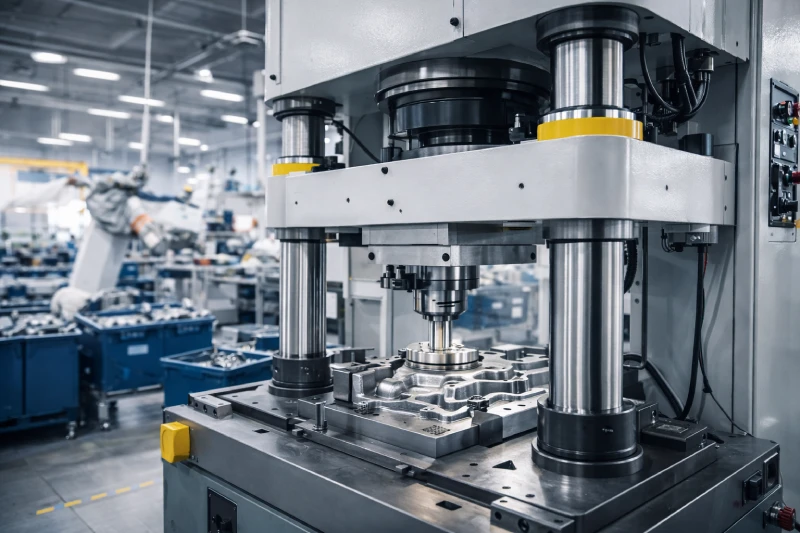
The automotive industry is one of the largest users of servo press technology. Many automotive components require controlled forming force and precise positioning to maintain dimensional accuracy and structural strength. Servo presses are commonly used to manufacture parts such as gears, bushings, bearing components, and structural metal parts.
Because servo presses allow programmable motion control, engineers can optimize the pressing cycle for each component. The ram can approach the material quickly, slow down during contact, and apply controlled force during the forming stage. This helps reduce material stress, improve forming consistency, and extend tool life in high-volume production environments.
For a deeper explanation of automotive production processes and real manufacturing examples, see the guide on Servo Press for Automotive Manufacturing.
Battery Manufacturing
Battery production, especially for lithium-ion batteries and energy storage systems, requires highly controlled forming and assembly operations. Servo presses are used in processes such as battery can forming, electrode component shaping, tab forming preparation, and module assembly.
These processes involve thin metal materials and sensitive internal structures, which means excessive force or uncontrolled motion can easily damage components. Servo press systems allow manufacturers to precisely adjust force, speed, and dwell time during the pressing cycle. This level of control helps maintain consistent production quality while protecting delicate battery materials.
To explore how servo presses support modern energy manufacturing, see Servo Press for Battery Manufacturing.
Metal Stamping
Metal stamping operations require stable force and carefully controlled forming motion to produce consistent parts. Servo presses are increasingly used in stamping lines because they allow manufacturers to modify the motion profile during different stages of the forming cycle.
For example, the press can run at higher speed during the approach stage and slow down when the material begins to deform. This helps control metal flow and reduces common stamping defects such as cracking, wrinkling, or uneven material thickness. Servo press technology is particularly useful when forming advanced materials such as high-strength steel and lightweight alloys used in modern industrial products.
A detailed overview of these processes can be found in Servo Press for Metal Stamping.
Electronics Assembly
In electronics manufacturing, servo presses are used for precision assembly and component forming. Applications include connector insertion, terminal crimping, sensor assembly, and the forming of small electronic components.
These operations require extremely accurate force control because even slight over-pressing can damage fragile parts. Servo presses provide real-time monitoring of force and position, allowing engineers to maintain consistent assembly quality across high-volume production runs. The ability to record pressing data also supports process traceability and quality assurance in electronics manufacturing environments.
Learn more about these applications in Servo Press for Electronics Assembly.
Servo Press vs Other Press Types
When evaluating industrial press equipment, manufacturers often compare servo presses with other common press technologies such as hydraulic presses and pneumatic presses. While each type of press can perform forming or assembly operations, the differences lie in motion control, force regulation, energy efficiency, and process flexibility. Understanding these differences helps manufacturers select the most suitable press system for their production requirements.
Traditional hydraulic presses are widely used for heavy forming operations because they can generate very high tonnage and maintain stable pressure throughout the stroke. However, conventional hydraulic systems typically rely on fixed pump operation and valve control, which limits the precision of motion control and energy efficiency. By contrast, servo press systems allow engineers to program motion profiles and adjust force dynamically during the pressing cycle. A detailed engineering comparison can be found in Servo Press vs Hydraulic Press, where the differences in force control, forming capability, and industrial use cases are explained in depth.
Another commonly used press type is the pneumatic press, which uses compressed air to drive the ram. Pneumatic presses are typically used for lighter assembly operations because they provide fast cycle times and relatively simple machine structures. However, compressed air systems generally offer limited control over force and stroke accuracy compared with servo-driven systems. This makes them less suitable for applications that require precise forming or controlled force monitoring. For a deeper comparison of these technologies, see Servo Press vs Pneumatic Press, which explains when each press type is most appropriate in manufacturing environments.
Manufacturers may also compare servo presses with traditional mechanical presses, which use flywheel-driven crank systems to generate pressing force. Mechanical presses are well suited for high-speed stamping operations but usually operate with fixed stroke profiles and limited flexibility. Servo presses, on the other hand, allow programmable motion control that can adapt to different materials and forming requirements. The engineering differences between these technologies are discussed further in Servo Press vs Mechanical Press.
By understanding how these press technologies differ in performance and application scenarios, manufacturers can better determine whether a servo press is the most suitable solution for their production process.
How to Choose a Servo Press
Selecting the right servo press requires more than simply choosing a machine with sufficient force capacity. Manufacturers must evaluate several technical and production factors to ensure the press system matches the requirements of their forming or assembly process. Because servo presses offer programmable motion and flexible control, choosing the correct configuration can significantly improve production efficiency and product quality.
Below are several key factors engineers typically consider when selecting a servo press system.
1. Required Press Tonnage
The first and most important factor is the required pressing force, commonly referred to as tonnage. The press must be capable of generating enough force to complete the forming or assembly operation without overloading the machine or damaging tooling.
Tonnage requirements depend on material type, part geometry, and forming method. For example, heavy metal forming operations require significantly higher force than precision electronic assembly processes. Understanding how to estimate the required press force is essential when selecting equipment. A detailed explanation can be found in the Servo Press Tonnage Guide, which explains how engineers calculate pressing force for different manufacturing scenarios.
2. Stroke Length and Motion Control
Servo presses allow engineers to program customized motion profiles, making stroke length and speed control an important consideration. The press must provide sufficient stroke distance for the forming operation while also supporting the motion profile required by the process.
In many applications, manufacturers use multi-stage motion profiles where the ram moves quickly during approach, slows near material contact, and then applies controlled forming force. Selecting a servo press with appropriate stroke capability ensures the machine can handle different product designs and production processes.
3. Production Volume and Cycle Time
Another key consideration is the production speed required by the manufacturing line. High-volume production environments often require short cycle times and consistent repeatability. Servo presses can help optimize cycle efficiency by allowing engineers to adjust ram speed and motion during different stages of the pressing cycle.
When evaluating servo press systems, manufacturers should consider how the press integrates with upstream and downstream equipment such as automated feeding systems, assembly stations, or robotic handling units.
4. Application Type
Different servo press designs are optimized for different types of manufacturing processes. For example, heavy forming operations may require servo hydraulic presses with higher tonnage capability, while precision assembly tasks may benefit from electric servo presses with extremely accurate positioning.
Understanding the specific process requirements—such as forming, joining, stamping, or assembly—helps ensure the selected servo press is suitable for the intended industrial application.
5. Equipment Cost and Operational Efficiency
Finally, manufacturers must consider the total cost of ownership, including equipment cost, energy consumption, maintenance requirements, and long-term operational efficiency. Servo presses can offer significant advantages in energy savings and process control compared with conventional press technologies.
However, the optimal system depends on production scale, process complexity, and automation requirements. For a detailed breakdown of investment considerations and pricing factors, see the Servo Press Cost Guide, which explains how manufacturers evaluate the financial aspects of servo press equipment.
By evaluating these key factors—tonnage, motion capability, production requirements, application type, and cost—manufacturers can select a servo press system that best supports their production goals. For a complete decision framework covering these considerations, refer to the Servo Press Buying Guide, which provides a step-by-step overview of how industrial buyers evaluate servo press solutions.
Featured Servo Press Machines

Servo Hydraulic Press Machine
Servo hydraulic presses combine hydraulic force with servo motor control for accurate motion, stable pressure, and high-force industrial forming applications.
View Product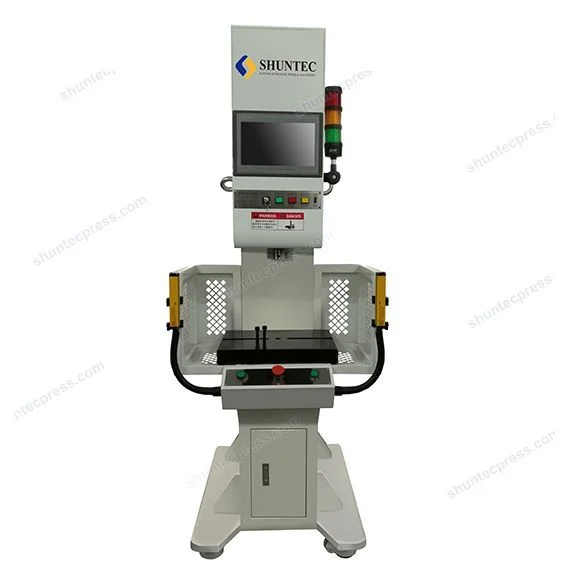
Electric Servo Press Machine
Electric servo presses deliver precise positioning, programmable stroke control, and clean operation for electronics, precision assembly, and component pressing.
View Product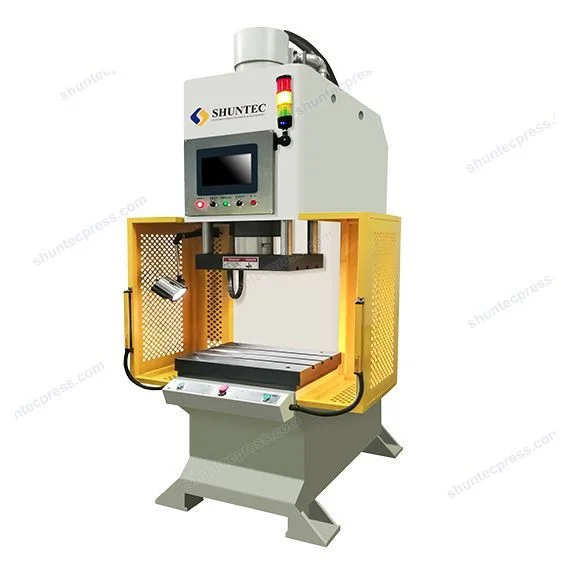
C Frame Hydraulic Press Machine
C-frame hydraulic presses are compact press systems suited for light forming, assembly work, and applications that require easy access to the working area.
View Product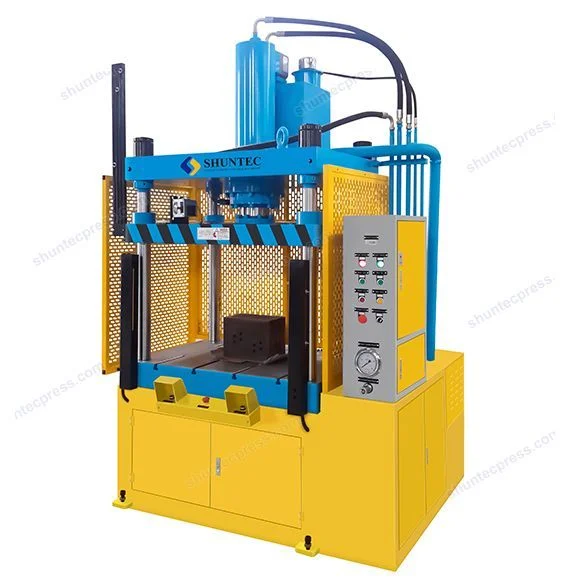
4 Post Hydraulic Press Machine
4-post hydraulic presses provide strong structural stability and balanced load distribution for larger workpieces and demanding industrial pressing operations.
View ProductFAQ
What is a servo press used for?
A servo press is used for industrial forming and assembly operations that require precise control of force, position, and motion speed. Typical applications include metal forming, connector insertion, battery component shaping, and precision assembly of mechanical or electronic parts.
Because servo presses allow programmable motion profiles, manufacturers can control how force is applied throughout the pressing cycle. This helps improve forming accuracy, reduce material stress, and maintain consistent production quality across high-volume manufacturing processes.
Servo presses are widely used in industries such as automotive manufacturing, battery production, metal stamping, and electronics assembly where precise pressing control is essential.
How does a servo press work?
A servo press works by using a servo motor to drive and control the movement of the press ram. The servo motor is connected to a mechanical or hydraulic transmission system that converts motor motion into controlled pressing force.
During operation, the press controller monitors parameters such as position, speed, and applied force through sensors and feedback systems. Engineers can program the press to follow specific motion profiles, such as rapid approach, slow contact, and controlled forming force.
This closed-loop control system allows the servo press to adjust its motion in real time, improving precision and repeatability compared with conventional press technologies.
What are the advantages of a servo press?
Servo presses offer several advantages compared with traditional mechanical, hydraulic, or pneumatic press systems. One of the main benefits is precise motion control, which allows engineers to program speed, force, and position during different stages of the pressing cycle.
Another advantage is improved process flexibility. Because motion parameters can be digitally programmed, manufacturers can adapt the press for different materials or product designs without major mechanical adjustments.
Servo presses can also improve energy efficiency and production quality, helping manufacturers reduce waste, extend tool life, and maintain stable production performance.
What are the advantages of a servo press?
Servo presses offer several advantages compared with traditional mechanical, hydraulic, or pneumatic press systems. One of the main benefits is precise motion control, which allows engineers to program speed, force, and position during different stages of the pressing cycle.
Another advantage is improved process flexibility. Because motion parameters can be digitally programmed, manufacturers can adapt the press for different materials or product designs without major mechanical adjustments.
Servo presses can also improve energy efficiency and production quality, helping manufacturers reduce waste, extend tool life, and maintain stable production performance.
What is the difference between a servo press and a hydraulic press?
The main difference between a servo press and a conventional hydraulic press lies in how motion and force are controlled. Traditional hydraulic presses typically use constant-speed pumps and valve systems to generate pressure, which can limit motion precision and energy efficiency.
Servo presses, on the other hand, use servo motors and digital controllers to regulate the pressing cycle. This allows manufacturers to program motion profiles and precisely control force during the forming process.
While hydraulic presses are often used for heavy forming applications, servo presses provide greater flexibility and precision for complex manufacturing processes.
How much does a servo press cost?
The cost of a servo press varies depending on several factors, including press tonnage, machine size, control system complexity, and automation requirements. Small precision servo presses used for assembly operations are typically less expensive than large industrial presses used for heavy metal forming.
Additional features such as force monitoring systems, automated feeding equipment, and customized tooling can also affect the final cost. Because servo presses are often integrated into automated production lines, manufacturers usually evaluate the total cost based on both equipment price and long-term production efficiency.
What industries use servo presses?
Servo presses are used in a wide range of manufacturing industries where controlled forming and assembly operations are required. Major industries include automotive manufacturing, battery production, metal stamping, and electronics assembly.
In automotive production, servo presses are used for forming and assembling precision metal components. In battery manufacturing, they help shape battery housings and other structural parts. Electronics manufacturers rely on servo presses for connector insertion and precision component assembly.
Because of their programmable control and high repeatability, servo presses are well suited for modern manufacturing environments that demand both precision and production efficiency.