
Electronics manufacturing depends on extremely small, precise, and repeatable metal parts. Connector terminals, lead frames, shielding cans, battery contacts, clips, and miniature brackets all require tight tolerances and consistent quality over millions of cycles.
Unlike heavy industrial stampings, electronic components are usually made from thin copper, brass, stainless steel, nickel, or phosphor bronze. Even a small burr, dimensional shift, or feeding error can cause assembly failure later in the production line.
That is why choosing the right stamping press for electronics is critical. The best machine is not always the highest-tonnage press. Instead, electronics manufacturers usually need a combination of high speed, precision, low vibration, and repeatable slide motion.
Why Electronics Manufacturing Requires Specialized Stamping Presses
Electronics components are very different from automotive brackets or appliance housings. Most parts are small, lightweight, and produced from thin strip material. In many cases, tolerances must remain within ±0.01 mm or better.
A general-purpose press may provide enough force, but often cannot provide the control required for electronics production. Common problems include:
- Burr formation on connector edges
- Inconsistent dimensions during high-speed runs
- Excessive vibration affecting delicate dies
- Material deformation in thin copper or brass
- Low repeatability during long production cycles
Electronics manufacturers therefore prioritize:
- High repeatability
- Low vibration
- Stable feeding systems
- Precise bottom dead center control
- High-speed operation without losing accuracy
The table below highlights the difference between standard industrial stamping and electronics stamping.
| Requirement | General Industrial Stamping | Electronics Stamping |
|---|---|---|
| Material Thickness | 1–6 mm | 0.05–1.5 mm |
| Tolerance | ±0.1–0.5 mm | ±0.005–0.02 mm |
| Typical Production Speed | 20–100 SPM | 200–1,200 SPM |
| Burr Requirement | Moderate | Extremely low |
| Repeatability | Standard | Very high |
| Preferred Press Type | Hydraulic or mechanical | Servo or high-speed mechanical |
Typical Production Requirements in Electronics Stamping
Most electronics manufacturers stamp materials such as:
- Copper alloys
- Brass
- Stainless steel
- Nickel-plated steel
- Phosphor bronze
Typical strip thickness ranges from 0.05 mm to 1.0 mm. Because the material is thin, even slight slide misalignment or die vibration can create defective parts.
Many electronics plants also run 24/7 production. That means the stamping press must maintain stable precision over millions of cycles without excessive tool wear.
Common Electronics Components Made with a Stamping Press
A stamping press for electronics is usually used to produce small precision metal parts that later become part of electronic assemblies.
Common stamped electronics components include:
- Connector terminals
- Lead frames for semiconductor packaging
- Battery contacts
- EMI shielding covers
- USB and charging port parts
- Precision clips and spring contacts
- PCB mounting brackets
- Micro metal shields for smartphones and laptops
- Switch contacts and relay parts
| Component | Typical Material | Main Requirement |
|---|---|---|
| Connector Terminal | Brass, copper alloy | High conductivity and low burr |
| Lead Frame | Copper alloy | High precision and repeatability |
| Battery Contact | Nickel-plated steel | Accurate forming and durability |
| EMI Shield | Stainless steel | Thin-wall forming without distortion |
| PCB Bracket | Stainless steel | Tight dimensional control |
Many of these parts are manufactured using progressive dies. A strip enters the press, passes through multiple stations, and exits as a finished part at high speed. This approach improves productivity and reduces labor cost.
Industries That Commonly Use Electronics Stamping
Electronics stamping is widely used in:
- Consumer electronics manufacturing
- Semiconductor packaging
- Telecommunications equipment
- EV battery modules
- Medical electronics
- Industrial control systems
For example, semiconductor packaging companies often use high-speed presses to produce lead frames and tiny shielding components. EV battery manufacturers use precision presses to make battery tabs and connection terminals.
Best Types of Stamping Presses for Electronics Manufacturing
Several types of stamping presses can be used in electronics production, but not every machine is equally suitable.
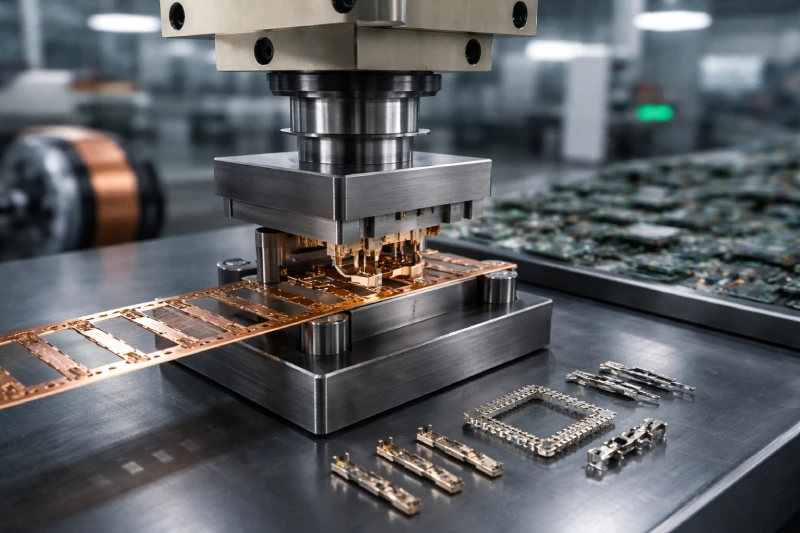
For electronics manufacturing, the most common choices are listed below.
Servo Stamping Press
Servo presses are increasingly popular in electronics manufacturing because they provide precise motion control.
Instead of using a traditional flywheel, a servo press controls slide movement through a servo motor. This allows the press to:
- Slow down during forming
- Reduce impact force
- Improve dimensional accuracy
- Minimize burrs and deformation
- Protect delicate tooling
Servo presses are especially useful for:
- Thin copper and brass materials
- Precision connector parts
- Complex formed components
- Small parts requiring exact positioning
| Advantage of Servo Press | Why It Matters in Electronics |
|---|---|
| Adjustable slide motion | Better control for thin materials |
| Lower vibration | Protects precision dies |
| Higher repeatability | Consistent dimensions over long runs |
| Flexible programming | Useful for different component types |
High-Speed Mechanical Stamping Press
A high-speed mechanical press remains one of the most common solutions for mass-production electronics parts.
These presses are ideal when production volume is extremely high and the part geometry is relatively simple.
Typical advantages include:
- 200–1,200 strokes per minute
- Lower cost than a servo press
- Excellent productivity for connector terminals and lead frames
- Proven compatibility with progressive dies
However, mechanical presses offer less motion control than servo presses. They are best when the process is already stable and optimized.
Precision Mechanical Press
Precision mechanical presses are often used for medium-speed applications where high accuracy is still required.
They provide:
- Better rigidity than standard mechanical presses
- Stable bottom dead center position
- Lower cost than a servo press
These machines are commonly selected for medium-sized brackets, clips, and shielding components.
Small Hydraulic Press
Hydraulic presses are not typically the first choice for high-volume electronics stamping, but they can still be useful in some situations.
A small hydraulic press may be suitable when:
- Production volume is low
- The part requires deep drawing or complex forming
- Flexible force control is more important than speed
Typical applications include:
- Small metal housings
- Specialized battery components
- Prototype production
Key Specifications to Evaluate Before Buying an Electronics Stamping Press
Choosing the correct press requires more than simply matching tonnage. Electronics manufacturers should evaluate several specifications together.
1. Tonnage
Electronics parts usually require lower tonnage than automotive or industrial parts.
| Application | Typical Tonnage |
|---|---|
| Small connector terminals | 10–30 tons |
| Lead frames and battery contacts | 30–45 tons |
| Brackets and shielding parts | 45–80 tons |
| Larger precision metal housings | 80–120 tons |
Too much tonnage can be just as problematic as too little. Oversized presses may increase vibration and reduce control for small parts.
2. Stroke Speed (SPM)
Speed is critical in electronics manufacturing because production volumes are usually very high.
| Production Type | Recommended Speed |
|---|---|
| Small precision parts | 300–1,200 SPM |
| Medium-size brackets | 100–300 SPM |
| Complex formed parts | 30–150 SPM |
Higher speed is only beneficial if the press can maintain precision. A machine that runs fast but creates burrs or dimensional variation will increase scrap cost.
3. Precision and Repeatability
Look for a press that provides:
- Stable slide guidance
- Tight bottom dead center accuracy
- Minimal deflection
- High repeatability over long production runs
This is particularly important when producing connector terminals or lead frames, where even a tiny dimensional shift can affect assembly performance.
4. Feeding System Compatibility
Most electronics stamping lines use automatic feeders and progressive dies.
The press should be compatible with:
- High-speed coil feeders
- Servo feeders
- Straighteners
- Automated scrap removal systems
Without a stable feeding system, the entire production line becomes less efficient.
5. Automation Integration
Many modern electronics factories require a press that can integrate with:
- Vision inspection systems
- Robotic handling
- MES production systems
- Predictive maintenance software
If automation is part of your future production plan, choose a press with expansion capability from the beginning.
Common Challenges in Electronics Stamping — and How the Right Press Solves Them
Even experienced manufacturers face problems during electronics stamping.
Burr Formation
Small burrs may seem minor, but they can create major issues in electronics products. Burrs can damage connectors, affect conductivity, or interfere with assembly.
The best way to reduce burrs is to use:
- A precision die
- Stable slide motion
- Proper material feeding
- Servo-controlled forming when necessary
Inconsistent Dimensions
High-speed production often creates variation if the press is unstable.
Common causes include:
- Poor slide guidance
- Die vibration
- Inaccurate feeding
- Excessive press deflection
Servo presses and precision mechanical presses are often selected because they maintain better dimensional consistency.
Tool Wear
Thin copper and stainless steel can create rapid wear on tooling. When the press produces excessive impact force, the die wears faster.
Servo motion helps extend die life by slowing the slide during the most sensitive part of the forming process.
Scrap and Yield Loss
Electronics manufacturers often run millions of parts per year. Even a 1% scrap increase can create major cost problems.
The right press reduces scrap by improving:
- Feeding accuracy
- Part consistency
- Tool stability
- Process repeatability
How to Choose the Right Stamping Press for Your Electronics Production
The best stamping press depends on the specific type of electronic component you produce.
| Production Requirement | Recommended Press |
|---|---|
| High-speed connector terminals | High-speed mechanical press |
| Precision lead frames | Servo press |
| Thin and delicate copper parts | Servo press |
| Medium-size brackets and shields | Precision mechanical press |
| Low-volume complex forming | Small hydraulic press |
Use the following checklist before requesting a quotation:
- What material will you stamp?
- What is the material thickness?
- What tolerance is required?
- What annual production volume do you expect?
- What stroke speed is necessary?
- Will you use a progressive die?
- Does the line require automation or inspection systems?
You should also confirm whether your existing tooling is compatible with the new press.
FAQs
What tonnage is usually required for electronics stamping?
Most electronics applications fall between 10 and 80 tons. Very small connector terminals may only require 10–30 tons, while larger brackets or shielding parts may require 45–80 tons.
Is a servo press better than a mechanical press for electronics parts?
A servo press is often better for delicate, thin, or high-precision components because it provides more control and lower vibration. A high-speed mechanical press is still an excellent option for large-volume, stable production.
Can one stamping press produce multiple electronic components?
Yes. Many manufacturers use the same press with different dies and tooling setups. Servo presses are especially flexible because the slide motion can be reprogrammed for different parts.
What materials are commonly used in electronics stamping?
Copper alloy, brass, stainless steel, nickel-plated steel, and phosphor bronze are the most common materials.
How important is high-speed capability?
High speed is important because electronics manufacturers often produce millions of parts each year. However, precision and repeatability are more important than maximum speed.
Request the Right Electronics Stamping Press
Choosing the wrong stamping press can increase scrap, shorten die life, and limit production efficiency. The right machine should match your material, tolerance, production speed, and automation requirements.
For most electronics manufacturers, servo presses and high-speed mechanical presses provide the best balance of speed and precision. However, the final decision depends on the exact component you need to produce.
If you have part drawings, material specifications, or target production volume, contact our engineering team. We can recommend the ideal tonnage, press type, and production configuration for your electronics stamping application.
