
Introduction
Battery manufacturing requires extremely precise forming processes to produce reliable electrical connections and structurally stable components. In modern lithium battery and energy storage production, even small dimensional inconsistencies can affect conductivity, sealing performance, and long-term durability.
Many battery components—such as tabs, connectors, and casing elements—are manufactured through stamping, forming, or precision assembly operations. These processes require highly controlled press force, consistent motion profiles, and repeatable positioning.
Servo press systems have become increasingly important in battery production lines because they provide programmable control over force, speed, and stroke. Compared with conventional mechanical presses, servo-driven systems enable more precise forming operations, which is critical when working with thin conductive materials such as aluminum and copper.
As battery technology evolves and manufacturing tolerances become tighter, servo presses are playing a growing role in ensuring stable, high-quality production.
Role of Precision Press Systems in Battery Manufacturing
Battery production involves numerous small forming and assembly operations that must maintain strict dimensional and electrical tolerances. Precision press systems are commonly used in several stages of battery component manufacturing, particularly when forming thin metal parts or assembling conductive interfaces.
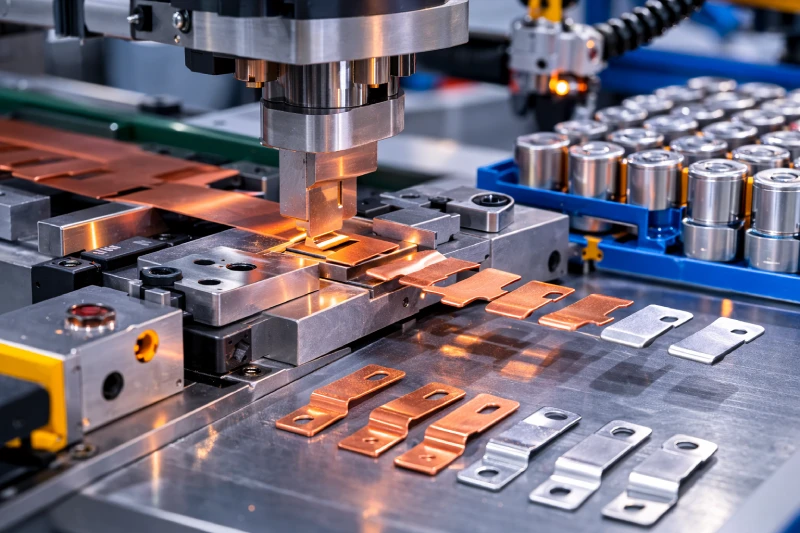
One important application is tab forming and stamping. Battery tabs connect internal electrodes to external terminals and are typically made from thin aluminum or copper sheets. Press systems are used to cut, shape, and form these tabs while maintaining consistent geometry and edge quality.
Another key process is terminal forming and connector assembly. Battery packs contain multiple conductive connection points that must be precisely formed to ensure low electrical resistance and reliable current transfer. Press systems provide the controlled force required to shape connectors without damaging conductive coatings.
Press equipment is also used in casing component manufacturing. Cylindrical and prismatic battery cells often require stamped metal parts such as covers, sealing plates, and structural supports. Accurate forming helps maintain sealing integrity and dimensional stability during assembly.
In automated battery production lines, press systems are typically integrated with feeding systems, inspection equipment, and robotic handling units. This integration ensures that each formed component meets the required specifications before moving to the next manufacturing stage.
Because many battery components are small and manufactured in large volumes, press systems must deliver both high precision and consistent cycle performance to maintain stable production.
Battery Components Produced Using Servo Press Technology
Servo press systems are widely used in the production of precision battery components, particularly those made from thin conductive materials. The programmable motion control of servo presses allows manufacturers to form delicate parts while maintaining consistent dimensions and material integrity.
Battery Tabs
Battery tabs are one of the most common components produced using precision presses. These tabs connect the internal electrodes of the battery cell to external electrical terminals. Because tabs are typically made from thin aluminum or copper foil, forming processes must be carefully controlled to prevent tearing, deformation, or burr formation.
Servo presses enable accurate force application during tab stamping and forming, helping maintain consistent tab geometry across high-volume production runs.
Battery Casing Components
Metal casings and structural elements used in cylindrical and prismatic battery cells are often produced through stamping and forming processes. Servo presses can shape thin metal sheets into casing components while maintaining dimensional accuracy and surface integrity.
Precise control over the forming motion helps reduce material stress and ensures that casing components meet sealing and assembly requirements.
Connectors and Terminal Parts
Battery modules and packs contain numerous electrical connectors that require accurate forming and assembly. Servo press systems are used to manufacture connector plates, terminal components, and contact elements that transfer current between cells.
Because electrical conductivity depends heavily on contact quality, the ability to precisely control forming force helps ensure stable electrical performance.
Small Precision Components
In addition to larger components, battery manufacturing also requires many small stamped parts such as brackets, clips, and conductive contacts. Servo presses provide the flexibility to produce these components with programmable motion profiles that support complex forming requirements.
Advantages of Servo Press Systems in Battery Production
Servo press systems provide several technical advantages that make them well suited for battery manufacturing environments where precision and repeatability are essential.
Precise Force Control
One of the most significant advantages of servo presses is the ability to control forming force with high accuracy. Battery components are often made from thin conductive metals that can deform easily if excessive force is applied.
Servo systems allow manufacturers to program force profiles that match the material characteristics of each component. This level of control helps reduce defects such as cracks, deformation, and burr formation.
High Repeatability
Battery production typically involves extremely high production volumes. Maintaining consistent component quality across thousands or millions of parts requires equipment that can repeat forming operations with minimal variation.
Servo press systems provide stable motion control and accurate position feedback, allowing manufacturers to maintain consistent forming conditions throughout the production process.
Integration with Automated Production Lines
Modern battery manufacturing relies heavily on automated production systems. Servo presses can be integrated with robotic handling systems, automated feeders, and inline inspection equipment.
Because servo presses allow programmable motion control, they can be easily synchronized with other production equipment to support fully automated manufacturing workflows.
Improved Production Efficiency
Servo press systems can also improve production efficiency by allowing manufacturers to adjust forming speed and motion profiles according to specific process requirements.
In some cases, servo presses can reduce unnecessary mechanical motion compared with traditional press systems, which may help shorten cycle times while maintaining forming accuracy.
These capabilities make servo press technology particularly valuable in battery production environments where both precision and throughput are critical.
Selecting the Right Servo Press for Battery Manufacturing
Selecting an appropriate servo press for battery production requires careful consideration of several technical factors related to component design, production volume, and integration with automated systems.
Tonnage Requirements
Battery components are typically small and made from thin metal materials, but the required forming force can vary depending on component thickness and forming complexity. Manufacturers must evaluate the maximum forming force needed for each application to determine the appropriate press capacity.
Choosing the correct tonnage helps ensure stable forming performance without overloading the equipment.
Stroke and Motion Control
Servo presses provide programmable stroke profiles that can be optimized for different forming processes. For example, certain battery components may require slower forming speeds near the bottom of the stroke to prevent material damage.
Adjustable stroke control allows manufacturers to fine-tune motion profiles according to the specific forming requirements of each component.
Automation Compatibility
Battery production lines are typically highly automated, with multiple processes connected in continuous manufacturing systems. Servo presses used in these environments must be compatible with automation equipment such as feeders, robotic handling systems, and inline inspection units.
Equipment that supports flexible integration can help streamline production and reduce manual intervention.
Precision and Process Monitoring
Many battery manufacturers also require real-time monitoring of forming force and stroke position to ensure product quality. Servo press systems often include sensors and control systems that record forming data during each cycle.
This data can be used for process optimization, quality control, and traceability within battery production lines.
Conclusion
Battery manufacturing involves a wide range of precision forming processes used to produce conductive components, connectors, and structural elements. These processes require equipment capable of delivering accurate force control, repeatable motion, and compatibility with automated production lines.
Servo press systems provide the programmable motion control needed to handle thin conductive materials while maintaining consistent part quality. Their ability to integrate with automated production environments also supports the high-volume manufacturing requirements of modern lithium battery and energy storage industries.
As battery technology continues to evolve, servo press equipment is expected to remain an important tool for manufacturers seeking reliable and precise forming solutions.
