
Introduction
Automotive manufacturing depends heavily on precision metal forming processes to produce structural components, connectors, brackets, and numerous stamped parts used throughout a vehicle. As vehicle designs become more complex and materials become stronger and thinner, traditional mechanical presses often struggle to provide the motion control required for modern forming operations.
Servo press technology has emerged as an effective solution for these challenges. By combining high-precision servo motors with advanced motion control systems, servo presses allow engineers to precisely control slide movement, forming speed, and dwell time during the pressing cycle. This level of control enables manufacturers to improve forming accuracy, reduce material waste, and adapt production lines to different automotive components.
For manufacturers evaluating forming equipment, understanding how servo press systems support automotive production is essential for improving both product quality and manufacturing efficiency.
Why Servo Press Technology Is Important in Automotive Manufacturing
Modern automotive production requires forming equipment capable of handling increasingly complex geometries, advanced materials, and high production volumes. Servo press technology provides a level of motion control that traditional crank-driven presses cannot easily achieve.
One of the primary advantages is precision forming capability. Servo presses allow engineers to program the slide motion profile, enabling controlled acceleration, deceleration, and dwell positions during the forming process. This is particularly valuable when working with high-strength steel, aluminum alloys, or thin automotive sheet metal where forming accuracy directly affects final part quality.
Another key benefit is programmable motion flexibility. Unlike conventional presses that follow a fixed mechanical curve, servo presses allow different motion profiles for different parts. Automotive manufacturers often produce multiple components on the same production line, and programmable press motion allows quick adjustment without changing major mechanical components.
Servo technology also improves production efficiency. By optimizing slide speed and dwell time, manufacturers can shorten cycle times for certain operations while maintaining precision where it matters most. This balance between speed and control is critical in high-volume automotive production environments.
Finally, servo presses help reduce material waste and forming defects. Controlled forming speeds can reduce cracking, wrinkling, or uneven deformation in metal sheets. When forming processes become more stable, scrap rates decrease and production quality becomes more consistent.
These advantages explain why servo presses are increasingly used in automotive stamping and precision forming lines.
Typical Automotive Components Produced with Servo Press
Servo presses are widely used in automotive manufacturing to produce a range of components that require precise forming control and consistent dimensional accuracy. Many automotive parts involve complex geometries or high-strength materials that benefit from programmable press motion.
One common category is structural brackets and reinforcement components. These parts are used throughout the vehicle body to support assemblies such as dashboards, seats, suspension systems, and safety components. Because these brackets must maintain strict dimensional tolerances, precise forming control is necessary to prevent deformation or inconsistent shapes.
Another major application is precision stamped components. Automotive electrical systems contain numerous small stamped parts used in relays, connectors, and sensor housings. Servo presses allow manufacturers to carefully control forming speed and pressure, which helps maintain tight tolerances required for these smaller parts.
Servo presses are also used in producing automotive connectors and terminal components. Electrical connectors used in vehicle wiring harnesses require consistent forming to ensure reliable electrical contact and mechanical strength. Precise motion control during stamping helps maintain consistent geometry in these high-volume components.
With the growth of electric vehicles, servo presses are increasingly used to produce battery-related components such as battery case parts, cooling plate structures, and connector elements. These parts often involve thin aluminum or specialized alloys that require careful forming control to prevent cracking or distortion.
In each of these applications, the key requirement is not simply high force but controlled forming behavior. Servo presses enable manufacturers to tailor the forming process for each part type, ensuring stable production while maintaining high throughput.
Advantages of Servo Press Systems in Automotive Production
Servo press systems provide several operational advantages that align well with the requirements of modern automotive production environments.
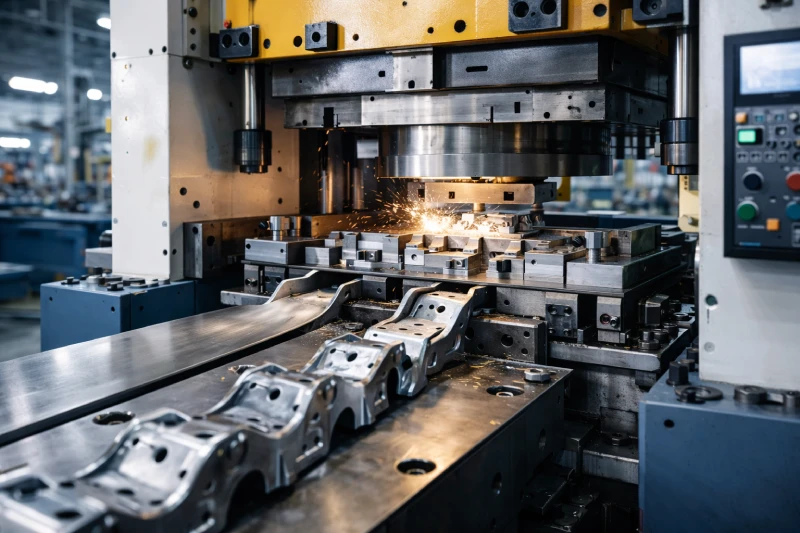
One of the most important advantages is precision motion control. Servo-driven presses allow the slide movement to be programmed with high accuracy. Engineers can control forming speed at specific points in the stroke, introduce dwell periods during critical forming stages, or adjust acceleration profiles to protect tooling and material.
This level of control supports flexible production lines, which are increasingly important in automotive factories. Vehicle platforms evolve frequently, and production lines must adapt to new parts or design updates. Servo press systems allow manufacturers to modify motion profiles through software adjustments rather than mechanical modifications, reducing downtime when switching between parts.
Another benefit is improved part consistency. Because servo presses provide stable and repeatable motion control, they reduce variability in the forming process. Consistent press motion results in uniform deformation, which improves dimensional accuracy and reduces downstream quality issues.
Servo presses also contribute to energy efficiency. Traditional mechanical presses run continuously and often consume energy even when no forming occurs. Servo-driven systems use energy primarily during the pressing cycle and can recover energy during deceleration phases. This helps reduce overall power consumption in high-volume production facilities.
Additionally, improved motion control can extend tool life. By optimizing slide speed and reducing impact forces during forming, servo presses place less stress on dies and tooling components. This reduces maintenance requirements and increases tooling durability in long production runs.
These operational advantages make servo press systems well suited for demanding automotive manufacturing environments.
Key Considerations When Selecting a Servo Press for Automotive Applications
Selecting the right servo press for automotive manufacturing requires careful evaluation of several technical factors. Production engineers must ensure that the press system matches the requirements of the intended forming operations.
One of the most important parameters is required tonnage capacity. Automotive parts vary widely in size and material strength, so the press must provide sufficient forming force without operating constantly near its maximum capacity. Proper tonnage selection ensures stable operation and extends machine lifespan.
Another important factor is stroke length. Different automotive components require different forming depths, and the press stroke must accommodate the geometry of the tooling and the part. Adjustable stroke capability can also improve flexibility when producing multiple parts on the same press line.
Cycle speed is also critical in high-volume production. Automotive manufacturing often requires thousands of parts per shift, so the press must maintain efficient cycle times while preserving forming accuracy. Servo presses allow manufacturers to balance speed and control by adjusting slide motion profiles according to the specific forming operation.
The control system capability of the servo press is equally important. Modern servo press machines rely on advanced control systems that allow engineers to program motion curves, monitor production parameters, and integrate with automated production lines. Integration with sensors and monitoring systems can help detect forming issues early and maintain consistent production quality.
Finally, manufacturers should consider tooling compatibility and production flexibility. Automotive production environments often require quick adjustments when new parts or vehicle models are introduced. Servo presses that support flexible programming and easy die integration can significantly reduce production changeover time.
Conclusion
Servo press technology plays an increasingly important role in automotive manufacturing as vehicle designs become more complex and production processes demand greater precision. By providing programmable motion control, stable forming behavior, and improved production flexibility, servo presses allow manufacturers to produce automotive components with higher accuracy and consistency.
Compared with conventional press systems, servo-driven presses offer greater adaptability to different part designs and materials, making them suitable for both traditional automotive components and emerging electric vehicle applications.
For manufacturers evaluating modern forming equipment, understanding the capabilities of servo press systems is an essential step toward improving production efficiency and maintaining consistent product quality.
