
Introduction
Global puzzle manufacturing standards continue to rise, as retail buyers and end consumers increasingly demand well-crafted jigsaw puzzles with tight interlocking pieces, burr-free edges, and uniform thickness. Subpar puzzle quality directly stems from unreliable production equipment, making industrial jigsaw puzzle die cutting machines the cornerstone of consistent, high-end puzzle output. For manufacturers aiming to scale production, improve customer satisfaction, and strengthen global brand credibility, investing in quality die cutting machinery is a key driver of sustainable business growth.
Selecting a professional jigsaw puzzle die cutting machine manufacturer is a vital strategic decision, not just a standard equipment purchase. Machine quality directly governs production stability, yield rates, operational costs, and long-term brand reputation. Many manufacturers opt for low-cost machinery to cut upfront expenses, only to face recurring production issues, high material waste, unplanned downtime, and declining customer trust. This guide highlights why quality should dominate your supplier evaluation process, analyzing core machine performance metrics, key technical benchmarks, and the long-term business value of partnering with premium puzzle die cutter manufacturers.
How Quality Directly Impacts Die Cutting Performance
The overall build quality of your industrial jigsaw puzzle die cutting machine directly dictates every critical part of your production workflow. From fine cutting precision and uniform piece sizing to day-to-day operational stability and long-term running costs, machine quality makes or breaks your product line. Well-built industrial puzzle die cutting equipment holds consistent performance through endless high-volume production runs. By contrast, cheap, lightweight die cutters create a domino effect of quality issues that drag down your product standard, increase waste, and eat into your profit margins over time.
Cutting Precision and Perfect Piece Interlocking
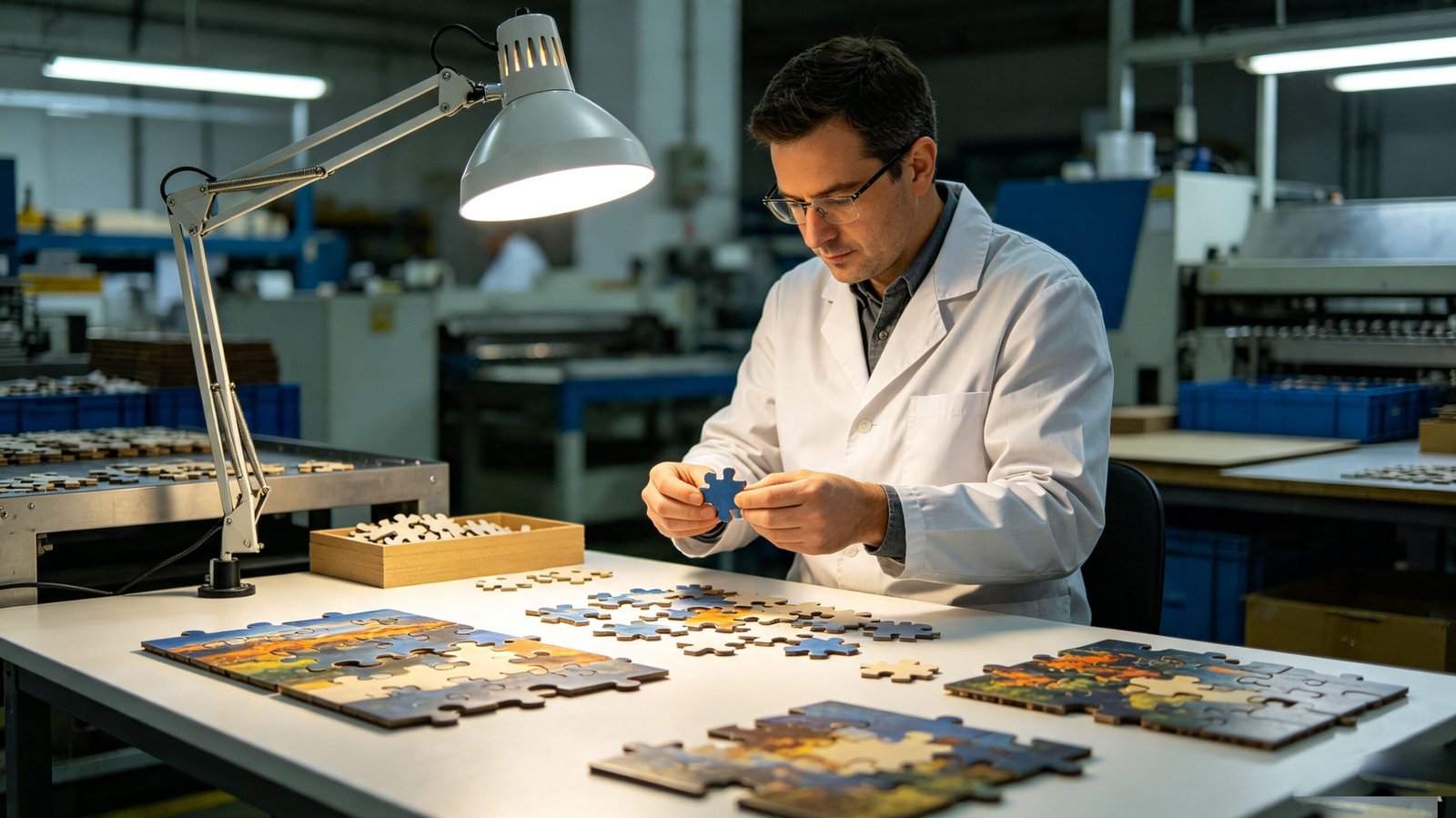
Reputable custom jigsaw puzzle die cutting machine manufacturers rely on a heavy-duty four-column guide frame as the backbone of their equipment. This proven engineering design keeps the machine bed and hydraulic ram perfectly parallel under pressure, ensuring even force distribution across the entire cutting surface. Consistent pressure eliminates most common manufacturing flaws—unfinished corner cuts, over-compressed center pieces, uneven thickness, and sharp edge burrs. The end result is clean, precisely cut puzzle pieces that lock together tightly without slipping or sticking, a defining feature of premium 1000-piece sets and custom-shaped puzzles sold by top retail brands.
On the flip side, low-cost jigsaw puzzle die cutting machines marketed toward small-scale operations use flimsy frames that flex and deform under repeated hydraulic pressure. This subtle structural instability creates uneven force during each cut, resulting in ill-fitting pieces, jagged edges, and inconsistent sizing across a single batch. These seemingly minor defects add up quickly, leading to customer complaints, returned orders, and a weakened brand reputation in the competitive global puzzle market.
Production Stability and Operational Efficiency
Established industrial puzzle die cutter manufacturers equip their heavy-duty machines with energy-efficient hydraulic systems paired with high-precision servo controls and user-friendly PLC touchscreens. This smart setup lets operators fine-tune cutting pressure, depth, and feed speed to match different raw materials, whether standard cardboard, thick plywood, or MDF puzzle boards. The refined cutting cycle delivers uniform results batch after batch, drastically cutting down defective units and boosting overall production yield.
Consistent machine stability is essential for uninterrupted high-volume production. High-quality automatic jigsaw puzzle die cutting machines run continuously through long factory shifts without drifting in precision or shutting down unexpectedly, maximizing daily output for large-scale puzzle manufacturers. Budget semi-automatic models, however, require frequent stops for recalibration and repairs. This unplanned downtime disrupts production schedules and limits your ability to scale order fulfillment.
Extended Die Lifespan and Reduced Maintenance Costs
Puzzle cutting dies are one of your most valuable production consumables, typically lasting 200,000 to 500,000 cutting cycles when operated under stable conditions. Unfortunately, low-grade hydraulic die cutters produce erratic pressure and excessive structural vibration, which wears down dies far faster than normal. Frequent die replacements create recurring operational expenses and lead to inconsistent cutting quality between production batches.
Premium servo-controlled jigsaw puzzle die cutting machines maintain steady, regulated pressure with every cutting stroke, protecting your dies from premature wear and preserving your tooling investment. By extending die lifespan and minimizing sudden equipment malfunctions, well-built industrial die cutters significantly lower long-term maintenance, replacement, and downtime costs for puzzle manufacturers of all sizes.
Key Technical Metrics to Evaluate Manufacturer Quality
Price should never be the deciding factor when shopping for commercial-grade jigsaw puzzle die cutting machines. To accurately judge a supplier’s reliability and equipment quality, you need to look beyond upfront costs and evaluate core technical features that determine long-term performance and consistency—especially if you handle custom orders and large-batch production. The following metrics separate professional industrial puzzle die cutter manufacturers from budget-focused overseas suppliers that prioritize low pricing over durable performance.
| Technical Dimension | Key Indicators & Function | Impact of Quality Difference |
|---|---|---|
| Frame Structure | Heavy-duty four-column or integrated frame-type construction delivers exceptional structural rigidity and long-term precision retention, designed to resist deformation under continuous hydraulic pressure. | Poor lightweight frame structures suffer gradual precision drift after prolonged use, causing uneven cutting, misaligned pieces, and frequent calibration requirements. |
| Hydraulic & Servo System | Advanced servo control systems reduce energy consumption by 30%-50% and support the optimized “fast-down, slow-cut, hold-pressure, fast-return” cutting cycle critical for clean puzzle cuts. | Non-servo basic hydraulic systems provide only coarse pressure control, generating strong mechanical impact forces that damage cutting dies, scratch puzzle materials, and increase defect rates. |
| Cutting Force & Tonnage | Matched tonnage options (30T, 135T, 500T and above) for different material thicknesses and puzzle sizes. High-quality machines sustain stable, consistent tonnage throughout every cutting cycle. | Insufficient or fluctuating cutting force leads to incomplete cuts, partially attached puzzle pieces, or crushed cardboard/wood materials, resulting in high scrap rates. |
| Automation Level | Integrated automatic feeding, dual shuttle worktables, and automatic waste removal systems boost overall production efficiency by 2-3 times compared to semi-automatic models. | Low-automation manual or semi-automatic machines limit production capacity, require extensive manual labor, and increase human error in material handling and positioning. |
The Manufacturer’s Quality Assurance System
Great machine performance does not come from high-end individual parts alone—it comes from a complete, rigorous quality assurance system. When sourcing jigsaw puzzle die cutting machines for bulk commercial production, always verify a manufacturer’s full-spectrum quality control standards, global compliance certifications, ability to customize equipment for unique materials, and speed of technical support.
Formal Quality Control Processes and International Certifications
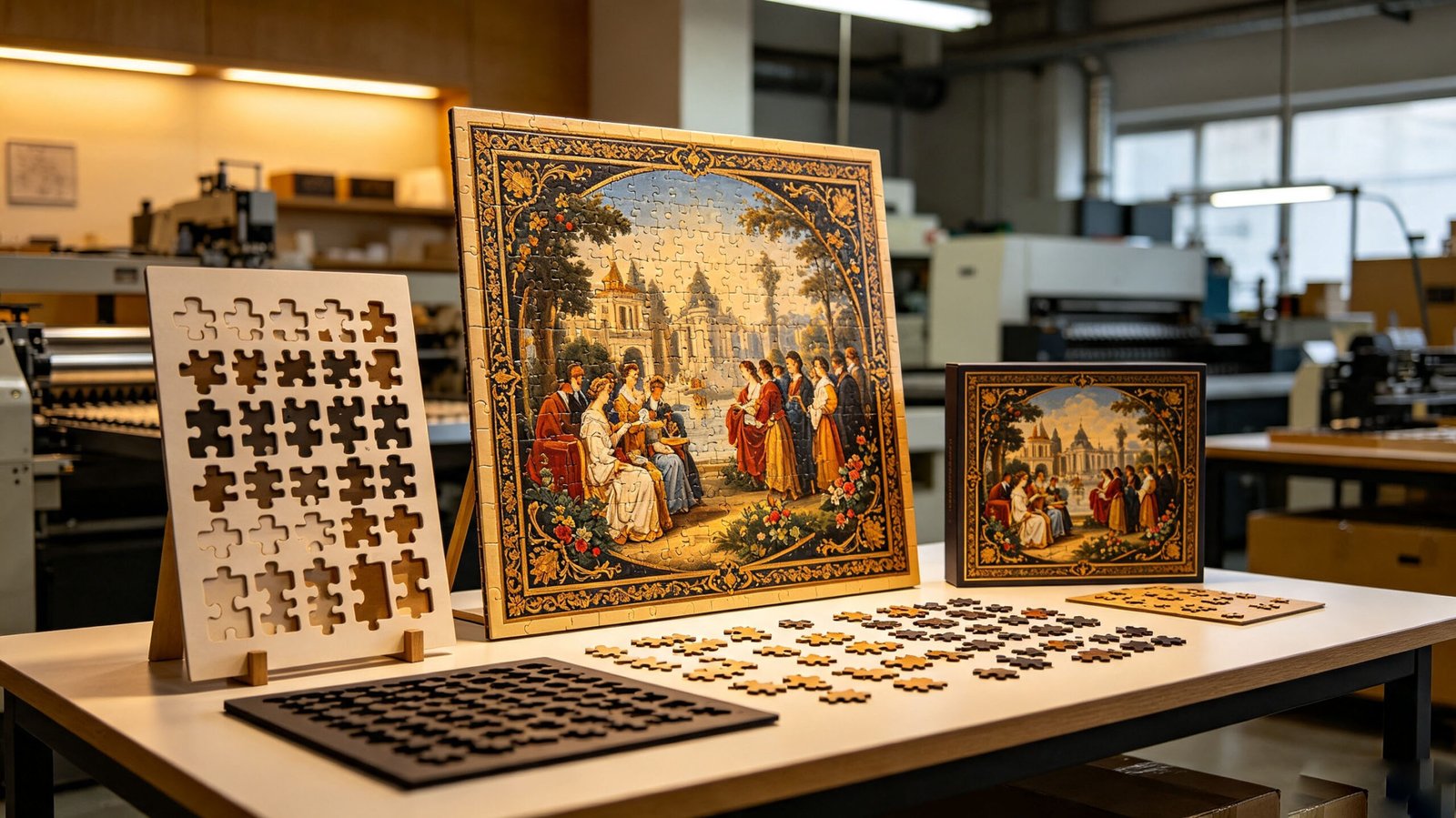
Trusted manufacturers enforce strict end-to-end quality management protocols, covering raw material inspections, precision component machining, calibrated assembly, full performance testing, and thorough pre-delivery debugging for every industrial puzzle die cutter. Global certifications like CE confirm that their commercial equipment meets international safety, operational, and environmental standards. Manufacturers without formal quality control procedures often ship uncalibrated machines that deliver inconsistent results from batch to batch.
Professional Customization and Technical Support
Puzzle production involves a wide range of materials and designs, from standard cardboard sheets and thick plywood to sturdy MDF panels, alongside fully custom irregular shapes and oversized puzzle formats. Qualified manufacturers tailor each industrial die cutting solution to your exact workflow, adjusting machine tonnage, cutting stroke length, and automation levels to match your unique production requirements. Generic one-size-fits-all machines simply cannot support differentiated, high-value custom puzzle product lines.
Timely After-Sales Service and Risk Mitigation
Industrial puzzle die cutting machines are long-term capital assets that require consistent professional support and routine preventive maintenance to perform at their best. Premium manufacturers provide fast remote technical guidance, reliable spare parts access, and ongoing system updates to keep your production lines running without unnecessary delays. For large bulk procurement projects, working with manufacturers that offer trial order options lets you test real-world machine performance before committing to full-scale equipment investments, greatly reducing business risk.
Long-Term Business Returns of Partnering With a Quality Manufacturer
Most puzzle manufacturers naturally focus on upfront equipment costs, assuming budget die cutters deliver better short-term savings. In practice, low-cost machinery creates persistent hidden expenses that kill long-term profitability. Investing in high-quality industrial die cutting equipment lowers waste, reduces unplanned downtime, and lets you produce higher-margin puzzle products, resulting in far stronger overall returns over the machine’s lifespan.
Superior Long-Term Total Cost of Ownership
Budget puzzle die cutting machines come with a low purchase price, but they carry constant hidden operational costs: frequent breakdowns that halt mass production, high scrap rates for cardboard and wooden puzzle materials, accelerated die wear that demands frequent replacements, and extra labor hours spent on repeated manual calibration. Premium industrial puzzle die cutters require a higher initial investment but maintain stable, low-cost operation for years, delivering a much lower total cost of ownership for professional puzzle manufacturing businesses.
Critical Brand Protection
In the global commercial puzzle industry, consistent product quality is the foundation of strong brand reputation. Loose-fitting pieces, rough edges, and uneven thickness lead directly to customer refunds, negative reviews, and lost brand credibility. Precision-built, stable hydraulic puzzle die cutting equipment ensures every batch of standard and custom puzzles meets uniform quality benchmarks, protecting your brand image and fostering long-term customer loyalty.
Support for High-Margin Premium Products
Entry-level machines are only capable of producing basic, low-profit standard puzzles with simple piece layouts. Today’s fastest-growing market opportunities center on complex, high-value puzzles featuring 1,000+ uniquely shaped pieces—products that demand extreme cutting accuracy and stable pressure control. Only seasoned custom jigsaw puzzle die cutting machine manufacturers can deliver the precision equipment needed to manufacture these premium products, helping your business capture high-end market share and boost profit margins.
FAQ
How do I choose the right machine tonnage for cardboard vs. plywood puzzles?
Standard cardboard puzzles work well with 30T to 135T cutting tonnage, delivering clean, crush-free cuts for lightweight paper-based materials. Thicker plywood and MDF puzzle boards require 500T or higher stable tonnage hydraulic die cutting machines to ensure full material penetration and uniform piece dimensions. Professional manufacturers always match machine tonnage to your specific materials and product specifications for optimal results.
What are the key after-sales differences between premium and budget manufacturers?
Budget-focused die cutter manufacturers typically offer only basic warranty coverage, with slow response times, limited spare parts inventory, and no remote troubleshooting support for industrial equipment. In contrast, premium suppliers deliver 24/7 technical consultation, remote fault diagnosis, scheduled maintenance reminders, and long-term spare parts availability to keep your commercial puzzle production running smoothly around the clock.
Why is a servo system essential for high-precision puzzle production?
Servo systems allow precise, real-time adjustment of cutting speed and pressure throughout the entire production cycle, eliminating the harsh, high-impact operation of traditional hydraulic setups. The tailored slow-cut and pressure-holding process removes edge burrs and piece deformation entirely, making servo technology indispensable for crafting high-precision, perfectly interlocking custom jigsaw puzzle pieces.
What real-world tests verify a machine’s cutting precision?
You can easily verify a die cutter’s real-world precision with simple in-house production tests. Run batch cutting trials to check piece interlocking tightness, measure thickness uniformity across different machine zones, inspect edge smoothness for burrs, and track defect rates during continuous 8-hour production runs. Consistent precision and minimal waste are the clearest indicators of a high-quality puzzle die cutting machine.
Conclusion
In today’s fiercely competitive global puzzle manufacturing market, partnering with a reliable jigsaw puzzle die cutting machine manufacturer is more than a operational purchasing decision—it is a foundational strategic choice that steers long-term business growth. As end consumers and retail brands continue to raise their standards for puzzle craftsmanship, consistent precision, smooth finishes, and perfect piece interlocking have become non-negotiable benchmarks for market success. While low-cost machinery offers tempting upfront savings, its structural instability, inconsistent cutting performance, and rapid tool wear trigger ongoing production losses, higher scrap rates, and gradual erosion of brand credibility over time. Premium, well-engineered die cutting equipment eliminates these pain points by delivering reliable operational stability, precise repeatable cutting results, and extended tool service life. This solid production foundation allows manufacturers to streamline mass production, cut unnecessary operational waste, and expand into high-value custom puzzle lines with complex designs and stringent precision demands. Ultimately, prioritizing manufacturing quality and professional supplier expertise is the most sustainable approach to sharpening market competitiveness, stabilizing product quality, and building a trustworthy, long-lasting brand presence in the global puzzle industry.
