
Introduction
Choosing the correct hydraulic press size is a critical engineering decision that directly affects process stability, tooling life, energy efficiency, and long-term equipment reliability. In real manufacturing environments, press selection errors rarely fail immediately; instead, they appear as inconsistent forming results, accelerated die wear, hydraulic overload, or structural fatigue over time.
A common mistake is to equate press size with part dimensions alone. In practice, required press capacity depends on multiple interacting factors, including the type of operation, material deformation behavior, tooling contact area, stroke conditions, and expected duty cycle. Selecting a press that is too small introduces operational risk, while excessive oversizing often leads to unnecessary cost and reduced control at lower loads.
This hydraulic press sizing guide is designed to support technical decision-making. It helps engineers and industrial buyers determine an appropriate press capacity range based on real application conditions, rather than relying on simplified rules or nominal tonnage assumptions.
Understand the Forming or Processing Operation
The first step in hydraulic press sizing is to clearly define what the press is required to do, not simply what the finished part looks like. Different manufacturing operations generate force in fundamentally different ways, even when working on similar materials or part dimensions.
Operation type determines force behavior
Common hydraulic press applications include forming, cutting, compression molding, laminating, press-fitting, and assembly. Each operation has a distinct force profile. For example, forming and molding processes typically build force progressively over the stroke, while cutting or blanking operations generate peak load rapidly near the bottom of the stroke. This difference directly affects required press capacity and frame rigidity.
Processes that involve material flow or gradual deformation usually allow better force control and tolerance to load variation. In contrast, operations with sudden resistance changes place higher instantaneous stress on the press structure and tooling, even if average force appears moderate.
Peak force location and process sensitivity
It is also important to identify where in the stroke peak force occurs and how sensitive the process is to force variation. Operations that require precise pressure control over a specific stroke range may demand a higher nominal press capacity than their average load suggests. Ignoring this factor can lead to unstable production, inconsistent part quality, or premature mechanical wear.
From an engineering perspective, press sizing should always begin with a clear understanding of the operation’s force generation characteristics, rather than relying on generalized tonnage assumptions.

Material Characteristics and Resistance to Deformation
After defining the operation type, the next critical factor in hydraulic press sizing is the material’s resistance to deformation. Required press capacity is not determined by material category alone, but by how the material responds to load under specific processing conditions.
Material behavior matters more than nominal strength
In press applications, materials do not behave as static test samples. Metals, composites, rubber, laminated boards, and engineered plastics all exhibit different deformation characteristics depending on thickness, internal structure, and whether deformation is elastic, plastic, or a combination of both. Some materials resist deformation gradually, while others exhibit a sharp increase in resistance once compression or forming begins.
Thickness trends also play a significant role. Increasing material thickness does not increase required press force in a linear way, particularly in forming or compression processes where material flow is restricted. Multi-layer or bonded materials further complicate force estimation, as internal friction and layer interaction can significantly raise resistance during pressing.
Qualitative comparison for early-stage sizing
At the press selection stage, material behavior is best evaluated using relative force demand, not precise strength values. This allows engineers to define a reasonable capacity range before final tooling or process trials are completed.
Typical qualitative grouping:
- Lower resistance materials with gradual deformation response
- Moderate resistance materials with mixed elastic–plastic behavior
- Higher resistance materials with limited deformation or abrupt load increase
Using this qualitative approach helps avoid underestimating press capacity while preventing unnecessary oversizing based on isolated material properties.
Tooling Contact Area and Force Distribution
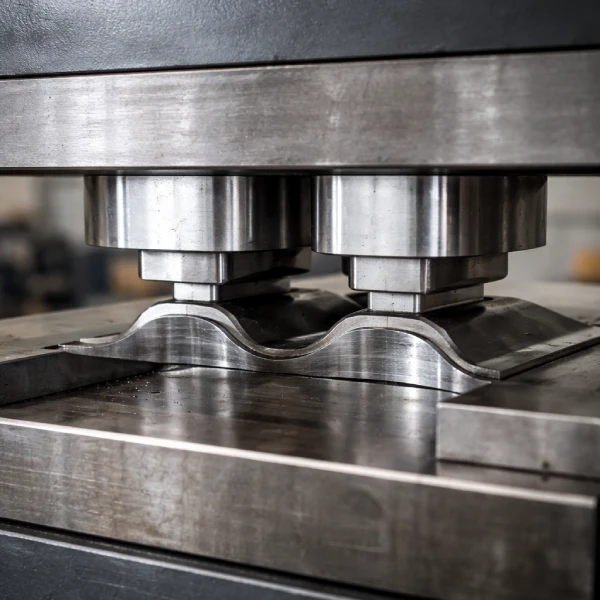
In hydraulic press sizing, required tonnage is driven not by the overall part size, but by the actual tooling contact area at peak load. This distinction is often overlooked and is a common source of press undersizing in real production environments.
Effective contact area at peak force
During pressing, force is transmitted only through areas where the tooling directly contacts the workpiece. Narrow cutting edges, ribs, embossing features, or localized forming zones concentrate load into small regions, significantly increasing pressure demand even when the overall part appears large and simple.
As a result, two parts with similar external dimensions may require very different press capacities if their tooling geometries differ. Operations involving segmented contact, progressive engagement, or sharp resistance transitions typically demand higher nominal press capacity and greater structural rigidity.
Force distribution and structural stability
Uneven force distribution also affects press frame behavior. Localized or asymmetrical loads increase the risk of platen deflection, misalignment, and uneven tool wear. Even when average load remains within nominal capacity, poor force distribution can lead to repeatability issues and reduced tooling life.
For reliable press selection, engineers should evaluate tooling geometry, contact sequence, and load symmetry together. Press capacity should be determined based on the worst-case contact condition, not the average operating load.
Stroke Length, Daylight, and Structural Envelope
Hydraulic press sizing is not complete once required tonnage is estimated. A press with sufficient force capacity may still be unsuitable if its stroke length, daylight, or structural envelope do not match the application. These geometric constraints often become limiting factors during installation or tooling setup rather than during initial calculation.
Stroke and open height requirements
Stroke length determines whether the press can complete the operation without excessive setup complexity. Forming, molding, and assembly processes often require controlled motion over a defined stroke range, not just force at the end of travel. Insufficient stroke can prevent proper material positioning, tool engagement, or safe unloading.
Daylight, or maximum open height between platens, must account for the full tooling stack, fixtures, and any future process modifications. Selecting a press with minimal clearance leaves little tolerance for tooling changes and increases the risk of improper setup.
Structural envelope and integration constraints
The press frame, platen size, and overall machine envelope must also align with the workpiece footprint and handling method. Presses that technically meet tonnage requirements may still limit productivity if they restrict access, automation integration, or part orientation.
From an engineering standpoint, press geometry should be evaluated together with force capacity to ensure the machine can perform the intended operation reliably and repeatably.
Safety Margins, Duty Cycle, and Long-Term Reliability
Hydraulic press capacity should never be selected based solely on calculated working load. In real production environments, variations in material batches, tooling condition, and operating rhythm introduce load fluctuations that must be absorbed safely by the press system.
Capacity margin and operational tolerance
A reasonable capacity margin allows the press to handle short-term load increases without operating continuously at its structural or hydraulic limits. Presses that run near maximum rated capacity tend to experience higher thermal load in the hydraulic system, increased seal wear, and greater frame stress over time. These effects are cumulative and often appear as reliability issues rather than immediate failure.
Capacity margin also improves process stability. Operating within a comfortable load range provides better pressure control and repeatability, especially for processes sensitive to force variation or dwell time.
Duty cycle and production reality
Duty cycle is frequently underestimated during press selection. Intermittent prototype work and continuous production place very different demands on the same press. High cycle frequency, extended dwell times, or multi-shift operation increase thermal and mechanical stress even when individual cycles appear moderate.
From an engineering perspective, press sizing should reflect real operating conditions, not idealized calculations. Considering safety margin and duty cycle together helps ensure long-term reliability, predictable maintenance intervals, and consistent product quality throughout the press’s service life.
Typical Sizing Pitfalls in Hydraulic Press Selection
Many hydraulic press sizing problems originate not from incorrect calculations, but from incomplete evaluation of real operating conditions. The following issues are frequently observed in industrial press selection projects.
One common mistake is relying on nominal press tonnage without understanding how force is delivered throughout the stroke. A press that meets peak load requirements on paper may still perform poorly if force buildup, rigidity, or control characteristics are mismatched with the process.
Another frequent issue is sizing based on part dimensions rather than tooling contact area. This often leads to underestimating localized loads, resulting in platen deflection, uneven wear, or inconsistent product quality.
Oversizing can also be problematic. Selecting excessive capacity to “stay safe” increases cost and energy consumption while reducing control accuracy during low-load operation.
Finally, future process changes are often ignored. Tool wear, material variation, and potential product upgrades should be considered during selection to avoid early capacity limitations or unnecessary machine replacement.
Conclusion
Determining the correct hydraulic press size requires more than selecting a nominal tonnage value. Press capacity must be evaluated in the context of the specific operation, material behavior, tooling contact conditions, machine geometry, and expected duty cycle. Each of these factors influences not only whether the press can perform the task, but whether it can do so consistently, efficiently, and reliably over time.
A well-sized press operates within a stable load range, protects tooling, and provides the flexibility needed for real production variability. Before finalizing a specification, practical evaluation and engineering review are essential, especially for applications with localized loads or continuous operation. As an equipment manufacturer with application-focused engineering experience, Shuntec Press supports press sizing decisions through technical analysis and configuration guidance to ensure the selected press aligns with real manufacturing requirements.
