
Modern manufacturing depends on precise, repeatable assembly processes. Whether a factory is installing bearings into a gearbox housing, pressing bushings into an automotive frame, or assembling precision electronic components, manufacturers need a controlled way to apply force without damaging the part. This is where an assembly press becomes essential.
An assembly press is a machine designed to join, insert, fit, or assemble components by applying controlled pressure. Unlike manual assembly methods, an industrial assembly press delivers consistent force, repeatable accuracy, and higher production efficiency. This makes it especially valuable in industries where tight tolerances and product reliability are critical.
Today, assembly presses are widely used in automotive manufacturing, heavy machinery, electronics, appliance production, metal fabrication, and frame assembly. Hydraulic, pneumatic, and servo-driven systems each offer different advantages depending on the required force, speed, and precision.
In this guide, you will learn what an assembly press is, explore the different types of assembly press machines, understand their industrial applications, and discover how to choose the right assembly press solution for your production line.
What Is an Assembly Press?
An assembly press is a specialized industrial machine that applies controlled force to assemble two or more components together. It is commonly used for press-fit operations, inserting bearings, bushings, shafts, gears, fasteners, pins, and other components into a final product.
Unlike general assembly equipment such as conveyors, robotic arms, or fastening tools, an assembly press focuses specifically on delivering a defined pressing force and stroke. The goal is to ensure that the component is installed accurately, evenly, and without damage.
For example, when a bearing must be inserted into a housing, the amount of force applied is critical. Too little force can lead to poor fit and product failure. Too much force can deform the component or damage the surrounding structure. An assembly press solves this problem by controlling the exact force, speed, and travel distance during the operation.
Assembly presses can use different drive technologies:
- Hydraulic systems for high force applications
- Pneumatic systems for fast and economical operations
- Servo systems for highly precise, programmable assembly tasks
Each type is designed for different production needs, from simple manual workstations to fully automated manufacturing lines.
For a more detailed explanation of how these machines work, see What Is an Assembly Press?.
Types of Assembly Press Machines
There are several types of assembly press machines used in manufacturing. The right choice depends on the force required, the desired level of precision, production speed, and budget.
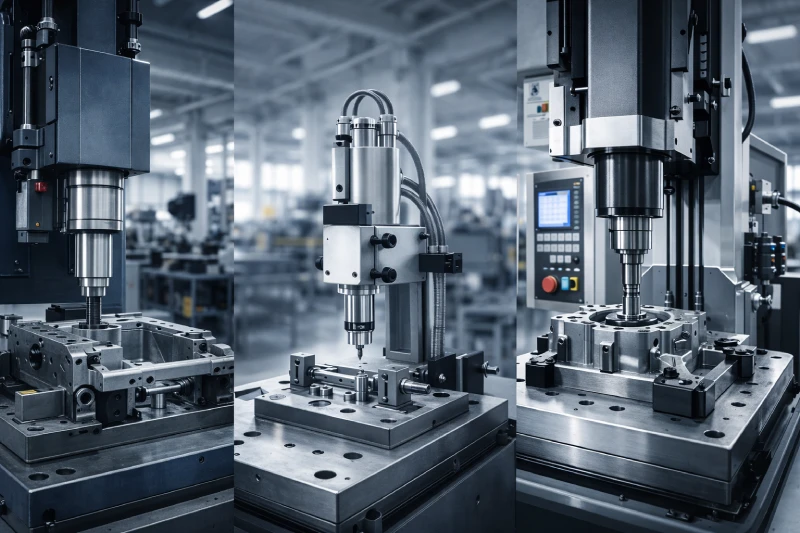
Hydraulic Assembly Press
A hydraulic assembly press uses hydraulic cylinders and fluid pressure to generate large amounts of force. These machines are commonly used when manufacturers need to install large bearings, gears, shafts, or structural components.
Hydraulic assembly presses are ideal for heavy-duty operations because they can deliver very high pressing force while maintaining smooth and stable movement. They are often used in automotive, machinery, frame assembly, and metal fabrication applications.
Typical advantages include:
- High force capacity
- Suitable for large parts and heavy-duty assemblies
- Stable pressing motion
- Good for long stroke applications
However, hydraulic systems are generally slower than pneumatic systems and may require more maintenance due to pumps, valves, and hydraulic oil.
Learn more about these systems in our guide to the Hydraulic Assembly Press.
Pneumatic Assembly Press
A pneumatic assembly press uses compressed air to generate pressing force. Compared with hydraulic systems, pneumatic presses are usually smaller, faster, and more cost-effective.
Pneumatic assembly presses are commonly used for light-duty applications such as inserting small pins, fasteners, connectors, plastic parts, and electronic components. Because compressed air systems respond quickly, pneumatic presses are well suited for high-speed production environments.
Key benefits include:
- Fast cycle times
- Lower cost and simpler design
- Clean operation with minimal maintenance
- Suitable for lighter assembly work
The main limitation is that pneumatic presses cannot produce the same force levels as hydraulic or servo presses. For this reason, they are typically used for lower-force applications.
See our detailed article on the Pneumatic Tool Assembly Press for more information.
Servo Assembly Press
A servo assembly press uses an electric servo motor to control the pressing process. This type of press provides the highest level of precision, repeatability, and programmability.
Servo assembly presses allow manufacturers to control:
- Exact force
- Pressing speed
- Position and stroke
- Multiple stages within a single cycle
Because of this, servo presses are widely used in industries that require tight tolerances and full process monitoring, such as automotive engine assembly, electronics, medical devices, and precision machinery.
A servo press can also record force-displacement curves during each cycle, making it easier to verify quality and trace production data. Although servo assembly presses usually cost more than hydraulic or pneumatic models, they provide better control and lower long-term waste in precision manufacturing.
Common Industrial Applications of Assembly Presses
Assembly presses are used in a wide range of industries. Their role is to ensure that parts are installed accurately and consistently while reducing manual labor and improving product quality.
Automotive Engine Assembly
In automotive engine production, assembly presses are commonly used to install bearings, pistons, sleeves, bushings, valve guides, seals, and other precision engine components.
These parts must be assembled with exact force and alignment. Even a small error can affect engine performance, vibration levels, or long-term durability. For this reason, automotive manufacturers often use servo or hydraulic assembly presses for engine production.
Servo presses are especially valuable because they can monitor the pressing force in real time and confirm that each component is installed correctly. Hydraulic presses are also used when higher force is required for larger engine parts.
To learn more, visit our guide on the Assembly Press for Automotive Engine.
Transmission Assembly
Transmission systems contain many tightly fitted components, including gears, shafts, bearings, synchronizers, bushings, and clutch elements. These parts must be assembled with high force and excellent accuracy.
An assembly press for transmission production is designed to handle these demanding requirements. Hydraulic presses are often used when high pressing force is necessary, while servo presses are preferred when the manufacturer needs accurate force control and quality monitoring.
Modern transmission assembly lines often use automated assembly presses integrated with robots, conveyors, and inspection systems. This allows manufacturers to increase productivity while reducing the risk of assembly errors.
Read more about this process in our article on the Assembly Press for Transmission.
Frame Assembly
Frame assembly presses are used to join structural components in products such as vehicle frames, industrial equipment, appliances, furniture, and metal structures.
Unlike precision bearing insertion, frame assembly often involves larger parts and longer stroke lengths. The assembly press must apply even force across a wide area to avoid distortion or misalignment.
Hydraulic frame assembly presses are commonly used because they provide the large force required for these applications. In some cases, manufacturers may also use multi-station presses or custom fixtures to assemble large frames more efficiently.
Common frame assembly applications include:
- Automotive chassis and subframes
- Metal furniture frames
- Industrial machine structures
- Equipment housings and support frames
For additional information, see our guide to the Frame Assembly Press.
General Industrial Press-Fit Assembly
Many industries use assembly presses for general press-fit operations. Examples include:
- Inserting bearings into housings
- Installing bushings into metal components
- Pressing pins into brackets
- Fitting electrical connectors into assemblies
- Joining shafts and gears
- Installing seals and sleeves
These operations are common in industries such as machinery manufacturing, consumer products, electronics, aerospace, appliances, and industrial equipment.
Compared with manual assembly methods, an assembly press improves repeatability, reduces operator fatigue, and lowers the risk of defective products. It also makes it easier to standardize the production process across multiple workstations or manufacturing plants.
How to Choose the Right Assembly Press
Choosing the right assembly press requires more than simply selecting the highest force capacity. Manufacturers must consider the specific requirements of the application, the production environment, and future automation plans.
Required Force
The first step is determining how much force is needed to complete the assembly operation. Small electronic components may require only a few hundred newtons, while large automotive parts may require several tons of pressing force.
Always choose a press with slightly more capacity than the minimum required. This provides a safety margin and prevents overloading the machine.
Stroke Length
Stroke length refers to how far the press ram travels during operation. Large parts or deep assemblies require longer stroke lengths, while small precision parts may only need a short travel distance.
If the stroke is too short, the assembly operation cannot be completed. If it is unnecessarily long, the cycle time may become slower.
Precision and Repeatability
Some assembly operations only require basic force control, while others demand extremely high precision. For example, installing an engine bearing may require precise monitoring of both force and position.
Servo assembly presses provide the highest precision and repeatability. Hydraulic presses are suitable for high-force work, while pneumatic presses are often sufficient for simpler operations.
Automation Requirements
Modern manufacturing increasingly depends on automated production lines. If the assembly press must work with robots, conveyors, sensors, or inspection systems, the machine should support automation interfaces and programmable controls.
Servo assembly presses are especially well suited for automated systems because they can store multiple programs and communicate with other equipment.
Production Volume
Low-volume production may only require a manual or semi-automatic press. High-volume production lines often need fully automated assembly press systems with faster cycle times and quality monitoring.
When planning for long-term growth, manufacturers should also consider whether the press can be upgraded in the future.
Featured Assembly Press Solutions
Modern manufacturers often need more than a standard machine. Different products require different pressing force, stroke, fixtures, automation levels, and quality control systems. For this reason, many companies choose custom assembly press solutions.
A custom assembly press can be configured with:
- Hydraulic, pneumatic, or servo drive systems
- Single-station or multi-station layouts
- Force monitoring and data collection
- Automated loading and unloading
- Custom tooling and fixtures
- Integration with robotic production lines
For example, an automotive manufacturer may need a servo press with force-displacement monitoring, while a heavy machinery producer may require a hydraulic press with a larger frame and higher tonnage.
The best solution depends on the product being assembled, the required production speed, and the level of quality control needed.
To explore available models and custom configurations, visit our Assembly Press Manufacturer page.
FAQ
What is an assembly press used for?
An assembly press is used to join or insert components using controlled force. Typical applications include installing bearings, bushings, gears, shafts, pins, fasteners, seals, and structural components.
What is the difference between a hydraulic and servo assembly press?
A hydraulic assembly press uses hydraulic fluid to create high force and is best for heavy-duty applications. A servo assembly press uses an electric servo motor and provides higher precision, programmability, and process monitoring.
Which industries use assembly presses?
Assembly presses are widely used in automotive manufacturing, transmission assembly, engine production, machinery, electronics, aerospace, appliance manufacturing, and frame assembly.
Which type of assembly press is best for automotive production?
Automotive manufacturers often use both hydraulic and servo assembly presses. Hydraulic systems are suitable for larger, high-force components, while servo systems are preferred when precise force control and quality monitoring are required.
Can an assembly press be integrated into an automated production line?
Yes. Modern assembly presses can be integrated with robots, conveyors, sensors, and quality inspection systems. This allows manufacturers to improve production speed, reduce labor costs, and maintain consistent quality.
Should I choose a standard or custom assembly press?
A standard press may be sufficient for simple applications, but custom assembly presses are usually the better option when the product requires unique force, tooling, stroke length, automation, or quality control features. A custom solution ensures the press matches your exact production requirements.
