
Modern automotive transmissions are built from dozens of precision-machined components that must fit together with exact alignment and controlled force. Bearings, shafts, gears, seals, and housings all require highly accurate press-fit assembly to ensure the transmission operates smoothly and reliably over millions of cycles. Even a slight error in force or positioning can lead to premature wear, increased noise, leakage, or complete transmission failure.
For this reason, transmission manufacturers rely on specialized assembly press systems rather than general-purpose pressing equipment. Advanced assembly presses provide the accuracy, repeatability, and process monitoring needed for modern production lines. Whether assembling automatic, manual, CVT, or electric vehicle transmissions, the right press system helps manufacturers install bearings, shafts, gears, and housings without damaging sensitive components while maintaining strict production tolerances.
Why Transmission Assembly Requires Specialized Press Systems
Transmission assembly is far more demanding than general mechanical assembly. Components inside a transmission must work together with extremely tight tolerances, often measured in hundredths or thousandths of a millimeter. If a bearing is pressed too deep, a shaft is slightly misaligned, or a housing is distorted during assembly, the entire transmission can suffer from vibration, gear noise, excessive friction, or shortened service life.
One of the biggest challenges is maintaining perfect alignment during the pressing process. Gear shafts and bearings must enter the housing in a straight, controlled path. Even minor angular misalignment can damage the component surface or create uneven loading once the transmission is operating.
Specialized assembly presses are designed to solve these problems through:
- Precise force control during each stage of the pressing cycle
- Accurate position feedback to ensure the correct insertion depth
- Rigid machine structures that prevent deflection under load
- Monitoring systems that detect abnormal force or displacement
- Custom tooling that keeps components aligned during assembly
Incorrect pressing force is another major risk in transmission manufacturing. Too little force can result in loose fits that fail during operation. Too much force can crack housings, deform bushings, damage bearing races, or create microscopic defects in gears and shafts. Because many transmission components are expensive and difficult to replace, manufacturers need a press system that applies only the exact amount of force required.
This is why automotive manufacturers increasingly use dedicated transmission assembly presses rather than conventional shop presses or manual assembly methods.
Typical Components Installed Using a Transmission Assembly Press
A transmission assembly press is used throughout the production process to install multiple precision components. Different stations on the assembly line may use different press capacities and tooling depending on the part being assembled.
Bearings
Bearings are among the most common components installed with a transmission assembly press. Input shaft bearings, output shaft bearings, needle bearings, and tapered roller bearings must be inserted into housings or onto shafts with precise depth and force.
Improper bearing installation can create internal preload problems, increased friction, and premature bearing failure. A controlled press ensures that the force is applied only to the correct bearing surface, preventing damage to the rolling elements or bearing race.
Gear Shafts
Transmission gear shafts often require press-fit installation into housings, gear clusters, or supporting assemblies. Because shafts must remain perfectly concentric and aligned, the press system must provide highly accurate positioning.
Servo-driven presses are especially useful for shaft installation because they can control both force and displacement throughout the entire pressing cycle. This reduces the risk of shaft tilt, surface scratching, or excessive interference.
Bushings
Bushings support rotating shafts and help reduce friction inside the transmission. These components are typically thin-walled and easily damaged if installed unevenly. A specialized press with alignment tooling can insert bushings smoothly while preventing distortion.
Bushing installation often requires relatively low force but very high positional accuracy. If the bushing is installed too deep or at the wrong angle, it can affect shaft movement and lubrication performance.
Housings
Transmission housings are large, expensive components that frequently require bearing races, sleeves, seals, or subassemblies to be pressed into place. Because the housing material is often aluminum or lightweight alloy, excessive pressing force can permanently deform the part.
Assembly presses used for housing work must provide consistent force control and stable tooling support. Multi-axis fixtures are sometimes used to hold the housing securely while components are installed.
Seals
Oil seals and sealing rings are critical to preventing fluid leakage in transmission systems. These parts require extremely consistent insertion depth and even pressure around the seal circumference.
If a seal is installed too deep, too shallow, or unevenly, it may leak during operation. A dedicated seal press station can ensure repeatable installation while protecting the seal lip from damage.
Why Servo and Hydraulic Assembly Presses Are Used in Transmission Manufacturing
Transmission manufacturers most commonly use servo assembly presses and hydraulic assembly presses because these systems provide the force control, repeatability, and flexibility required for demanding automotive applications.
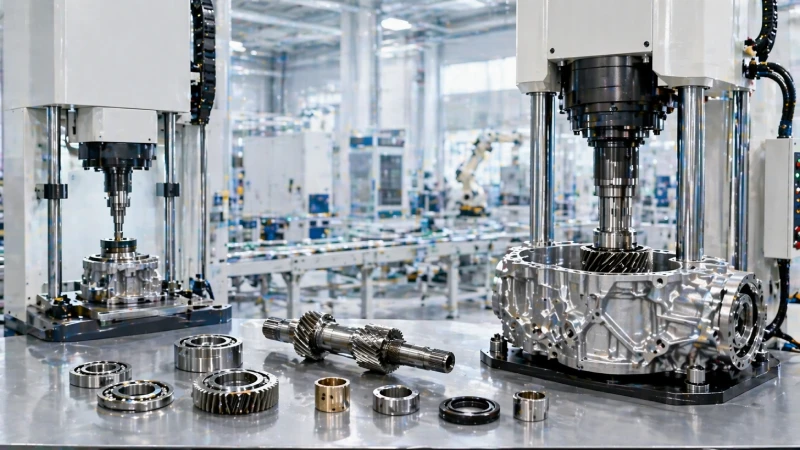
Servo Press Advantages
Servo assembly presses are widely used in modern transmission production because they offer exceptional control over force, speed, and position. The electric servo motor allows the press ram to move precisely according to a programmed motion profile.
Key advantages of servo presses include:
- Extremely accurate force and position control
- Ability to program different motion curves for different components
- Real-time monitoring of force-displacement curves
- Faster cycle times for high-volume production
- Easy integration with automated assembly lines and robotics
- Better repeatability across large production batches
For example, when installing a transmission bearing, the servo press can approach the component quickly, slow down before contact, then apply the exact pressing force required until the correct insertion depth is reached. The machine can also stop automatically if the measured force is outside the acceptable range.
Servo presses are particularly useful for electric vehicle transmissions and advanced automotive drivetrains where tighter tolerances and more complex assembly requirements are common.
Hydraulic Press Advantages
Hydraulic assembly presses remain an important solution for transmission manufacturing, especially when higher pressing force is required. These machines use hydraulic cylinders to generate large amounts of force while maintaining smooth, stable movement.
Hydraulic presses are commonly used for:
- Installing large bearings or heavy gear shafts
- Pressing components into large transmission housings
- Applications requiring very high tonnage
- Production lines where flexibility and ruggedness are more important than maximum speed
Compared with servo presses, hydraulic systems are often more cost-effective for heavy-duty applications. They can generate substantial force without requiring a large mechanical structure.
Modern hydraulic assembly presses also include force sensors, position control, and programmable cycles, making them suitable for precision automotive assembly. You can learn more about these systems in our Hydraulic Assembly Press guide.
In many transmission plants, manufacturers use both servo and hydraulic presses at different stages of the production line. Servo presses handle delicate or highly precise components, while hydraulic presses are used for larger, higher-force operations.
Key Specifications to Consider for Transmission Assembly Presses
Selecting the correct transmission assembly press requires more than simply choosing the required tonnage. Manufacturers must evaluate several technical specifications to ensure the press matches the production process.
Press Force
The first specification to consider is press force. Different transmission components require different levels of force depending on their size, material, and interference fit.
Typical transmission assembly applications may require:
- 5–20 kN for small seals and bushings
- 20–80 kN for bearings and medium-sized shafts
- 80–300 kN or more for large shafts and housings
Choosing a press with insufficient force can lead to incomplete assembly, while selecting an oversized machine may reduce precision and increase equipment cost.
Stroke Length
Stroke length refers to the total travel distance of the press ram. Transmission assembly often involves components of different heights and varying insertion depths, so the machine must provide enough stroke for the entire process.
A longer stroke also makes it easier to accommodate different tooling setups or future product changes. However, excessive stroke can reduce cycle speed, so manufacturers should balance flexibility and productivity.
Position Control
Precise position control is essential because many transmission components must be installed to an exact depth. Advanced assembly presses use linear encoders or displacement sensors to measure ram position in real time.
Position control allows the press to:
- Stop at the exact insertion depth
- Detect if a component is installed incorrectly
- Maintain consistent quality across every production cycle
This is especially important for seals, bearings, and bushings.
Force Monitoring
Modern transmission assembly presses use integrated load cells and process monitoring software to record force during the entire press cycle. This creates a force-displacement curve that can be used for quality verification.
If the measured force is too high or too low, the machine can reject the part immediately. This prevents defective assemblies from moving further down the production line.
Force monitoring also helps manufacturers trace production data and meet automotive quality standards such as IATF 16949.
Automation Compatibility
Most automotive transmission factories require assembly presses that can integrate with robots, conveyors, barcode scanners, vision systems, and MES software.
A press designed for automation compatibility can:
- Exchange data with factory control systems
- Receive automatic part identification information
- Support robotic loading and unloading
- Enable fully automated production cells
This is particularly important for high-volume automotive manufacturing where efficiency and traceability are critical.
How to Choose the Right Assembly Press for Your Transmission Line
The best assembly press for a transmission production line depends on production volume, component type, automation level, and future expansion plans.
For lower-volume production or prototype work, a manual or semi-automatic press may be sufficient. These systems are more affordable and flexible, making them suitable for small production runs, repair operations, or development projects.
However, manual systems depend heavily on operator skill and may not provide the consistency required for large-scale automotive manufacturing.
Semi-automatic presses offer a balance between flexibility and productivity. The operator loads the part, while the machine controls force, position, and cycle parameters. This approach is common for medium-volume production where multiple transmission variants are assembled on the same line.
Fully automated assembly presses are the preferred solution for high-volume transmission manufacturing. These systems integrate directly with robots, conveyors, and inspection equipment to achieve faster cycle times and lower labor cost.
When comparing different press systems, manufacturers should also consider whether production is high-volume or low-volume:
- High-volume lines benefit from servo presses with full automation and data monitoring
- Low-volume or mixed-model production often requires flexible tooling and programmable settings
- Heavy-duty applications may require hydraulic presses with higher force capacity
Custom tooling is another critical factor. Standard press machines rarely provide the exact support needed for transmission components. Manufacturers often require:
- Dedicated fixtures for specific housings or shafts
- Alignment tools to prevent part tilting
- Special press heads for bearings or seals
- Quick-change tooling for multiple product variants
The most effective solution is usually a customized press system designed specifically for the transmission components being assembled.
Conclusion
Transmission assembly demands far more precision than standard pressing operations. Bearings, shafts, bushings, housings, and seals all require exact force, perfect alignment, and repeatable installation depth. Specialized servo and hydraulic assembly presses help automotive manufacturers improve quality, reduce defects, and increase production efficiency.
Whether you need a compact press for a single transmission component or a fully automated line for high-volume automotive production, choosing the right system is essential.
