For commercial puzzle manufacturers, custom print shops, and gift product suppliers across Europe and North America, understanding the full technical specifications of a 1000 piece puzzle cutting machine is the foundation of stable, high-quality puzzle production. Unlike general cardboard die-cutting equipment, professional 1000-piece jigsaw puzzle cutters are engineered with exclusive parameters to meet the precise interlocking requirements of adult standard puzzles, ensuring consistent piece size, clean cutting edges, and long-term operational stability.
Most production defects—including loose puzzle joints, stuck pieces, burr edges, and incomplete cutting—stem from mismatched machine parameters rather than operational errors. This article systematically breaks down all core technical specs of a qualified hydraulic die cutting machine for 1000 piece jigsaw puzzles, covering mechanical structure, power configuration, precision standards, production capacity, material adaptability, and safety parameters. It serves as an authoritative technical reference for factory procurement, equipment comparison, and production line optimization.
1. Core Working & Structural Specifications
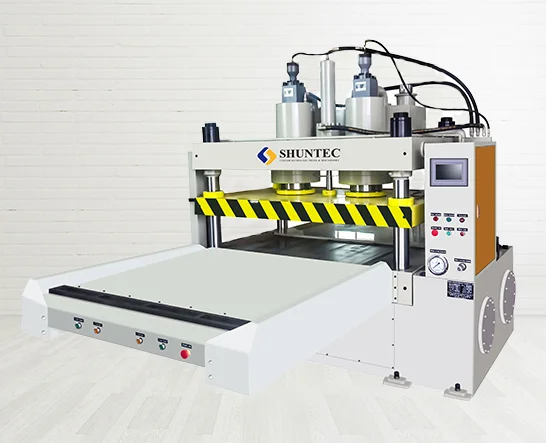
Industrial-grade commercial jigsaw puzzle cutting machine for cardboard puzzle production adopts a four-column hydraulic pressure structure, the most reliable design for long-term continuous puzzle die-cutting work. This structural configuration effectively reduces equipment vibration during high-pressure operation, guarantees uniform pressure distribution across the entire cutting bed, and avoids local incomplete cutting or over-compression of puzzle cardboard.
The standard machine dimension for 1000-piece puzzle production is 3000mm × 2100mm × 2050mm, with a net equipment weight of 9000kg to 15000kg. The heavy-duty steel frame and reinforced base eliminate equipment displacement caused by long-term high-frequency pressing, maintaining stable cutting accuracy for years. The machine’s maximum working stroke reaches 220mm, and the adjustable opening distance ranges from 70mm to 80mm, reserving sufficient space for manual feeding, die replacement, and multi-layer stacked cutting.
The cutting bed size is a decisive structural parameter for 1000-piece puzzle production. Standard adult 1000-piece jigsaw puzzles require a raw cardboard sheet size of 700mm × 500mm. Qualified puzzle cutting machines are equipped with a super-large working table of 800mm × 600mm, fully compatible with standard 1000-piece puzzle blanks while reserving space for edge trimming and positioning adjustment. The sliding table design of semi-automatic 1000 piece puzzle cutter machine further optimizes feeding stability and operational safety.
2. Hydraulic Tonnage & Pressure Parameters
Hydraulic tonnage is the most critical parameter determining cutting quality for 1000-piece puzzles, directly affecting cutting completeness and edge flatness. Many small-scale manufacturers mistakenly purchase low-tonnage equipment, resulting in high scrap rates and unstable product quality. For standard single-layer 1.8mm–2.5mm thick puzzle grey cardboard, the minimum effective working tonnage of a professional puzzle cutter is 200 tons.
For factories pursuing high-efficiency mass production and adopting multi-layer stacked cutting processes, a 300–600 ton hydraulic die cutting machine for 1000 piece jigsaw puzzles is highly recommended. Higher stable hydraulic pressure ensures synchronous and thorough cutting of all puzzle pieces in one stroke, even when stacking 2–3 layers of cardboard. Different from ordinary mechanical platen cutters, hydraulic puzzle cutting machines deliver constant pressure output without pressure attenuation, ensuring every puzzle tab and slot achieves consistent cutting effect.
The machine is equipped with an intelligent pressure adjustment system, supporting stepless pressure regulation according to cardboard thickness and hardness. The built-in pressure sensor monitors real-time hydraulic data, automatically compensating pressure deviation to avoid defective products caused by pressure fluctuation. This parameter advantage greatly reduces manual debugging difficulty and improves product yield for batch production.
3. Precision & Dimensional Tolerance Specifications
Precision tolerance is the core competitiveness of high-end low maintenance puzzle cutting machine for mass puzzle production, and it is also the key standard for distinguishing industrial equipment from ordinary civilian cutting machines. Premium 1000-piece adult puzzles sold in European and American markets have extremely strict requirements for piece fitting, and the industry’s qualified tolerance standard is controlled within ±0.15mm.
Formal industrial puzzle cutting machines adopt servo positioning and precision guide rail calibration technology, with repeated positioning accuracy up to ±0.1mm, far exceeding the industry basic standard. This ultra-high precision ensures that all puzzle pieces have consistent size and radian, avoiding two common quality problems: excessive tight assembly causing piece jamming, and excessive gaps leading to loose puzzle splicing.
In addition to dimensional tolerance, the machine’s flatness deviation of the cutting bed is controlled within 0.03mm per square meter. The overall flatness of the working table ensures uniform stress on the puzzle die and cardboard, preventing local uneven cutting caused by table tilt. For customized special-shaped 1000-piece puzzles, this high-precision parameter can perfectly restore the design pattern and piece structure.
4. Power & Electrical Configuration Parameters
To adapt to global industrial power supply standards, especially the grid requirements of EU and US factories, qualified 1000 piece puzzle cutting machine supports wide voltage customization, covering AC220V, AC380V, and 400V three-phase power supplies. The rated total power of the equipment is 22kW, with low power consumption and high energy efficiency, meeting the energy-saving and environmental protection standards of European industrial production.
The whole machine adopts high-quality servo motors and solid-state relay control components, with low operating noise and stable circuit operation. The servo drive system optimizes the hydraulic pressing and reset speed, reducing equipment wear and failure rate. All electrical components comply with UL and CE certification standards, effectively avoiding customs detention and safety risks for cross-border equipment procurement.
Equipped with a full PLC intelligent control panel, the machine supports one-click setting of cutting frequency, pressing time, and reset stroke. The digital parameter display interface allows operators to intuitively view real-time working data, facilitating parameter adjustment and production data statistics. The intelligent power-off protection and overload protection functions automatically cut off the power supply in case of equipment overload or abnormal operation, protecting the machine and improving production safety.
5. Production Efficiency & Output Parameters
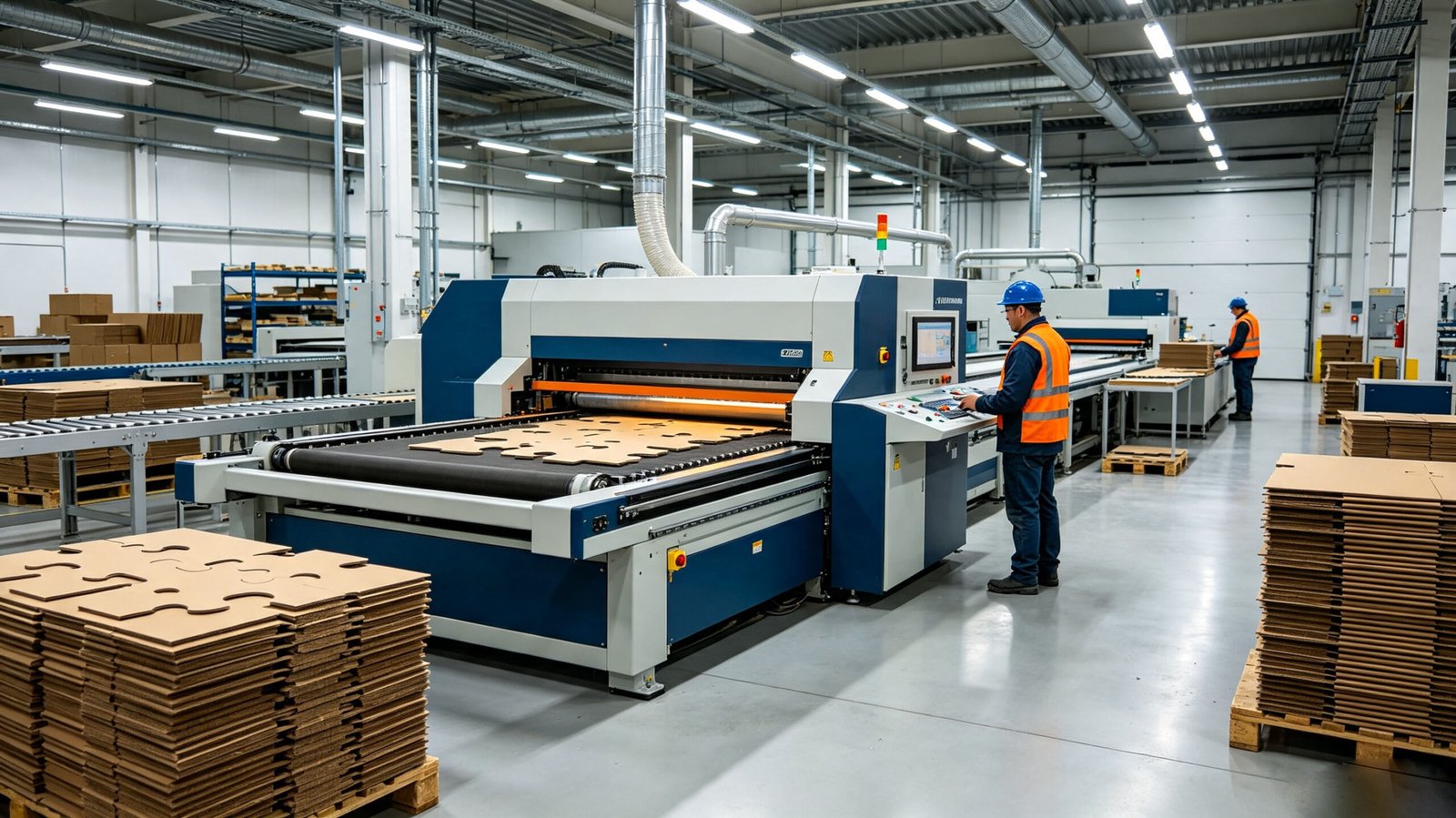
Production output is a key parameter for factory capacity planning and cost accounting. The efficiency of a 1000-piece puzzle cutting machine varies according to automation level and cutting mode. Standard semi-automatic models achieve a single-layer cutting speed of 80–120 sheets per hour, with each sheet producing a complete set of 1000-piece puzzles.
After optimizing the workflow and adopting double-layer stacked cutting technology, the hourly output can be increased to 150–220 sets, greatly improving production efficiency. Fully automatic models with automatic feeding and unloading systems can achieve continuous unmanned production, with a maximum daily output of more than 3000 sets of 1000-piece puzzles, suitable for large-scale puzzle factories with bulk order demands.
The machine’s cutting frequency is stable at 4–6 strokes per minute, with no speed drop or precision deviation during long-term continuous operation. Compared with laser cutting machine make 1000 piece jigsaw puzzles, hydraulic die-cutting equipment has 3–5 times higher efficiency, no edge charring, and lower unit production cost, making it more suitable for commercial mass production.
6. Material Adaptability & Cutting Thickness Parameters
Professional puzzle cutting machines have wide material compatibility, covering all mainstream puzzle production substrates. It can stably cut 1.5mm–3.0mm thick grey cardboard, blue chip puzzle board, coated paper board, and lightweight wood board, meeting the production needs of ordinary paper puzzles and high-end wooden 1000-piece puzzles.
The adjustable hydraulic pressure system can adapt to different material hardness and thickness. For thin coated cardboard, low-pressure fine cutting is adopted to avoid board crushing; for thick high-hardness puzzle boards, high-pressure thorough cutting is used to ensure no residual connections between pieces. This flexible parameter adjustment enables one machine to meet diversified production needs and improve equipment utilization.
7. Safety, Certification & After-sales Parameters
All CE certified 1000 piece puzzle cutting machine for EU market is equipped with complete safety protection configurations, including safety light curtains, emergency stop buttons, protective baffles, and anti-pinch devices. When foreign objects or human bodies enter the working area, the machine will automatically stop running, fully complying with EU workplace safety regulations and US industrial operation standards.
In terms of after-sales parameters, the standard equipment is equipped with a 1-year full-machine warranty and lifelong paid maintenance services. Core components such as hydraulic cylinders, servo motors, and PLC controllers have a 3-year extended warranty. Suppliers provide complete operation manuals, parameter debugging tutorials, and remote video technical support, solving equipment operation and parameter adjustment problems for overseas users in a timely manner.
FAQ
Q1: What is the minimum tonnage required for cutting standard 1000-piece puzzles? A: Single-layer cutting requires a minimum 200-ton hydraulic pressure. For stacked cutting and thick puzzle boards, 300–600 ton models are recommended to ensure cutting quality and efficiency.
Q2: Can one machine adjust parameters to produce 500-piece and 1000-piece puzzles simultaneously? A: Yes. By replacing different puzzle dies and adjusting hydraulic pressure and stroke parameters, the machine can adapt to puzzles of different specifications, with no need to replace equipment.
Q3: What tolerance standard ensures high-quality 1000-piece puzzle production? A: Industrial-grade machines with a tolerance of ±0.15mm or lower can produce premium puzzles with smooth fitting and no jamming or loosening.
Conclusion
The complete technical specifications of a 1000 piece puzzle cutting machine determine its production quality, efficiency, and service life. Core parameters including hydraulic tonnage, cutting precision, bed size, power configuration, and safety standards are the key basis for equipment selection and production line optimization. For European and American puzzle manufacturers, choosing equipment with standardized industrial parameters can effectively reduce defective rates, improve production efficiency, and create stable product competitiveness in the premium puzzle market.