
What Is a Stamping Press?
A stamping press is an industrial machine used to shape or cut metal sheets into specific forms using a die and applied force. It is one of the most widely used technologies in modern manufacturing, especially for producing high-volume, precision metal parts.
At its core, a stamping press transforms flat metal—such as steel, aluminum, or copper—into functional components through a controlled pressing process. These components can range from simple brackets to complex automotive panels.
If you’re new to metal forming, this guide will help you understand how stamping presses work, where they are used, and when they make sense for your production needs.
What Does a Stamping Press Do?
Core Function in Manufacturing
A stamping press is designed to convert flat sheet metal into shaped parts quickly and consistently. Instead of machining material away, it reshapes the material using force and tooling.
This makes stamping one of the most efficient methods for mass production.
Typical Operations Performed
Stamping presses can perform multiple operations depending on the tooling (die) used:
- Blanking: Cutting out flat shapes from sheet metal
- Punching: Creating holes or cutouts
- Bending: Forming angles or curves
- Drawing: Stretching metal into deeper shapes
These operations are often combined into a single process, allowing manufacturers to produce finished parts in just one press cycle.
How a Stamping Press Works (Simplified Explanation)
At a basic level, a stamping press works by applying force to a metal sheet using a tool called a die.
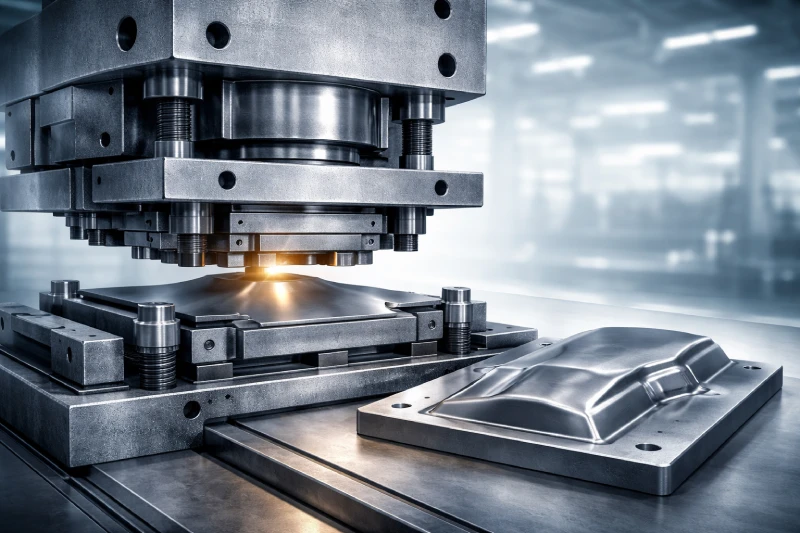
The Basic Process Flow
- Material Feeding
A sheet or coil of metal is positioned between two halves of a die. - ضغط(Press Stroke)
The press moves downward, forcing the metal into the shape of the die. - Part Formation
The material is cut, bent, or formed depending on the die design. - Part Ejection
The finished component is released, and the cycle repeats.
Each cycle—called a stroke—can take less than a second in high-speed production environments.
The key advantage here is repeatability. Once the die is set up, every part produced is nearly identical.
Main Components of a Stamping Press (Overview)
While stamping presses can vary in design, most share a few essential components:
Frame
The structural body of the press that supports all other components and absorbs force during operation.
Ram (Slide)
The moving part of the press that travels vertically to apply force to the material.
Die
A custom-designed tool that shapes the metal. It consists of upper and lower sections.
Bed
The stationary surface that holds the lower die and supports the workpiece.
Each of these components plays a role in ensuring precision, durability, and production stability.
Where Are Stamping Presses Used?
Stamping presses are used across a wide range of industries where metal parts are produced at scale.
Automotive Industry
- Body panels
- Structural brackets
- Chassis components
This is one of the largest applications of stamping technology due to the need for high-volume production.
Electronics & Electrical
- Connectors
- Shielding components
- Terminal parts
These applications require high precision and tight tolerances.
Appliances & Consumer Goods
- Washing machine panels
- Kitchen equipment housings
- Metal enclosures
Stamping enables cost-effective production of durable consumer products.
Industrial Equipment
- Machine components
- Structural parts
- Heavy-duty brackets
Why Stamping Presses Are Essential in Manufacturing
High Production Efficiency
Stamping presses are designed for speed. Once set up, they can produce thousands of parts per hour, making them ideal for mass production.
Consistent Precision
Because the process is controlled by tooling, every part produced maintains the same dimensions and quality standards.
Cost-Effective at Scale
While tooling costs can be high initially, the cost per part becomes extremely low in high-volume production.
This is why stamping is widely used in industries where repeatability and cost efficiency are critical.
Basic Types of Stamping Presses
There are several types of stamping presses, each suited to different applications:
Mechanical Press
- Uses a flywheel and crank mechanism
- High speed, ideal for large-volume production
Hydraulic Press
- Uses hydraulic force
- Better for deep forming and thicker materials
Servo Press
- Uses programmable motor control
- Offers flexibility and precision control
Stamping Press vs Other Metal Forming Methods
Stamping vs CNC Machining
- Stamping: Fast, cost-effective for high volumes
- CNC Machining: Flexible, better for low-volume or complex parts
Stamping vs Casting
- Stamping: Uses sheet metal, minimal material waste
- Casting: Uses molten metal, suitable for thicker parts
In general, stamping is preferred when you need speed, consistency, and scalability.
When Do You Need a Stamping Press?
A stamping press is the right solution when:
- You need high-volume production
- Parts are made from sheet metal
- The design is repeatable and consistent
- You want to reduce unit production cost
However, stamping may not be ideal for low-volume or highly customized parts due to tooling costs.
Conclusion: Is a Stamping Press Right for Your Application?
A stamping press is one of the most efficient and reliable machines for producing metal parts at scale. It combines speed, precision, and cost efficiency in a way few other manufacturing processes can match.
If your production involves high volumes of sheet metal components, investing in a stamping press—or working with a stamping supplier—can significantly improve your operational efficiency.
The next step is understanding how different press types, specifications, and configurations affect performance and cost
