
Selecting the right stamping press is not simply a matter of choosing the largest tonnage available. A press that is too small may damage tooling, reduce part quality, and create downtime. A press that is too large can increase energy use, floor space requirements, and capital cost without improving production.
For most manufacturers, the real challenge is understanding which specifications matter and how those values affect actual production. Tonnage, stroke length, bed size, shut height, and speed all work together. The best machine is the one whose specifications match your part, material, tooling, and production volume.
If you are still comparing overall machine categories, start with our guide to stamping press systems before reviewing specification sheets.
Why Stamping Press Specifications Matter
Every stamping press specification has a direct effect on production.
- Tonnage determines whether the press can apply enough force
- Stroke length affects forming depth and cycle time
- Bed size determines whether the die physically fits
- Shut height and slide adjustment affect tooling compatibility
- Speed affects production output and part quality
A machine with the wrong specification can cause several problems:
| Problem | Likely Cause |
|---|---|
| Die damage | Insufficient tonnage or incorrect shut height |
| Slow production | Low SPM or excessive stroke length |
| Poor dimensional accuracy | Inadequate repeatability |
| Inability to run larger dies | Bed size too small |
| Higher operating costs | Oversized motor and tonnage |
For this reason, a specification sheet should be reviewed as carefully as the price quotation.
The 10 Most Important Stamping Press Specifications
Many buyers focus only on tonnage. In reality, tonnage is only one part of the decision. The following specifications should always be reviewed together.
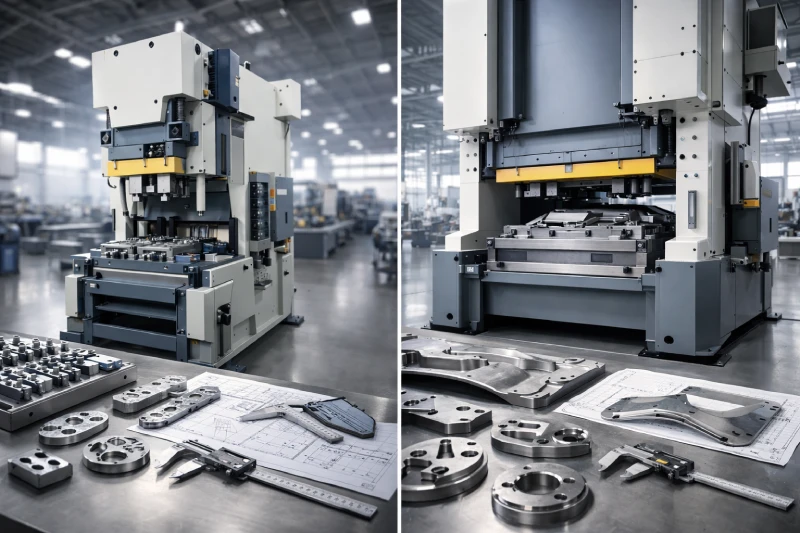
1. Press Tonnage Capacity
Tonnage is the maximum force the press can apply during the forming process. The required tonnage depends on:
- Material thickness
- Material type
- Part size
- Die design
Typical tonnage ranges include:
| Application | Typical Tonnage |
|---|---|
| Small electronic parts | 20–60 tons |
| Appliance brackets and housings | 80–200 tons |
| Automotive body parts | 300–800+ tons |
| Heavy steel components | 500–1,500+ tons |
Choosing too little tonnage can damage the die and produce incomplete parts. Choosing far more tonnage than needed increases cost and energy consumption.
2. Stroke Length
Stroke length is the vertical travel distance of the slide. Short strokes are generally better for fast, shallow operations. Longer strokes are needed for deep-drawing and larger formed parts.
| Part Type | Recommended Stroke |
|---|---|
| Thin stamped washers or terminals | 20–50 mm |
| General sheet metal parts | 80–150 mm |
| Deep drawn automotive panels | 200–400 mm |
A longer stroke often reduces speed, so it should only be selected when the part geometry requires it.
3. Stroke Per Minute (SPM)
SPM measures how many cycles the press can complete in one minute. High-volume production lines require higher SPM, while thicker materials and complex parts typically require lower speeds.
| Production Type | Typical SPM |
|---|---|
| Precision electronic components | 200–1,000+ SPM |
| General metal stamping | 40–150 SPM |
| Heavy-duty forming | 10–40 SPM |
High speed is valuable only if the tooling and part can tolerate it. Running too fast may reduce accuracy, increase tool wear, and create part defects.
4. Shut Height
Shut height is the distance between the slide and bolster when the slide is at the bottom of its stroke. This value determines whether a die can fit inside the press.
If the shut height is too small, the die may not fit. If it is too large, additional spacers or modifications may be required. Many buyers overlook this specification until tooling installation, which can delay production.
5. Slide Adjustment Range
The slide adjustment range allows the operator to fine-tune shut height for different dies. A larger adjustment range provides greater flexibility when switching between tooling.
Manufacturers running multiple part families often benefit from presses with wider slide adjustment capability because setup changes are faster and easier.
6. Bed Size and Bolster Dimensions
The press bed and bolster must be large enough to support the die footprint. Large progressive dies and automotive tools often require significantly larger bed sizes.
| Die Size Requirement | Recommended Bed Size |
|---|---|
| Small precision die | 600 × 400 mm |
| Medium progressive die | 1,200 × 800 mm |
| Large automotive die | 2,500 × 1,500 mm or larger |
If you regularly process larger parts, you may also want to review our guide to heavy-duty stamping press.
7. Die Cushion Capacity
Die cushions apply upward force beneath the die and are commonly used for deep drawing and complex forming operations. This specification is especially important for:
- Automotive body panels
- Deep-drawn stainless steel parts
- Complex formed housings
Without sufficient cushion capacity, wrinkling, tearing, and inconsistent part quality may occur.
8. Motor Power and Energy Consumption
Motor size affects both operating cost and machine performance. A larger press typically requires more power, but machine design also matters.
Modern servo-driven systems often reduce energy consumption because they only use power when needed. If you are comparing different machine categories, see our article on different types of stamping presses.
9. Accuracy and Repeatability
Precision matters in high-volume manufacturing. Two key indicators are:
- Ram parallelism
- Repeatability from stroke to stroke
Tighter accuracy is essential for precision parts, thin materials, and progressive dies. Manufacturers producing small electronic or precision metal parts should prioritize repeatability over raw tonnage.
10. Automation Compatibility
Many production lines now include feeders, transfer systems, or robotic loading. Before purchasing a press, confirm that the machine supports:
- Coil feeding systems
- Servo feeders
- Robotic part handling
- Transfer automation
A press that cannot integrate with automation may become a bottleneck later.
Stamping Press Specification Table by Application
The required specifications vary significantly depending on the type of part being produced.
| Application | Typical Tonnage | Stroke Length | SPM | Bed Size | Special Requirement |
|---|---|---|---|---|---|
| Small electronics terminals | 20–60T | 20–50 mm | 300–1,000 | Small | High precision and repeatability |
| Appliance components | 80–200T | 80–150 mm | 50–150 | Medium | Moderate flexibility |
| Automotive body panels | 300–800T | 200–400 mm | 10–40 | Large | Die cushion and large bed |
| Thick steel brackets | 200–500T | 100–200 mm | 20–60 | Medium–Large | Higher force requirement |
| Progressive die production | 80–300T | 50–120 mm | 100–300 | Medium | Automation compatibility |
For automotive production, additional factors such as larger bed size, transfer systems, and die cushion force become critical. Learn more in our article on automotive stamping press applications.
How to Read a Stamping Press Specification Sheet
Different manufacturers present specifications differently, which can make comparison difficult. One supplier may emphasize tonnage and speed, while another highlights bed size and automation.
To avoid confusion, review the specification sheet in the following order:
- Tonnage
- Bed size
- Stroke length
- Shut height
- Slide adjustment
- SPM
- Automation compatibility
This sequence ensures that the machine can first handle the required force and tooling dimensions before speed and additional features are considered.
Many buyers also make the mistake of comparing only maximum tonnage. A 300-ton hydraulic press and a 300-ton mechanical press may behave very differently because of stroke profile, speed, and forming characteristics.
If you need a better understanding of why those differences exist, read our guide on how a stamping press works.
Common Mistakes When Comparing Stamping Press Specifications
Choosing the Highest Tonnage Available
Bigger is not always better. Excess tonnage usually means:
- Higher purchase cost
- Larger motor and energy use
- More floor space
- Reduced efficiency for smaller parts
Ignoring Bed Size and Shut Height
A press with enough force is still unusable if the die does not fit. Bed size and shut height should always be verified before final selection.
Focusing on Speed Alone
High SPM looks impressive on a specification sheet, but speed must match the material, die, and part complexity. Running too fast may create quality problems.
Forgetting Future Production Needs
Some manufacturers purchase a press that only matches current requirements. Six months later, new tooling or larger parts may require a different machine.
It is often wise to leave some additional capacity for future dies, automation, or part changes.
For a broader evaluation process that includes budget, supplier selection, and ROI, see our complete stamping press buying guide.
Which Specifications Matter Most for Your Production Needs?
Different production environments prioritize different specifications.
| Production Goal | Most Important Specifications |
|---|---|
| High-speed production | SPM, automation compatibility, repeatability |
| Large or thick parts | Tonnage, bed size, stroke length |
| Precision components | Accuracy, repeatability, shut height |
| Flexible tooling changes | Slide adjustment range, shut height |
| Deep drawing operations | Stroke length, die cushion capacity |
If your production line focuses on small, high-precision components, accuracy and repeatability may matter more than maximum tonnage. If you manufacture large structural parts, tonnage and bed size become the priority.
The best approach is to begin with your part requirements, then work backward to determine the minimum and ideal specification range.
Choose Specifications Based on Production Needs, Not Just Machine Size
The right stamping press is not necessarily the largest, fastest, or most expensive machine. It is the one whose specifications closely match your material, die, part size, and production volume.
Before purchasing, compare your tooling and production requirements against the machine’s tonnage, stroke, shut height, bed size, and speed. A careful specification review can reduce downtime, prevent tooling issues, and improve long-term productivity.
If you are unsure which specification range is right for your application, contact our engineering team with your part drawing, material thickness, and production target. We can help you identify the most suitable stamping press configuration for your line.
