
Stamping presses are essential in automotive, appliance, electronics, and metal fabrication plants, but they are also among the most dangerous machines on the production floor. A single mistake around the die area can lead to crushed hands, severe cuts, or costly downtime.
The good news is that most stamping press accidents are preventable. With the right guarding system, operator procedures, lockout practices, and training, manufacturers can dramatically reduce injuries while improving productivity and machine uptime.
If you are new to press equipment, start with our stamping press overview before reading this guide.
Why Stamping Press Safety Matters
A stamping press combines high force, fast cycle times, moving tooling, and heavy material handling. Even experienced operators can be injured if a guard is removed, a die jams unexpectedly, or the machine restarts during maintenance.
Poor safety practices create more than injury risk. They also lead to:
- Production stoppages
- Damaged dies and tooling
- Increased insurance and compliance costs
- Higher employee turnover
- Lower overall equipment efficiency
Modern manufacturers no longer view safety as a compliance requirement alone. The safest plants are often the most productive because they reduce unplanned downtime and operator error.
The Most Common Stamping Press Hazards
Understanding the risks is the first step toward preventing them.
Pinch Points and Crushing Zones
The highest-risk area on any stamping press is the space between the ram and the die. Hands can easily become trapped during loading, unloading, or manual adjustment.
Mechanical presses, hydraulic presses, and servo presses all create similar crushing risks, although the speed and force profile may differ. For a deeper comparison of machine designs, see our guide to types of stamping presses.
Flying Scrap and Broken Tooling
Damaged dies, broken punches, or improperly secured material can eject metal fragments at high speed. Operators may suffer eye injuries, cuts, or impact injuries if the press area is not properly enclosed.
Unexpected Startup
A press can restart unexpectedly after maintenance, jam clearing, or power interruption. This is especially dangerous when technicians are working inside the machine.
Unexpected startup usually occurs because:
- Energy sources were not isolated
- Lockout/tagout was skipped
- Safety sensors were bypassed
- Control systems were improperly reset
Noise, Vibration, and Repetitive Motion
Stamping environments often expose workers to long-term hearing damage, fatigue, and repetitive strain injuries. Even when there is no major accident, poor ergonomics can reduce productivity and increase operator turnover.
| Hazard | Typical Cause | Potential Result |
|---|---|---|
| Crushing injury | Hand enters die area | Severe hand or finger injury |
| Flying metal | Broken die or scrap ejection | Eye or facial injury |
| Unexpected startup | No lockout procedure | Maintenance injury |
| Noise exposure | High-speed press operation | Hearing damage |
| Repetitive motion | Manual loading/unloading | Wrist, shoulder, back strain |
Essential Stamping Press Safety Devices
Safety devices are the first physical barrier between the operator and the machine. Every press should be equipped with the correct guarding system for its application.
Fixed Guards and Barrier Guards
Fixed guards physically block access to the dangerous area. They are commonly installed around the die space, flywheel, belts, or other moving components.
These guards are best for operations where the operator does not need frequent access during production.
Advantages include:
- Simple and reliable
- Low maintenance
- Difficult to bypass
However, they may reduce access during die changes or maintenance.
Light Curtains
Light curtains use an invisible beam across the front of the press. If the operator’s hand enters the danger zone, the machine stops immediately.
Light curtains are widely used in high-speed and semi-automatic production because they provide protection without slowing down material handling.
They are especially useful when combined with advanced stamping press control systems and automated feeders.
Two-Hand Controls
Two-hand controls require the operator to press two buttons at the same time before the machine cycles. This keeps both hands away from the die area.
Two-hand systems are common in smaller presses or manual operations where parts are loaded by hand.
Emergency Stop Systems
Every stamping press should have clearly visible emergency stop buttons located within easy reach of the operator.
An emergency stop system should:
- Shut down the machine immediately
- Be tested at the beginning of every shift
- Remain easy to access at all times
Interlocked Doors and Safety Sensors
Interlocked doors prevent the machine from operating if an access panel or enclosure is open. Additional sensors can monitor guard position, pressure, temperature, or abnormal movement.
| Safety Device | Main Function | Best Use Case |
|---|---|---|
| Fixed guard | Blocks physical access | Repetitive production lines |
| Light curtain | Stops machine when hands enter zone | High-speed operations |
| Two-hand control | Keeps both hands away from die | Manual loading applications |
| Emergency stop | Instantly stops press | All stamping presses |
| Interlocked door | Prevents operation when open | Enclosed or automated cells |
If your production line uses robotic loading or automated transfer systems, read our full guide to stamping press automation.
Safe Operating Procedures for Press Operators
Even the best safety devices cannot prevent accidents if operators use unsafe habits.
Pre-Shift Inspection
Before production starts, operators should inspect:
- Guards and light curtains
- Die condition
- Emergency stop buttons
- Lubrication and fluid levels
- Air and hydraulic connections
Any issue should be reported before the machine is started.
Safe Loading and Unloading
Operators should never place their hands directly inside the die area during an active cycle. Instead, they should use:
- Feed tools
- Tongs
- Magnetic pickups
- Automated feeders
Where possible, manufacturers should eliminate manual handling completely.
Stay in a Safe Position
Operators should stand outside the direct line of flying scrap or broken tooling. They should also avoid leaning into the machine while it is cycling.
Report Unsafe Conditions Immediately
Loose guards, strange noises, leaking hydraulic lines, or worn tooling can quickly turn into major hazards.
These problems should be addressed as part of a planned stamping press maintenance program rather than ignored until failure occurs.
Lockout/Tagout Procedures During Maintenance
Many serious stamping press injuries happen during die changes, repairs, or jam clearing. That is why lockout/tagout (LOTO) is one of the most important safety procedures in any factory.
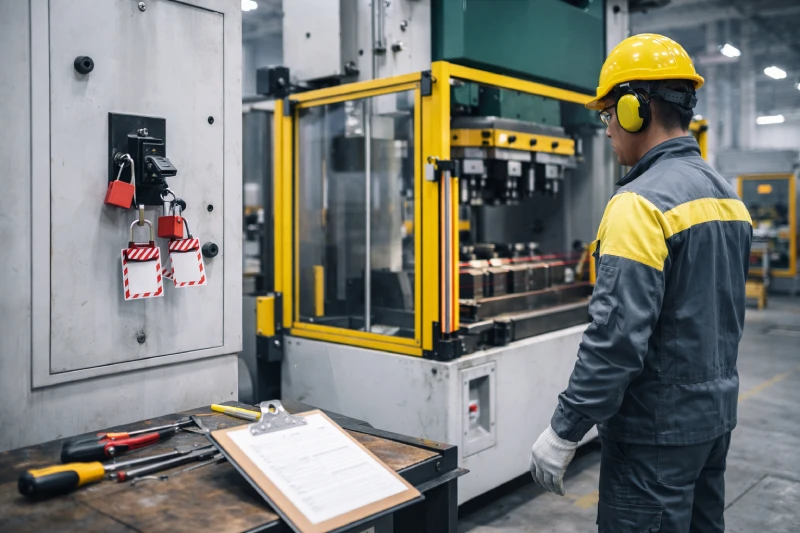
Before maintenance begins, all energy sources must be isolated, including:
- Electrical power
- Hydraulic pressure
- Pneumatic pressure
- Stored mechanical energy
A standard lockout procedure typically follows these steps:
- Shut down the press
- Disconnect all energy sources
- Apply a lock and warning tag
- Release stored energy
- Verify that the machine cannot restart
- Begin maintenance
LOTO is required whenever employees:
- Change dies
- Clear material jams
- Repair guards or controls
- Enter the press enclosure
Bypassing this process to save a few minutes creates one of the highest-risk situations in the plant.
PPE Requirements for Stamping Press Operations
Personal protective equipment is important, but it should never replace proper guarding.
Operators should typically wear:
- Safety glasses or face shields
- Hearing protection
- Cut-resistant gloves
- Steel-toe shoes
- Close-fitting work clothing
Loose sleeves, jewelry, necklaces, or gloves that can become caught in moving parts should never be worn near a press.
| PPE Item | Purpose |
|---|---|
| Safety glasses | Protect against flying scrap |
| Hearing protection | Reduce long-term noise damage |
| Cut-resistant gloves | Reduce hand injuries during handling |
| Steel-toe footwear | Protect against dropped tooling |
OSHA and ISO Standards for Stamping Press Safety
Manufacturers should align their safety program with recognized standards.
The most important standards include:
- OSHA 29 CFR 1910.217 for mechanical power presses
- ANSI B11 standards for machine safeguarding
- ISO 13849 for safety-related control systems
These standards cover:
- Machine guarding
- Emergency stop requirements
- Safety control reliability
- Operator training
- Inspection intervals
A factory that follows these standards is less likely to face injuries, fines, or unplanned downtime.
Regular audits are also important. Even a safe machine can become dangerous if guards are removed or controls are modified over time.
A Simple Stamping Press Safety Checklist
Before every shift, supervisors and operators should confirm the following:
- All guards are installed and secure
- Light curtains are functioning correctly
- Emergency stop buttons have been tested
- The die is properly secured
- There are no unusual noises or leaks
- PPE is being worn
- The work area is clean and free of scrap
- Lockout devices are available nearby
Using a short checklist at the start of every shift takes only a few minutes, but it can prevent major accidents.
Improve Safety Before an Accident Happens
The safest stamping press is not necessarily the newest one. Older machines can often be upgraded with light curtains, interlocked guards, improved controls, and better operator procedures.
If your team is evaluating a new press line, retrofitting an older machine, or improving plant-wide safety, start by reviewing:
- Current guarding systems
- Lockout procedures
- Operator training
- Maintenance practices
- Opportunities for automation
A safer press line reduces injuries, improves uptime, and creates a more reliable production process.
