
Introduction
In stamping manufacturing, understanding how a machine works is not the same as knowing how to operate it. While engineering principles explain motion, force, and mechanics, real production depends on precise operational control, repeatable workflows, and strict safety discipline.
Stamping press operation is the execution layer of metal forming—where setup, feeding, pressing, and output handling are coordinated into a continuous production cycle. Whether in automotive, electronics, or general metal fabrication, operational quality directly impacts part consistency, production speed, and workplace safety.
This guide focuses specifically on how stamping presses are operated in real-world manufacturing environments, from setup to continuous production.
Overview of the Stamping Press Operation Cycle
At its core, stamping press operation follows a repeatable cyclic process designed for high-volume production.
Basic Operation Flow:
- Material Loading – Coil or sheet metal is introduced into the system
- Positioning – Material is aligned within the die area
- Press Stroke Activation – The press initiates downward motion
- Forming / Cutting – The die shapes or cuts the material
- Part Ejection – Finished parts and scrap are removed
This cycle repeats continuously, often at high speeds, depending on the application and press type.
Understanding this cycle is critical before diving into operator-level control and responsibilities.
Pre-Operation Setup and Preparation
Before production begins, proper setup ensures accuracy, safety, and efficiency.
Die Installation and Alignment
The die is the most critical tooling component in the operation process.
- Proper mounting ensures stability during high-force operations
- Alignment prevents uneven wear and part defects
- Misalignment can lead to tool damage or machine failure
Material Feeding Setup
Material feeding must be precisely controlled:
- Coil feeding systems for continuous production
- Sheet feeding systems for batch operations
Operators must ensure:
- Correct feed length
- Proper tension control
- Accurate positioning into the die
Parameter Configuration
Before starting the machine, key parameters must be set:
- Stroke length
- Operating speed (SPM – strokes per minute)
- Tonnage limits
Incorrect settings can lead to:
- Poor part quality
- Excessive tool wear
- Safety risks
Safety System Checks
Before any operation:
- Test emergency stop functions
- Verify light curtains and guards
- Ensure interlocks are active
Step-by-Step Stamping Press Operation Process
Once setup is complete, the press moves into active operation.
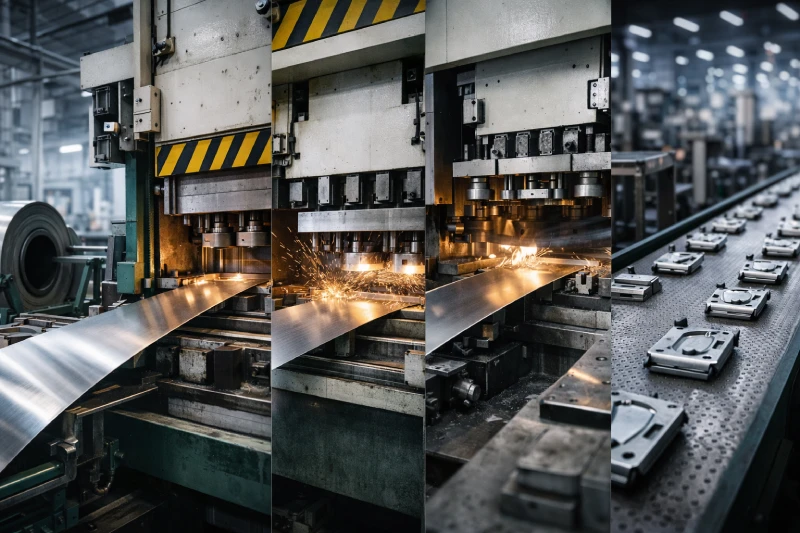
Step 1 — Machine Start-Up
- Power on the system
- Run diagnostics and system checks
- Ensure lubrication systems are functioning
Modern presses often include automated system verification before operation begins.
Step 2 — Feeding Material into the Press
Material is introduced into the die area via:
- Automatic feeders (high-volume production)
- Manual placement (low-volume or specialized work)
Accuracy at this stage directly affects part quality.
Step 3 — Initiating the Press Stroke
Operators activate the press via:
- Control panels
- Foot pedals
- Automated systems
Operation modes may include:
- Single stroke mode (for testing or setup)
- Continuous mode (for production runs)
Step 4 — Forming or Cutting Action
During the press stroke:
- The slide moves downward
- The die applies force to shape or cut the material
This process happens in milliseconds but must remain highly consistent.
Step 5 — Part Ejection and Transfer
After forming:
- Finished parts are ejected
- Scrap material is removed
- Parts are transferred via conveyors or robotic arms
Efficient ejection is critical to maintaining cycle speed.
Step 6 — Continuous Production Cycle
In production mode:
- The cycle repeats automatically
- Feeding, pressing, and ejection are synchronized
Operator Responsibilities During Production
Even in automated environments, operators play a critical role.
Monitoring Machine Performance
Operators must watch for:
- Abnormal noise
- Vibration changes
- Load fluctuations
These may indicate:
- Tool wear
- Misalignment
- Mechanical issues
Quality Control During Operation
Quality checks include:
- First article inspection
- Random sampling during production
Early detection of defects prevents large-scale waste.
Adjustments and Fine-Tuning
Operators may adjust:
- Feed alignment
- Stroke timing
- Speed settings
Small adjustments can significantly improve output quality.
Handling Interruptions and Errors
Common issues include:
- Misfeeds
- Jammed parts
- Emergency stops
Operators must respond quickly to minimize downtime and damage.
Stamping Press Safety During Operation
Stamping presses involve high force and fast motion, making safety critical.
Common Operational Hazards
- Pinch points between die components
- Flying scrap material
- Unexpected machine movement
Safety Protocols for Operators
Operators must follow strict guidelines:
- Keep hands clear of die area
- Use proper personal protective equipment (PPE)
- Never bypass safety systems
Automation and Safety Integration
Modern systems include:
- Light curtains
- Safety interlocks
- Presence sensors
These technologies reduce human risk during operation.
Factors That Affect Operational Efficiency
Operational performance is influenced by multiple variables.
Machine Speed vs Accuracy Trade-Off
- Higher speed increases output
- But may reduce precision or increase defects
Balancing speed and quality is key.
Tooling Condition and Maintenance
Worn tooling leads to:
- Poor part quality
- Increased downtime
Preventive maintenance ensures consistent operation.
Material Consistency
Variations in material thickness or hardness can cause:
- Inconsistent forming
- Increased reject rates
Stable material supply improves reliability.
Operator Skill Level
Experienced operators:
- Detect issues early
- Optimize machine settings
- Improve overall productivity
Manual vs Automated Stamping Press Operation
Different production environments require different operational approaches.
Manual Operation
- Suitable for low-volume or custom work
- Higher flexibility
- Greater reliance on operator skill
Automated Operation
- Used in high-volume production
- Higher speed and consistency
- Reduced human error
Common Operational Problems and Troubleshooting
Even well-maintained systems encounter issues.
Misfeeds and Alignment Issues
- Cause: incorrect feed setup
- Solution: recalibrate feeder system
Inconsistent Part Quality
- Cause: worn tooling or parameter drift
- Solution: inspect dies and adjust settings
Machine Overload or Shutdown
- Cause: excessive tonnage or material issues
- Solution: reduce load and inspect system
Understanding root causes helps prevent recurring problems.
Best Practices for Reliable Stamping Press Operation
To maintain stable production:
- Implement standardized operating procedures (SOPs)
- Schedule regular preventive maintenance
- Train operators continuously
- Document process parameters
Consistency is the foundation of efficient stamping operations.
Conclusion
Stamping press operation is where engineering design meets real-world execution. From setup and feeding to continuous production and troubleshooting, every step influences product quality, production efficiency, and workplace safety.
By following structured workflows, maintaining equipment, and ensuring operator competence, manufacturers can achieve reliable and high-performance stamping operations.
