
A stamping press is one of the most valuable—and expensive—assets in a manufacturing facility. When it runs properly, production stays on schedule, part quality remains consistent, and maintenance costs stay predictable. When it is neglected, even a small issue can lead to scrap, downtime, damaged tooling, or a complete line shutdown.
The good news is that most stamping press failures are preventable. A structured maintenance plan helps operators catch wear early, extend equipment life, and reduce costly emergency repairs.
In this guide, you will learn:
- What daily, weekly, monthly, and annual maintenance tasks matter most
- The most common signs of a failing stamping press
- How maintenance differs between mechanical and hydraulic presses
- Best practices to reduce downtime and improve production reliability
Why Regular Stamping Press Maintenance Matters
Many manufacturers only service a stamping press after a problem appears. This reactive approach often results in higher repair costs, longer downtime, and lower production quality.
Preventive maintenance is different. Instead of waiting for a breakdown, operators inspect, clean, lubricate, and test the machine on a regular schedule. This allows problems to be identified before they become serious.
A well-maintained stamping press can deliver:
- Longer equipment life
- Lower maintenance costs
- Better dimensional accuracy
- Reduced scrap and tooling wear
- Improved operator safety
- Fewer unexpected shutdowns
The Cost of Ignoring Maintenance
Ignoring routine maintenance often leads to:
| Problem | Typical Result |
|---|---|
| Poor lubrication | Bearing failure, overheating |
| Loose bolts or misalignment | Excessive vibration, poor part quality |
| Hydraulic leaks | Pressure loss and inconsistent force |
| Dirty electrical panels | Sensor failure or unexpected shutdown |
| Worn clutch or brake components | Unsafe operation and reduced accuracy |
Even a few hours of downtime can cost thousands of dollars in lost production. In high-volume operations, preventive maintenance is almost always cheaper than emergency repair.
Daily Stamping Press Maintenance Checklist
Daily maintenance should be completed by the operator at the start and end of every shift. These inspections take only a few minutes but often prevent much larger problems.
1. Check Lubrication Levels
Inspect oil reservoirs, grease points, and automatic lubrication systems. Low lubrication is one of the most common causes of bearing and slide failure.
Make sure:
- Oil levels are within the recommended range
- Grease is reaching all required points
- Lubrication lines are not blocked or leaking
2. Inspect for Visible Damage
Walk around the machine and look for:
- Loose bolts or fasteners
- Cracked guards
- Oil or hydraulic fluid leaks
- Damaged hoses or wiring
- Unusual wear around the ram or slide
3. Listen for Unusual Noise or Vibration
A stamping press often provides early warning signs before a major failure occurs. New knocking sounds, grinding, or excessive vibration may indicate:
- Worn bearings
- Loose gears or couplings
- Misalignment in the ram or drive system
Never ignore new sounds. Small problems can quickly become major failures.
4. Clean the Press Area
Remove scrap metal, dust, oil residue, and debris around the machine. A dirty press area can contaminate moving parts and create safety hazards.
5. Verify Safety Systems
Before starting production, confirm that all safety systems are working correctly:
- Emergency stop buttons
- Safety guards
- Light curtains
- Interlock switches
If any safety system fails, stop the press immediately.
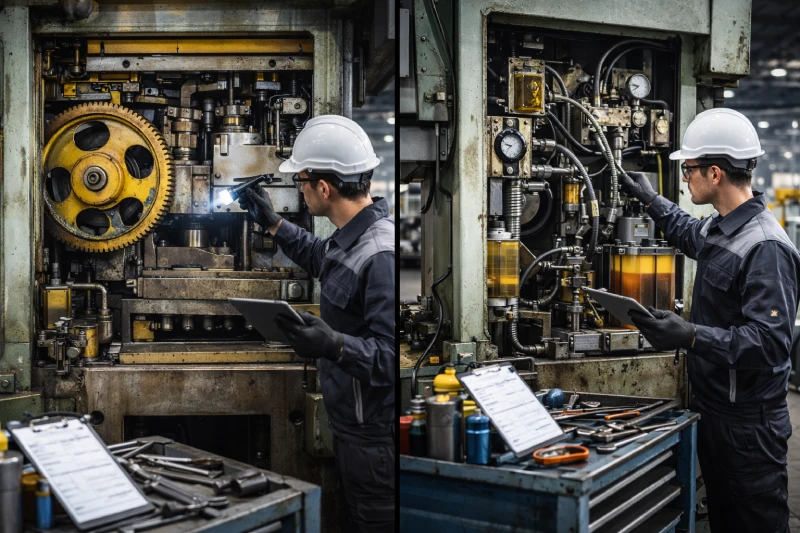
Weekly and Monthly Maintenance Schedule
Daily inspections help identify visible problems, but more detailed maintenance should be performed weekly and monthly.
Weekly Maintenance Tasks
Technicians should complete the following every week:
| Weekly Task | Why It Matters |
|---|---|
| Inspect drive belts and couplings | Prevent slippage and power loss |
| Check slide and ram alignment | Maintain part accuracy |
| Test lubrication system performance | Ensure all moving parts receive oil |
| Inspect pneumatic lines and air pressure | Avoid pressure-related failures |
| Tighten accessible fasteners | Reduce vibration and wear |
Monthly Maintenance Tasks
Monthly maintenance should be more detailed and may require short planned downtime.
Key tasks include:
- Inspect bearings and bushings for wear
- Check brake and clutch assemblies
- Tighten electrical terminals and connections
- Inspect hydraulic fluid quality and filter condition
- Verify sensor and control system performance
- Check alignment of the frame and slide
Mechanical presses often require additional inspection of the flywheel, clutch, and drive train. Hydraulic presses require closer attention to seals, cylinders, and hydraulic pressure.
Use a Maintenance Log
Every inspection should be recorded. A maintenance log makes it easier to identify recurring issues and predict when components will need replacement.
A simple log should include:
- Date of inspection
- Machine hours
- Problems found
- Repairs completed
- Parts replaced
- Next scheduled inspection
Quarterly and Annual Maintenance Tasks
Quarterly and annual inspections are more comprehensive and often require a planned shutdown.
Quarterly Maintenance
Every three months, technicians should:
- Inspect foundation bolts and machine leveling
- Check frame stability and alignment
- Replace worn hoses, seals, and filters
- Test motor performance and drive systems
- Inspect electrical panels for overheating or contamination
Annual Maintenance
At least once per year, complete a full inspection of the entire press.
| Annual Task | Recommended Purpose |
|---|---|
| Replace worn bearings and bushings | Restore smooth operation |
| Flush and replace hydraulic fluid | Prevent contamination and pressure loss |
| Inspect and calibrate control systems | Improve accuracy and safety |
| Test clutch and brake systems | Reduce risk of failure |
| Perform complete safety inspection | Ensure compliance and safe operation |
Annual service is also the best time to evaluate whether the machine still meets current production requirements. If maintenance costs continue to rise, it may be time to compare repair costs with replacement costs.
Mechanical vs Hydraulic Stamping Press Maintenance
Not all presses require the same maintenance strategy. Mechanical and hydraulic stamping presses have different wear points and service priorities.
| Maintenance Area | Mechanical Press | Hydraulic Press |
|---|---|---|
| Main Wear Points | Clutch, brake, flywheel, gears | Hydraulic pump, seals, cylinders |
| Common Failure Cause | Vibration and moving-part wear | Fluid contamination or leakage |
| Inspection Frequency | More frequent moving-part checks | More frequent fluid analysis |
| Typical Maintenance Focus | Lubrication and alignment | Pressure stability and seal condition |
Mechanical Press Maintenance Priorities
Mechanical presses require close monitoring of:
- Clutch and brake wear
- Flywheel lubrication
- Gear train condition
- Slide alignment
- Vibration and noise levels
Hydraulic Press Maintenance Priorities
Hydraulic presses require technicians to monitor:
- Fluid contamination
- Leaks around pumps and cylinders
- Pressure loss
- Seal wear
- Filter condition
7 Common Stamping Press Problems Caused by Poor Maintenance
Many common press problems can be traced directly to missed maintenance.
1. Excessive Vibration
Usually caused by loose bolts, worn bearings, or misalignment.
2. Oil or Hydraulic Fluid Leaks
Often caused by damaged seals, cracked hoses, or loose fittings.
3. Overheating
Poor lubrication, blocked cooling systems, or excessive friction can cause dangerous temperature increases.
4. Ram Misalignment
Worn guides or incorrect adjustments can reduce part accuracy and damage tooling.
5. Inconsistent Press Force
Mechanical clutch wear or unstable hydraulic pressure may cause uneven forming results.
6. Increased Scrap Rate
A poorly maintained press often produces inconsistent parts, which increases material waste and rejects.
7. Unexpected Shutdowns
Minor problems that are ignored often result in complete machine failure.
The following warning signs usually indicate that the machine needs immediate service:
- New vibration or unusual noise
- Higher operating temperature
- Slower cycle speed
- Fluid leaks
- Repeated part defects
- Smoke, burning smell, or electrical issues
If any of these problems appear, stop production and inspect the machine before restarting.
Best Practices to Extend Stamping Press Life
A strong maintenance program is not only about repairs. It is also about preventing problems before they happen.
Follow these best practices:
- Train operators to identify early warning signs
- Use OEM-recommended lubricants and replacement parts
- Standardize inspection procedures across every shift
- Keep common spare parts in inventory
- Schedule maintenance during planned downtime
- Use predictive maintenance tools when possible
Predictive maintenance technologies—such as vibration monitoring, thermal imaging, and oil analysis—can identify problems earlier than visual inspection alone.
Modern control and monitoring systems can also help reduce maintenance costs.
Build a Preventive Maintenance Program Before Problems Start
The best time to fix a stamping press problem is before it affects production.
A structured maintenance schedule helps manufacturers reduce downtime, improve safety, protect tooling, and extend equipment life. Whether you operate a mechanical or hydraulic press, consistent maintenance will always cost less than emergency repairs.
If your current press requires frequent repairs, excessive downtime, or rising maintenance costs, it may be time to evaluate an upgrade.
Need Help Choosing or Upgrading a Stamping Press?
Our team can help you:
- Evaluate your current maintenance costs
- Compare repair vs replacement options
- Select the right mechanical or hydraulic press
- Improve uptime with better controls and monitoring
Contact us today to discuss your stamping press application and maintenance challenges.
