
Medical component manufacturing demands far more than simple metal forming. Compared with general industrial stamping, medical production requires tighter tolerances, cleaner processes, smoother edges, traceable materials, and highly repeatable output.
A stamping press used for medical applications may produce everything from surgical blades and implant housings to diagnostic device brackets and miniature connector terminals. In many cases, manufacturers choose stamping because it can deliver micron-level consistency at production volumes that would be too expensive with CNC machining.
If you are evaluating a press for medical parts, the right choice depends on four factors:
- The geometry and size of the component
- The material being stamped
- Required tolerances and surface finish
- Production volume and regulatory requirements
Why the Medical Industry Uses Stamping Presses
Medical manufacturers use stamping presses because they provide a combination of speed, consistency, and precision that is difficult to achieve with other manufacturing methods.
While CNC machining is often suitable for low-volume prototypes or complex 3D parts, it becomes expensive when thousands or millions of identical components are required. A properly configured stamping press can produce the same medical component repeatedly with almost no dimensional variation.
Key benefits include:
- High-speed production for large medical device programs
- Very low material waste compared with machining
- Consistent part quality across long production runs
- Ability to stamp extremely thin or miniature metal parts
- Lower unit cost at medium and high volumes
- Easier integration into automated and validated production lines
In the medical industry, these benefits are especially important because even a small variation in edge quality, thickness, or shape can affect device performance.
Key Advantages in Medical Manufacturing
| Requirement | Why Stamping Presses Work Well |
|---|---|
| Tight tolerance | Modern presses can hold tolerances down to ±0.01 mm |
| High repeatability | The same part can be produced consistently over millions of cycles |
| Clean production | Low-residue and cleanroom-compatible systems are available |
| Scalability | Suitable for both pilot production and mass manufacturing |
| Low defect rate | Proper tooling reduces burrs, cracks, and dimensional variation |
For manufacturers producing medical connectors, thin shielding parts, or precision clips, stamping is often the most economical long-term solution.
Common Medical Components Produced by Stamping Presses
Stamping presses are used across almost every area of medical manufacturing. The specific parts vary by application, but most share a need for precision, repeatability, and high-quality metal finishing.
Surgical and Diagnostic Components
Many surgical tools contain stamped metal parts because they require sharp edges, tight tolerances, and excellent repeatability.
Common examples include:
- Surgical blades
- Forceps components
- Endoscope brackets
- Scalpels and cutting inserts
- Small brackets inside diagnostic devices
- Instrument housings and support clips
These parts are often made from stainless steel because it provides corrosion resistance, strength, and biocompatibility.
Implant and Device Components
Implantable and wearable medical devices also rely on precision stamping. These applications often use more difficult materials such as titanium or nickel alloys.
Examples include:
- Pacemaker housing components
- Battery contacts
- Implantable device shields
- Titanium clips and miniature brackets
- Small retaining rings and precision springs
In these cases, even a small burr or surface defect may create problems during assembly or long-term use. That is why medical stamping often includes additional finishing and inspection steps.
Medical Electronics and Connector Parts
Modern medical devices contain a growing number of electronic components. As a result, many medical manufacturers use stamping presses to produce tiny conductive and shielding parts.
Examples include:
- Connector terminals
- EMI shielding parts
- Thin metal frames
- Sensor contacts
- Battery tabs
- Electrical grounding clips
These components are often produced at very high volumes using thin copper alloys, stainless steel, or aluminum.
| Medical Component | Typical Material | Typical Tolerance |
|---|---|---|
| Surgical blade | Stainless steel | ±0.01–0.03 mm |
| Connector terminal | Copper alloy | ±0.02 mm |
| Shielding part | Stainless steel or aluminum | ±0.03 mm |
| Implant housing component | Titanium or stainless steel | ±0.01 mm |
| Battery contact | Nickel alloy | ±0.02 mm |
What Makes Medical Stamping Different from Standard Industrial Stamping
A stamping press used for automotive or appliance manufacturing is not automatically suitable for medical production. Medical manufacturers usually require a much higher standard in four key areas: tolerance, surface finish, cleanliness, and traceability.
Tighter Tolerances and Better Surface Quality
Medical parts are often much smaller than traditional industrial components. A connector terminal inside a portable medical device may only be a few millimeters wide, yet it still needs extremely consistent dimensions.
Medical manufacturers typically require:
- Minimal burr formation
- Smooth edges
- Precise hole locations
- Uniform thickness
- Tight flatness control
For many applications, fine blanking or precision servo stamping is preferred because it creates cleaner edges and more accurate dimensions.
In general industrial applications, a small burr may not matter. In medical production, however, even a tiny imperfection can affect assembly, create contamination, or reduce product reliability.
Cleanliness and Contamination Control
Another major difference is cleanliness. Many medical components are assembled in controlled environments or cleanrooms. The stamping process therefore must minimize:
- Oil residue
- Metal particles
- Surface contamination
- Burrs and loose fragments
Manufacturers often use:
- Low-residue lubricants
- Dry-film lubrication
- Enclosed press systems
- Additional washing and cleaning after stamping
Some medical manufacturers also require the press line to be compatible with ISO cleanroom environments.
Material Traceability and Regulatory Requirements
Medical manufacturers must be able to trace exactly which material batch was used for each production lot.
Common materials include:
- Stainless steel
- Titanium
- Nickel alloys
- Copper alloys
- Aluminum
Every batch may need supporting documentation such as:
- Material certificates
- Lot numbers
- Production records
- Inspection reports
- Validation data
Many medical suppliers operate under ISO 13485 quality systems. This means the stamping process must be repeatable, documented, and easy to validate.
If you already have a page covering press quality systems or safety, link to it here rather than repeating the full topic.
Best Types of Stamping Presses for Medical Applications
Different medical components require different press technologies. The best choice depends on part size, material thickness, tolerance, and production speed.
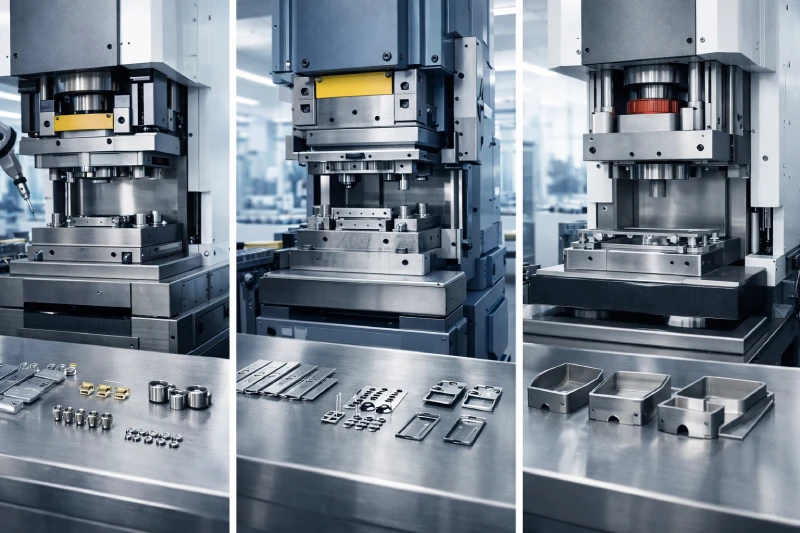
Servo Stamping Presses for Ultra-Precision Parts
Servo stamping presses are often the best choice for demanding medical applications.
Unlike conventional presses, a servo press allows the slide motion to be programmed precisely. This makes it easier to control speed, dwell time, and forming force.
Servo presses are ideal for:
- Miniature stamped components
- Thin titanium or stainless steel parts
- Delicate connector terminals
- Precision battery contacts
- Medical electronics components
Main advantages include:
- Better dimensional accuracy
- Reduced deformation
- Lower risk of cracking
- Cleaner edges
- More consistent results on difficult materials
If your article cluster includes a dedicated servo page, add a natural internal link here using anchor text such as “servo stamping press.”
Mechanical Presses for High-Volume Medical Components
Mechanical stamping presses remain a strong option for high-speed medical production when part geometry is relatively simple.
Typical uses include:
- Connector terminals
- Thin shielding parts
- High-volume stainless steel clips
- Small brackets and frames
Their main advantage is speed. A mechanical press can run far faster than a hydraulic system, making it a cost-effective solution for very large production runs.
However, mechanical presses provide less motion control than servo systems. They are therefore better suited to simpler parts with less demanding forming requirements.
Hydraulic Presses for Thicker or Complex Medical Parts
Hydraulic presses are less common in medical stamping, but they still play an important role when deeper forming or thicker materials are required.
Typical applications include:
- Formed stainless steel housings
- Larger medical trays
- Deeper-drawn components
- Thicker implant support parts
Hydraulic presses provide:
- Higher forming force
- Better control over longer strokes
- More flexibility for complex shapes
The tradeoff is lower production speed. For most small, thin medical components, servo or mechanical presses are usually more efficient.
How to Choose a Stamping Press for Medical Parts
Choosing the right stamping press begins with understanding the requirements of the specific medical component.
1. Evaluate Part Size and Tolerance
Small, delicate parts generally require a more precise machine.
| Part Requirement | Recommended Press Type |
|---|---|
| Very small component with tight tolerance | Servo press |
| High-volume thin metal part | Mechanical press |
| Deep-formed or thick part | Hydraulic press |
If the component requires tolerances near ±0.01 mm, a servo-driven system is usually the safest option.
2. Match the Press to the Material
Different materials behave differently during stamping.
| Material | Common Medical Use | Best Press Choice |
|---|---|---|
| Stainless steel | Surgical tools, housings | Servo or hydraulic |
| Titanium | Implant parts | Servo |
| Copper alloy | Connector terminals | Mechanical or servo |
| Nickel alloy | Battery contacts | Servo |
| Aluminum | Shielding parts | Mechanical |
Harder materials such as titanium generally benefit from more controlled motion and lower forming stress.
3. Consider Production Volume
Production volume has a major impact on the best machine choice.
- Low-volume prototype work may justify a slower but more flexible press
- High-volume programs often need mechanical or servo systems with automated feeding
- Long-term programs require durable tooling and repeatable process control
If your medical device program may eventually scale to millions of parts per year, it is important to choose a press that can support both current and future demand.
4. Review Validation and Monitoring Requirements
Medical manufacturers often need additional monitoring functions, such as:
- Force monitoring
- Vision inspection
- Tool wear detection
- Production traceability
- Automatic rejection of defective parts
These features are especially important for regulated medical applications.
| Requirement | Recommended Machine Feature |
|---|---|
| Tight tolerance | Programmable servo motion |
| Material traceability | Integrated production monitoring |
| Low contamination | Cleanroom-compatible enclosure |
| High-volume production | Automated feed and high-speed operation |
| Defect prevention | In-line inspection system |
FAQs
What tolerance is typically required for medical stamped parts?
Most medical stamped parts require tolerances between ±0.01 mm and ±0.05 mm. Smaller components used in electronics or implants usually require the tightest control.
Are servo presses better for medical applications?
In many cases, yes. Servo presses offer better motion control, improved accuracy, and less material deformation, making them ideal for high-precision medical components.
Can medical stamping be performed in a cleanroom?
Yes. Some medical stamping lines are specifically designed for cleanroom environments and use low-residue lubrication, enclosed systems, and post-process cleaning.
Which materials are most common in medical stamping?
The most common materials are stainless steel, titanium, copper alloys, nickel alloys, and aluminum.
What certifications matter when choosing a medical stamping supplier?
The most important quality certification is ISO 13485. Suppliers may also need documented traceability, material certificates, and validated inspection procedures.
Need Help Selecting a Stamping Press for Medical Components?
Medical stamping projects are rarely one-size-fits-all. The best press depends on your part geometry, material, tolerance requirements, cleanliness standards, and production volume.
Whether you are producing miniature connector terminals, stainless steel surgical parts, or implantable device components, selecting the right press early can reduce defects, lower cost, and improve long-term production stability.
Contact our engineering team to review your drawings, materials, tolerances, and production goals. We can help you identify the most suitable press type and production setup for your application.
