
Large metal components require more than simply “a bigger press.” When manufacturers stamp automotive body panels, truck frame components, appliance housings, HVAC cabinets, or heavy equipment panels, the press must provide enough tonnage, enough working area, and enough rigidity to support a large die without sacrificing accuracy.
Many production problems happen because the press was selected based only on tonnage. In reality, bed size, stroke length, frame strength, die handling, and automation are equally important when stamping oversized parts.
This guide explains how to choose the right stamping press for large parts, which press type works best, and what information you should prepare before requesting a quotation.
If you are new to the overall topic, first review the broader Stamping Press guide before returning to this article.
What Counts as a “Large Part” in Stamping?
In industrial stamping, a “large part” usually refers to a component that requires:
- A large die footprint
- Thick or high-strength material
- Deep drawing or long stroke movement
- Heavy part weight or large sheet dimensions
Typical examples include:
- Automotive body panels
- Truck chassis rails
- Refrigerator and washing machine panels
- Construction equipment covers
- Electrical cabinet housings
- Large HVAC enclosures
While small precision parts may fit inside a die only a few hundred millimeters wide, large-part dies often occupy most of the press bed and may weigh several tons.
| Large Part Type | Typical Material Thickness | Typical Part Size |
|---|---|---|
| Automotive outer panel | 0.8–1.5 mm steel or aluminum | 1,000–2,000 mm |
| Truck frame component | 3–8 mm steel | 1,500–3,000 mm |
| Appliance housing | 0.6–1.2 mm steel | 800–1,500 mm |
| Heavy equipment cover | 4–10 mm steel | 1,000–2,500 mm |
| HVAC cabinet panel | 0.8–2 mm galvanized steel | 1,000–2,000 mm |
Large parts generally require presses from 300 tons to more than 2,000 tons, depending on material thickness and die complexity.
Why Large Parts Need a Different Type of Stamping Press
A press that works well for small brackets or precision components may fail when used for large panels. The larger the die and part, the more force and structural stability are required.
Large-part stamping creates several additional challenges:
- Larger dies increase the load on the bed and frame
- Wider sheets require more working area and more accurate alignment
- Deep draw operations need longer stroke lengths
- Thick materials require much higher tonnage
- Heavy dies need efficient changeover systems
For example, a 600-ton press with a small bolster may technically provide enough force, but it still cannot run a large appliance panel if the die is too large to fit safely on the bed.
This is why press selection should begin with the entire application, not just with the tonnage number.
Key Requirements for a Stamping Press Used for Large Parts
High Tonnage Capacity
Tonnage is still one of the most important factors. Large parts usually require significantly more force because they involve:
- Larger cutting lengths
- Thicker material
- High-strength steel or aluminum
- More complex forming or drawing operations
Typical tonnage ranges include:
| Application | Typical Tonnage Range |
|---|---|
| Large appliance panels | 300–600 tons |
| Automotive body panels | 600–1,200 tons |
| Truck chassis parts | 800–1,500 tons |
| Heavy equipment structural parts | 1,000–2,500+ tons |
Underestimating tonnage can cause incomplete forming, excessive tool wear, poor dimensional accuracy, and possible damage to the press.
Large Bed and Bolster Area
The press bed and bolster must be large enough to support the entire die safely.
For large parts, bed size is often more important than tonnage. A die may physically not fit inside the press even if the press has sufficient force.
When evaluating a press, compare:
- Die width and length
- Required clearance around the die
- Feeding system space
- Transfer or robot integration space
As a rule, the bolster should provide enough additional space around the die for safe operation and maintenance.
Longer Stroke Length and Slide Adjustment
Large-part applications often require longer slide travel than standard blanking operations.
A longer stroke is especially important for:
- Deep-drawn components
- Tall dies
- Transfer systems
- Multi-stage forming operations
If the stroke is too short, the press may not provide enough clearance for the die to open fully or for automation to operate correctly.
Strong Frame Rigidity
Large presses must resist frame deflection. If the frame flexes under load, the result may be:
- Uneven forming across the part
- Variation in thickness or shape
- Premature die wear
- Higher scrap rates
Straight-side press frames are usually preferred for large-part stamping because they provide more rigidity than gap-frame designs.
Efficient Die Handling and Automation
Large dies are heavy, difficult to move, and expensive to change.
To improve productivity, many manufacturers use:
- Quick die change systems
- Die carts or rail systems
- Transfer feeders
- Robotic loading and unloading
- Automatic lubrication and part removal
If your production includes multiple part sizes or frequent changeovers, automation can significantly reduce downtime.
For more detail on integration and material handling, see the Stamping Press Automation page.
Which Type of Stamping Press Is Best for Large Parts?
The best press type depends on the size of the part, the material, the production volume, and whether deep drawing is required.
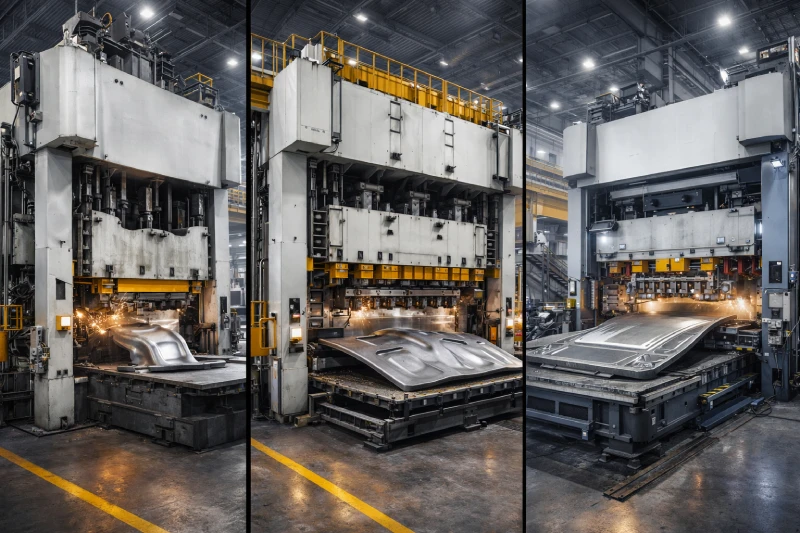
Instead of covering every press type in detail, this section focuses only on which option is usually best for large-part production.
Hydraulic Stamping Presses
Hydraulic presses are often the best choice for very large or deep-drawn parts.
Advantages include:
- Full tonnage throughout the stroke
- Better control for deep drawing
- Suitable for thick material and large irregular shapes
- Easier adjustment for different jobs
Hydraulic presses are commonly used for:
- Large appliance housings
- Heavy equipment panels
- Truck body components
- Deep-drawn industrial parts
The main disadvantage is slower cycle speed compared with a mechanical press.
If you need more background on this technology, see the Hydraulic Stamping Press page.
Mechanical Stamping Presses
Mechanical presses are usually the best choice for high-volume production of large parts where the tooling and process are stable.
Advantages include:
- Faster cycle times
- Better productivity in mass production
- Lower cost per part at high volumes
Mechanical presses are widely used for:
- Automotive body panels
- Appliance panels
- High-volume sheet metal production
However, they are less flexible than hydraulic presses and may not be ideal for deep-draw applications.
For a more detailed explanation, visit the Mechanical Stamping Press page.
Servo Presses
Servo presses are increasingly used for complex large parts that require precise motion control.
They can:
- Slow down during forming
- Reduce material stress
- Improve surface quality
- Handle advanced high-strength materials more effectively
Servo presses are especially useful for large automotive panels and complex formed parts, although they typically cost more than hydraulic or mechanical presses.
Quick Comparison Table
| Requirement | Best Press Type |
|---|---|
| Deep drawing and thick material | Hydraulic press |
| High-volume production | Mechanical press |
| Precision forming and advanced materials | Servo press |
| Maximum flexibility across different jobs | Hydraulic press |
| Lowest cost per part in large production runs | Mechanical press |
For a broader comparison of press technologies, see Types of Stamping Presses.
Recommended Press Specifications by Application
The following table provides general starting points. Actual requirements depend on part geometry, material, and die design.
| Application | Recommended Press Type | Typical Tonnage | Suggested Bed Size |
|---|---|---|---|
| Automotive body panel | Mechanical or servo | 600–1,200 tons | 2,500 × 1,500 mm or larger |
| Truck chassis component | Hydraulic or mechanical | 800–1,500 tons | 3,000 × 1,800 mm or larger |
| Appliance housing panel | Mechanical | 300–600 tons | 1,800 × 1,200 mm |
| Heavy equipment structural part | Hydraulic | 1,000–2,500 tons | 3,000 × 2,000 mm or larger |
| HVAC cabinet panel | Mechanical or hydraulic | 300–800 tons | 2,000 × 1,500 mm |
Automotive manufacturers usually need high-speed presses for large panels. If your application is focused specifically on vehicle production, review the Stamping Press for Automotive guide.
Common Problems When the Wrong Press Is Used
Choosing the wrong press often leads to much higher operating costs than expected.
Insufficient Bed Size
A die that barely fits inside the press creates difficult maintenance, poor access, and safety risks. In some cases, the die cannot be installed at all.
Too Little Tonnage
If the press does not provide enough force, parts may not form correctly. Operators may try to compensate by overloading the press, which can damage the machine and shorten die life.
Frame Deflection and Part Distortion
Large parts require even pressure across a wide area. If the press frame flexes, one side of the part may form differently than the other.
This can cause:
- Wrinkles
- Distortion
- Surface defects
- Dimensional variation
Poor Changeover Efficiency
Large dies can take hours to change if the press lacks quick die change systems or automation. The result is more downtime and lower production efficiency.
Questions to Ask Before Buying a Stamping Press for Large Parts
Before contacting a manufacturer, answer these questions internally:
- What is the largest part size you need to produce?
- What material and thickness will be used?
- Is the operation blanking, forming, bending, or deep drawing?
- What is the required production volume per shift?
- How large and heavy is the die?
- Will the press run only one part or multiple different parts?
- Is automation required?
- How much floor space and foundation capacity are available?
- How often will dies be changed?
- What level of accuracy is required?
The more complete your information, the more accurate the machine recommendation will be.
How to Request an Accurate Quotation
A stamping press manufacturer cannot recommend the correct machine based only on a sentence such as “we need a 1,000-ton press.”
To receive an accurate quotation, prepare:
- Part drawing or sample
- Material type and thickness
- Required production rate
- Die dimensions and weight
- Whether deep drawing is required
- Desired automation level
- Available factory floor space
- Power supply and installation requirements
The more detail you provide, the more likely the supplier can recommend the correct press configuration without oversizing or undersizing the machine.
Need Help Choosing the Right Press?
Selecting a stamping press for large parts is a major investment. Choosing the wrong tonnage, bed size, or press type can lead to expensive delays, low productivity, and higher scrap rates.
At Shuntec Press, we help manufacturers match the right hydraulic, mechanical, or servo press to their actual part size, material, die, and production requirements.
Whether you are producing automotive panels, truck components, appliance housings, or heavy equipment parts, we can help you evaluate:
- Required tonnage
- Press bed size
- Stroke length
- Frame type
- Automation options
- Future production flexibility
Request a Free Press Recommendation
Send us your:
- Part drawing
- Material specification
- Estimated annual production volume
- Die size
- Factory layout information
Our engineering team will recommend the most suitable stamping press configuration for your project.
FAQ
How much tonnage is needed for large stamped parts?
Most large-part applications require between 300 and 2,000+ tons. Large appliance panels may only need 300–600 tons, while truck chassis or heavy equipment parts may require more than 1,500 tons.
Are hydraulic presses better than mechanical presses for large parts?
Hydraulic presses are generally better for deep drawing, thick materials, and irregular shapes. Mechanical presses are usually better for high-volume production with stable tooling.
What bed size is needed for large automotive panels?
Large automotive panels often require a press bed at least 2,500 × 1,500 mm, although larger dies may require significantly more space.
Can one stamping press handle multiple large-part sizes?
Yes. A properly sized hydraulic or servo press can often handle multiple part sizes if the bed area, stroke, and tonnage are sufficient. However, frequent die changes may require quick die change systems and automation.
