
Introduction
In modern automotive manufacturing, efficiency, precision, and scalability are non-negotiable. Whether producing high-volume body panels or complex structural components, manufacturers rely heavily on stamping press systems to meet demanding production targets.
A stamping press for automotive applications is not just a machine—it is a critical part of an integrated production ecosystem. From traditional internal combustion vehicles to next-generation electric vehicles (EVs), stamping presses enable consistent, high-speed metal forming across a wide range of components.
This guide focuses specifically on how stamping presses are used in the automotive industry, what requirements they must meet, and how to choose the right system for your production line.
Why Stamping Presses Are Critical in Automotive Manufacturing
Automotive production is built on scale and repeatability. A single vehicle may require hundreds of stamped components, many of which must be produced at extremely high volumes with tight tolerances.
Stamping presses provide:
- High production speed — essential for mass manufacturing
- Consistent part quality — minimizing variation across batches
- Cost efficiency — lower per-unit cost compared to alternative forming methods
- Material utilization — optimized sheet metal usage
For OEMs and Tier 1 suppliers, stamping presses are not optional—they are foundational to competitive manufacturing.
Key Automotive Parts Produced by Stamping Presses
Stamping presses are used across virtually every structural and visible component of a vehicle.
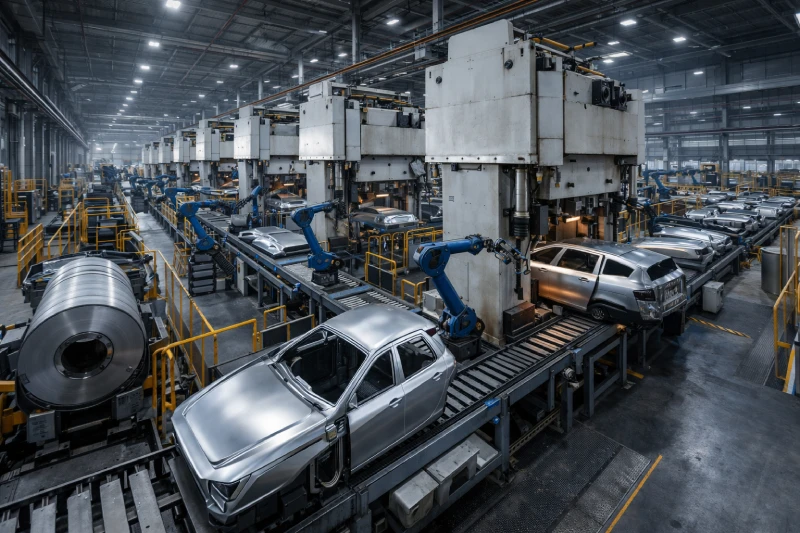
Body Panels and Exterior Components
- Doors
- Hoods
- Roof panels
- Fenders
These parts require large-tonnage presses and high surface quality.
Structural and Chassis Parts
- Frame reinforcements
- Cross members
- Crash structures
These components demand strength, durability, and dimensional accuracy.
Precision Components and Brackets
- Mounting brackets
- Small metal housings
- Connectors
Although smaller, these parts require tight tolerances and repeatability.
EV-Specific Components
With the rise of electric vehicles, stamping presses are increasingly used for:
- Battery enclosures
- Lightweight aluminum structures
- Thermal management components
👉 Automotive stamping is evolving rapidly with EV adoption, requiring more advanced press control and flexibility.
Production Requirements for Automotive Stamping Presses
Automotive applications impose some of the most demanding requirements on stamping equipment.
Key Performance Requirements
| Requirement | Why It Matters | Impact on Production |
|---|---|---|
| High Tonnage | Needed for large/thick parts | Enables forming of structural components |
| High Speed | Mass production demands | Reduces cycle time |
| Precision | Tight tolerances required | Ensures assembly compatibility |
| Automation Compatibility | Integration with robots | Improves efficiency |
| Durability | Continuous operation | Minimizes downtime |
Engineering Perspective
Automotive stamping presses must operate in 24/7 production environments, often within fully automated lines. Any downtime or inconsistency can disrupt the entire supply chain.
This is why automotive manufacturers prioritize:
- Proven reliability
- Advanced control systems
- Predictive maintenance capabilities
Types of Stamping Presses Used in Automotive Industry
Different automotive applications require different types of presses. This section focuses on application-based selection, not full classification.
Mechanical Stamping Presses
Best suited for:
- High-speed production
- Thin to medium thickness materials
- Progressive die operations
Hydraulic Stamping Presses
Best suited for:
- Deep drawing processes
- Complex shapes
- Thick materials
Servo Stamping Presses
Best suited for:
- Advanced automotive parts
- EV components
- Precision forming
Advantages include:
- Programmable motion
- Improved forming control
- Reduced material stress
Quick Comparison Table
| Press Type | Speed | Precision | Flexibility | Best Use Case |
|---|---|---|---|---|
| Mechanical | High | Medium | Low | Mass production |
| Hydraulic | Low | High | High | Deep drawing |
| Servo | Medium | Very High | Very High | Advanced components |
How Automotive Stamping Production Lines Work
Automotive stamping is rarely a standalone process—it is part of a fully integrated production line.
Typical Production Flow
- Coil Feeding System
Raw metal is fed into the press line - Stamping Operation
Parts are formed using dies - Transfer or Progressive Movement
Parts move between stations - Robotic Handling
Automation ensures speed and consistency - Inspection & Output
Quality control before assembly
Line Configurations
- Progressive Die Stamping → high-speed, continuous
- Transfer Press Systems → multi-stage forming
- Tandem Lines → large automotive panels
Key Challenges in Automotive Stamping (and Solutions)
Despite its efficiency, automotive stamping comes with several engineering challenges.
Common Challenges
| Challenge | Description | Solution |
|---|---|---|
| Material Springback | Metal returns to original shape | Advanced die design |
| Tool Wear | Dies degrade over time | Predictive maintenance |
| Scrap Rate | Material waste | Process optimization |
| Lightweight Materials | Harder to form | Servo press control |
Industry Insight
The shift toward aluminum and advanced high-strength steel (AHSS) has made stamping more complex. Manufacturers must balance:
- Formability
- Strength
- Production speed
Modern press systems, especially servo presses, play a key role in solving these challenges.
How to Choose the Right Stamping Press for Automotive Applications
This is the most critical section for buyers and decision-makers.
Step-by-Step Selection Framework
1. Define Production Volume
- High volume → mechanical press
- Flexible production → servo press
2. Evaluate Material Type
- Aluminum → requires precision control
- AHSS → requires high tonnage
3. Determine Required Tonnage
Tonnage depends on:
- Material thickness
- Part size
- Complexity
4. Consider Automation Level
- Manual → low investment, low efficiency
- Fully automated → high ROI, scalable
5. Assess Long-Term ROI
Key factors:
- Energy consumption
- Maintenance cost
- Downtime risk
Decision Matrix
| Factor | Priority Level | Recommended Solution |
|---|---|---|
| High Speed | High | Mechanical press |
| Complex Shapes | High | Hydraulic / Servo |
| Flexibility | Medium | Servo press |
| Cost Efficiency | High | Mechanical press |
| Future Scalability | High | Servo press |
Automotive Industry Trends Shaping Stamping Press Technology
The automotive industry is evolving rapidly, and stamping technology must adapt.
Key Trends
- EV Manufacturing Growth
New components and materials - Lightweight Materials
Aluminum and composites - Smart Factories (Industry 4.0)
Data-driven production - Energy Efficiency
Reduced power consumption
These trends are pushing manufacturers toward servo-driven and intelligent press systems.
Conclusion: Optimizing Automotive Production with the Right Stamping Press
Choosing the right stamping press for automotive applications is not just about machine specifications—it’s about aligning your equipment with production goals, material requirements, and future scalability.
From high-speed mechanical presses to advanced servo systems, the right solution can:
- Increase production efficiency
- Reduce costs
- Improve product quality
- Future-proof your manufacturing line
Get Expert Guidance for Your Automotive Stamping Project
If you’re evaluating stamping press solutions for automotive production, the best approach is to match your application requirements with the right system architecture.
👉 Whether you need:
- High-speed production lines
- EV component forming solutions
- Fully automated stamping systems
Our engineering team can help you identify the optimal configuration.
