
Introduction
In metal forming and stamping operations, presses are essential machines that determine production speed, part quality, and overall manufacturing efficiency. For decades, mechanical presses have been widely used in automotive, appliance, and electronics manufacturing due to their high speed and robust structure. However, modern production increasingly demands higher precision, flexible motion control, and improved energy efficiency.
This shift has led many manufacturers to adopt servo press technology, which uses programmable servo motors instead of traditional crankshaft mechanisms. Unlike mechanical presses that operate with fixed motion profiles, servo presses allow manufacturers to control slide position, speed, and dwell time throughout the forming cycle.
As a result, servo presses can improve forming quality, reduce material stress, and optimize energy consumption. Understanding the differences between these two press technologies is essential when evaluating equipment for modern manufacturing environments.
How Mechanical Presses Work
A mechanical press converts the rotational motion of an electric motor into linear slide movement through a mechanical transmission system. The main components typically include a flywheel, clutch, crankshaft, connecting rod, and ram (slide).
During operation, the motor continuously rotates a flywheel that stores kinetic energy. When the clutch engages, the energy from the flywheel is transferred to the crankshaft. The crankshaft then converts rotational motion into vertical movement, driving the press slide up and down in a fixed cycle.
This mechanism creates a sinusoidal motion profile, meaning the slide speed varies throughout the stroke. The highest speed typically occurs at mid-stroke, while the press reaches maximum forming force only near the bottom dead center.
Because the motion profile is mechanically defined by the crankshaft design, the operator cannot independently control speed, dwell time, or acceleration during different stages of the forming process. Any adjustment usually requires changing the press setup, tooling design, or operating speed.
Mechanical presses are known for their high production speed and durability, making them suitable for high-volume stamping operations such as automotive components, metal brackets, and appliance parts. However, the lack of motion flexibility can limit forming control, particularly for complex or precision parts.
How Servo Press Systems Work
A servo press replaces the traditional flywheel and crankshaft drive system with a high-torque servo motor connected to the press slide through a transmission mechanism such as a ball screw, gear system, or link drive.
Instead of operating with a fixed mechanical cycle, the servo motor directly controls the slide position throughout the entire stroke. The motion profile is generated by the press control system and can be programmed according to the forming requirements of the specific part.
This programmable motion capability allows manufacturers to adjust slide speed, acceleration, and dwell time at different points in the stroke. For example, the slide can move quickly during non-forming sections of the stroke and slow down during the critical forming stage to improve material flow and reduce stress.
Servo presses can also pause briefly at the bottom of the stroke, known as dwell control, which helps stabilize the forming process and improve dimensional accuracy.
Because motion parameters are software-controlled, manufacturers can quickly modify production settings without changing mechanical components. This flexibility makes servo presses particularly suitable for modern manufacturing environments where product designs and forming requirements frequently change.
Key Differences in Motion Control and Flexibility
One of the most significant differences between servo presses and mechanical presses is the level of motion control and operational flexibility available during the forming cycle.
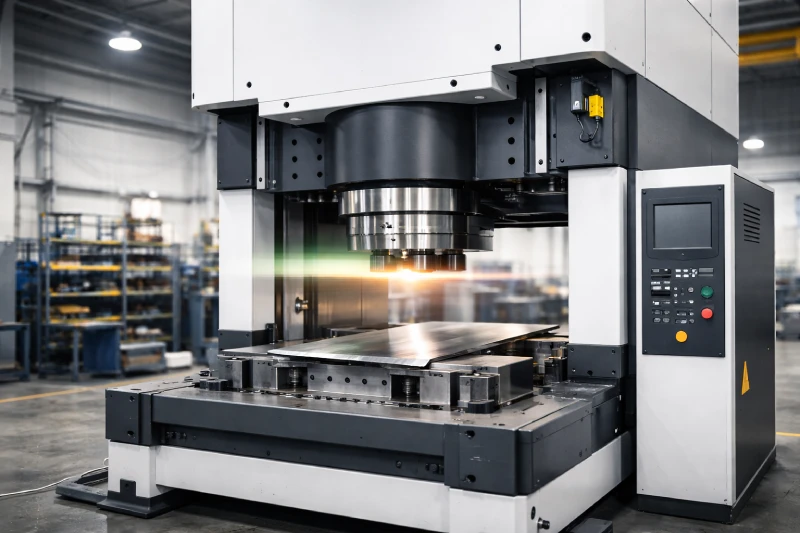
In a mechanical press, slide motion is determined by the crankshaft geometry and flywheel rotation. Once the machine is running, the motion profile remains fixed. The press slide follows the same speed and position pattern in every cycle. This limitation means that operators cannot adjust motion characteristics for different materials or part geometries without modifying tooling or changing the press speed.
Servo presses, by contrast, provide fully programmable slide motion. The press control system allows engineers to define custom motion profiles that optimize each stage of the forming process.
For example, a servo press can:
- Run at high speed during the approach stroke
- Slow down during material contact
- Maintain controlled forming speed during deformation
- Pause briefly at bottom dead center
- Accelerate quickly during the return stroke
This level of control helps manufacturers improve forming stability and reduce defects such as cracking, wrinkling, or material springback.
Another important advantage is multi-step forming capability. Servo presses can execute multiple forming stages within a single stroke by adjusting speed and force throughout the cycle. This can eliminate the need for secondary operations or additional tooling.
From a production perspective, this flexibility also improves changeover efficiency. Motion profiles can be stored in the control system and recalled for different parts, allowing manufacturers to switch between product types with minimal setup time.
As manufacturing processes become more complex and product lifecycles shorten, the programmable nature of servo presses provides a significant advantage over traditional mechanical press systems.
Precision and Forming Quality Comparison
Precision and part quality are critical considerations in modern manufacturing, particularly in industries such as automotive electronics, medical devices, and precision metal components.
Mechanical presses rely on rigid mechanical transmission systems to deliver force. While these machines can achieve high repeatability under stable conditions, the fixed motion profile can make it difficult to control material flow during complex forming operations.
Because the slide speed changes rapidly near the bottom of the stroke, the material may experience uneven deformation. This can increase the risk of defects such as cracks, wrinkles, or dimensional variation.
Servo presses provide improved forming control by allowing the slide speed to be precisely adjusted during the forming stage. Slower and more controlled motion near the bottom dead center helps maintain stable material deformation and reduces stress concentrations.
Another advantage is programmable dwell control. By briefly holding the slide at the bottom of the stroke, the press can stabilize the material before the return stroke begins. This improves part consistency and reduces springback in certain forming applications.
Servo presses also provide highly accurate position feedback through advanced control systems. This allows the press to maintain precise stroke positioning and repeatability across production cycles.
As a result, servo press technology is often preferred for manufacturing applications that require tight dimensional tolerances, consistent forming quality, and reliable production performance.
Production Efficiency and Energy Consumption
Production efficiency is another important factor when comparing servo presses and mechanical presses.
Mechanical presses typically operate at very high speeds, which makes them well suited for large-scale stamping operations where the forming process is relatively simple and repetitive. Once the press is running, the flywheel continuously stores and releases energy to maintain the production cycle.
However, this system consumes energy even when the press is not actively performing a forming operation. The flywheel must remain in constant rotation, which results in continuous power consumption.
Servo presses operate differently. The servo motor only consumes significant energy during the actual forming cycle. During idle periods or non-forming stages of the stroke, energy usage is significantly lower.
Another advantage of servo press technology is adaptive cycle control. Because the slide motion can be programmed, the press can optimize the movement profile to minimize unnecessary travel time. Faster approach and return strokes combined with slower forming speeds can maintain production efficiency while improving part quality.
In many manufacturing environments, these characteristics lead to lower overall energy consumption and improved operational efficiency.
Additionally, servo presses often generate less mechanical shock and vibration compared with traditional mechanical presses. This can reduce wear on tooling and machine components, helping extend equipment lifespan and reduce maintenance requirements.
When Manufacturers Should Choose Servo Press Technology
While both press technologies have their place in manufacturing, servo presses are increasingly selected for applications that require higher levels of forming control and production flexibility.
Manufacturers should consider servo press systems when producing complex or precision components where controlled forming speed and programmable motion are essential. Industries such as automotive electronics, battery components, precision metal stamping, and medical device manufacturing often benefit from the enhanced motion control provided by servo presses.
Servo presses are also advantageous in environments where multiple product types are produced on the same equipment. The ability to store and switch between different motion profiles allows manufacturers to reduce setup time and improve production flexibility.
Another scenario where servo presses are valuable is when forming materials that are sensitive to deformation conditions. By controlling speed and dwell time, the press can optimize material flow and reduce the risk of defects.
However, mechanical presses may still be appropriate for extremely high-volume operations involving simple parts where maximum production speed is the primary objective.
Ultimately, the choice between servo and mechanical press technology depends on production requirements, part complexity, and long-term manufacturing strategy.
Conclusion
Mechanical presses have long been the backbone of high-volume metal stamping due to their speed and robust design. However, modern manufacturing increasingly demands greater flexibility, precision, and energy efficiency.
Servo presses address these requirements by replacing fixed mechanical motion with programmable servo motor control. This enables manufacturers to optimize forming speed, improve part quality, and reduce energy consumption.
While mechanical presses remain effective for certain high-speed applications, servo press technology offers significant advantages for complex and precision manufacturing processes.
Manufacturers evaluating new press equipment should carefully consider how motion control, production flexibility, and energy efficiency will impact their long-term production capabilities.
