
Introduction
Manufacturers evaluating forming equipment often compare servo presses and hydraulic presses because both technologies can deliver high forming forces for industrial production. However, the way these systems generate and control force is fundamentally different.
Hydraulic presses have been widely used for decades in metal forming, forging, deep drawing, and heavy industrial applications. They rely on hydraulic fluid pressure to generate force and are known for their durability and high tonnage capability.
Servo presses, in contrast, use servo motors and programmable motion control systems to precisely control the movement of the press ram. This technology allows manufacturers to optimize forming speed, accuracy, and energy consumption.
For engineers and equipment buyers, understanding the differences between these press systems is essential when selecting equipment for modern production lines. The right choice depends on factors such as precision requirements, cycle time, force demand, and operational efficiency.
What Is a Servo Press?
A servo press is an industrial forming machine that uses a servo motor-driven system to control the movement of the press ram. Instead of relying on hydraulic pressure, the press motion is generated by an electric servo motor connected to a mechanical transmission system such as a ball screw, gear drive, or crank mechanism.
The key characteristic of a servo press is its programmable motion control. Engineers can precisely adjust the speed, position, and force profile throughout the entire stroke. This allows the press to slow down during critical forming stages and accelerate during non-forming segments of the cycle.
Servo presses are widely used in applications where precision and repeatability are critical. Common examples include electronic component assembly, automotive connector pressing, battery module assembly, and precision metal forming.
Another important advantage is energy efficiency. Because the servo motor only consumes power when the machine is moving, energy consumption is typically lower compared with conventional hydraulic systems that continuously run pumps.
Modern servo presses also integrate advanced control systems, enabling real-time monitoring of force, displacement, and process parameters. This capability helps manufacturers improve process stability and maintain consistent product quality.
Manufacturers exploring modern forming solutions often evaluate the capabilities of a dedicated Servo Press to improve precision and automation in production lines.
What Is a Hydraulic Press?
A hydraulic press is a forming machine that generates force through hydraulic pressure. The system operates using a hydraulic pump that pushes fluid into cylinders, creating pressure that drives the press ram downward to perform forming operations.
The fundamental principle behind hydraulic presses is Pascal’s law, which states that pressure applied to a confined fluid is transmitted equally in all directions. This allows hydraulic systems to produce extremely large forces using relatively compact components.
Hydraulic presses are widely used in heavy industrial processes such as forging, deep drawing, compression molding, and large metal forming operations. Their ability to generate high tonnage makes them suitable for applications involving thick materials or large parts.
One advantage of hydraulic presses is their flexibility in force control. Operators can maintain full tonnage throughout the stroke, which is beneficial for forming processes that require constant pressure.
However, hydraulic systems require pumps, valves, and fluid management components that must be regularly maintained. Hydraulic oil leakage, temperature management, and energy consumption are common considerations in long-term operation.
Despite these challenges, the traditional Hydraulic Press remains a widely used solution in many manufacturing industries due to its reliability and strong forming capability.
Key Differences Between Servo Press and Hydraulic Press
The fundamental difference between servo presses and hydraulic presses lies in how they generate and control forming force. While both machines perform similar manufacturing tasks, their drive systems, motion control methods, and operational characteristics lead to distinct advantages in different production environments.
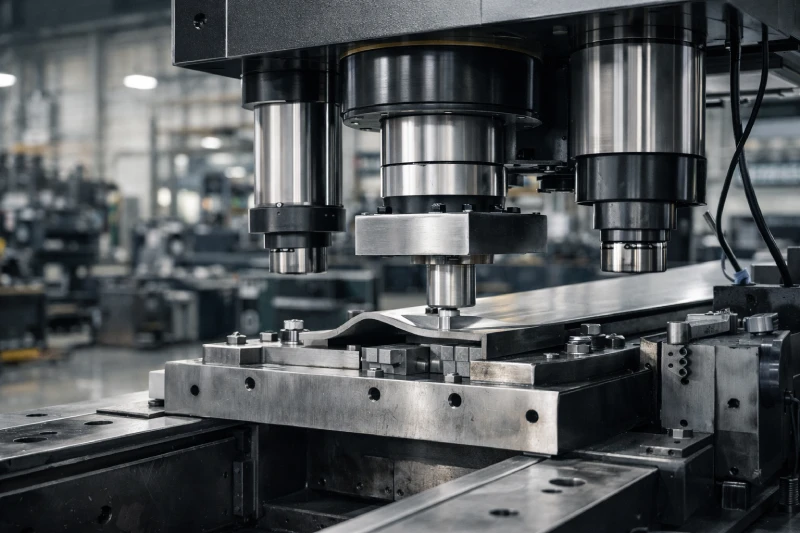
The following comparison summarizes the main engineering differences between these two press technologies.
| Feature | Servo Press | Hydraulic Press |
|---|---|---|
| Drive System | Servo motor with mechanical transmission (ball screw, gear, or crank) | Hydraulic pump and cylinder system |
| Motion Control | Fully programmable stroke and speed profiles | Motion controlled through hydraulic valves and fluid flow |
| Precision | Very high position and force accuracy | Moderate precision depending on hydraulic stability |
| Energy Efficiency | High efficiency, power mainly consumed during motion | Lower efficiency due to continuously running pumps |
| Production Speed | Adjustable stroke speed and optimized cycle profiles | Typically slower with limited motion flexibility |
| Force Capability | Medium to high tonnage depending on machine design | Extremely high tonnage capability |
| Maintenance | Mainly electrical components and mechanical transmission | Hydraulic oil systems, pumps, valves, and seals require maintenance |
| Process Monitoring | Advanced digital monitoring of force and displacement | Monitoring capabilities depend on hydraulic control systems |
| Typical Applications | Precision forming, electronics assembly, battery manufacturing | Heavy forming, forging, deep drawing |
Although both technologies perform forming operations, their operational characteristics can significantly influence manufacturing performance.
Motion Control
Servo presses provide highly precise motion control because the ram movement is driven directly by a programmable servo motor. Engineers can define complex motion profiles, including variable speed stages, dwell positions, and multi-step forming sequences. This flexibility allows the press to slow down during critical forming stages and accelerate during non-forming parts of the cycle.
Hydraulic presses control motion through hydraulic fluid flow regulated by valves. While modern hydraulic control systems can achieve relatively stable movement, the level of programmable motion flexibility is generally lower compared with servo-driven systems.
Energy Efficiency
Energy consumption is a major difference between the two technologies. Servo presses typically consume energy only when the motor is actively moving the ram. During idle periods, the machine draws minimal power.
Hydraulic presses usually rely on pumps that maintain system pressure continuously. Even when the press is not actively forming parts, the hydraulic system may continue running, which results in higher overall energy consumption.
Precision and Repeatability
Servo presses offer excellent repeatability because the servo motor and control system regulate both position and force with high accuracy. This allows manufacturers to maintain consistent forming results across high-volume production.
Hydraulic presses can also achieve accurate forming, but variations in hydraulic pressure, oil temperature, and valve response may introduce small inconsistencies during long production cycles.
Production Speed
Servo presses can optimize cycle times by adjusting ram speed throughout the stroke. For example, the press can approach the workpiece quickly, slow down during forming, and accelerate again after the forming process is complete.
Hydraulic presses typically move at speeds determined by hydraulic flow rates. Although some systems allow variable speeds, they generally cannot match the level of dynamic stroke optimization available with servo-driven systems.
Maintenance Requirements
Maintenance requirements also differ significantly between these technologies. Servo presses mainly involve electrical components, servo drives, and mechanical transmission systems. Routine maintenance typically focuses on lubrication, alignment, and periodic inspection.
Hydraulic presses require ongoing maintenance of pumps, hydraulic lines, seals, valves, and fluid quality. Hydraulic oil contamination, leaks, and temperature management can affect system performance if not properly maintained.
In general, servo presses provide superior motion control, precision, and energy efficiency, while hydraulic presses remain the preferred solution for applications that require extremely high forming forces and heavy-duty industrial operation.
Advantages of Servo Press Technology
Servo press technology provides several advantages that make it increasingly popular in modern manufacturing environments.
One of the most important benefits is programmable motion control. Engineers can design custom stroke profiles that optimize forming processes. For example, the press can approach the workpiece quickly, slow down during forming, and pause at specific positions to improve material flow.
This level of control allows manufacturers to reduce defects such as cracking, wrinkling, or incomplete forming.
Another major advantage is precision. Servo presses can maintain highly accurate position and force control throughout the forming process. This makes them suitable for applications involving delicate components, thin materials, or complex geometries.
Energy efficiency is also a significant benefit. Since servo motors only draw high power during motion, overall energy consumption can be significantly lower than hydraulic systems that rely on continuously operating pumps.
Additionally, servo presses integrate well with modern automation systems. Many machines include advanced sensors and control software that allow manufacturers to monitor force-displacement curves and process parameters in real time.
These capabilities support data-driven manufacturing and help engineers maintain consistent product quality across high-volume production lines.
For companies implementing advanced manufacturing technologies, evaluating a modern Servo Press System can provide improvements in precision, efficiency, and process control.
Advantages of Hydraulic Press Systems
Despite the growth of servo technology, hydraulic presses continue to offer important advantages in many industrial applications.
One of the primary benefits is their ability to generate extremely high forming forces. Hydraulic systems can produce thousands of tons of pressure, making them ideal for large metal forming operations, forging processes, and heavy manufacturing applications.
Another advantage is consistent force throughout the entire stroke. Hydraulic presses can maintain full tonnage at any position, which is useful in processes that require sustained pressure rather than rapid impact.
Hydraulic presses are also known for their robust construction and durability. Many machines operate reliably for decades with proper maintenance, even in demanding industrial environments.
From a purchasing perspective, hydraulic presses often have lower initial equipment costs compared with advanced servo-driven systems. For manufacturers operating on limited capital budgets, this can be a practical consideration when selecting equipment.
Additionally, hydraulic presses are widely available in a large range of sizes and configurations, allowing manufacturers to find suitable machines for heavy-duty forming operations.
For applications that prioritize force capacity and structural durability over precision motion control, hydraulic press systems remain a practical and proven solution.
Which Press Is Better for Different Applications?
Choosing between a servo press and a hydraulic press largely depends on the specific manufacturing process and performance requirements.
Automotive Component Manufacturing
In automotive production, servo presses are increasingly used for precision assembly tasks such as bearing installation, gear pressing, and electronic connector assembly. The programmable motion profile allows engineers to precisely control force and displacement.
However, hydraulic presses are still widely used for large body panel forming and heavy stamping operations that require very high tonnage.
Battery Manufacturing
Battery module and battery pack assembly often require precise force control to avoid damaging sensitive components.
Servo presses are well suited for these applications because they provide accurate displacement monitoring and programmable motion profiles.
Precision Metal Stamping
Servo presses are commonly used for high-precision stamping operations involving thin materials or complex forming processes. The ability to adjust motion profiles helps optimize material flow and reduce defects.
Heavy Metal Forming
For large-scale forming processes such as forging, deep drawing, or compression molding, hydraulic presses remain the preferred solution. Their ability to maintain high force across long strokes makes them suitable for heavy-duty industrial forming.
Many manufacturers therefore evaluate both technologies based on the specific forming process rather than selecting one universal solution.
In some production environments, servo presses and hydraulic presses are used together to handle different stages of manufacturing.
Conclusion
Servo presses and hydraulic presses both play important roles in modern manufacturing. Each technology offers distinct advantages depending on production requirements.
Servo presses provide precise programmable motion, improved energy efficiency, and advanced process monitoring capabilities. These characteristics make them well suited for precision assembly, electronics manufacturing, and applications requiring tight process control.
Hydraulic presses remain highly effective for heavy forming operations that demand extremely high tonnage and sustained force.
For equipment buyers and manufacturing engineers, the best choice depends on the balance between precision, force capacity, energy efficiency, and long-term maintenance considerations.
Understanding these differences helps manufacturers select the most suitable press technology for their production processes.
