
Introduction
Selecting the correct servo press tonnage is one of the most critical decisions when designing a metal forming or assembly process. Press capacity determines whether a machine can reliably perform forming, stamping, bending, or joining operations without damaging tooling, producing defective parts, or overloading the equipment.
In modern manufacturing environments—such as automotive electronics, battery production, and precision component assembly—servo presses are widely used because of their programmable motion and precise force control. However, the flexibility of servo systems does not eliminate the need for proper press tonnage calculation.
Engineers must estimate the required forming force based on material properties, part geometry, and tooling conditions. Selecting a press with insufficient capacity can cause unstable forming, while oversizing the press increases investment and operating costs.
This guide explains how servo press capacity is determined, how engineers estimate required force, and how to select the right press tonnage for industrial production.
What Does Press Tonnage Mean?
In metal forming and assembly operations, press tonnage refers to the maximum force a press machine can apply during a forming stroke. The value is typically expressed in tons (metric tons or short tons), representing the compressive force delivered by the press ram onto the workpiece.
For example, a 100-ton servo press can apply a maximum force of approximately 100 tons (≈980 kN) during forming.
Press tonnage represents the mechanical force required to deform a material beyond its yield strength, allowing it to be shaped into the desired geometry. The actual force required depends on several factors, including material strength, thickness, and the complexity of the forming process.
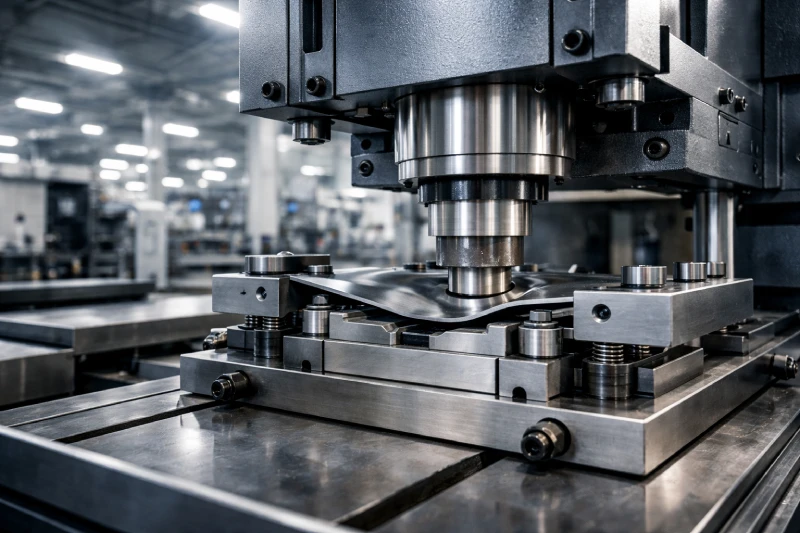
In stamping or forming operations, the press ram pushes the tool into the material. When the applied force exceeds the material’s resistance to deformation, the material flows plastically, creating the intended shape.
However, press tonnage is not constant throughout the stroke. In many forming processes, the maximum force occurs near the bottom of the stroke, where material deformation is highest and the tooling fully engages the workpiece.
Servo presses provide an advantage in this area because their motion profile can be precisely controlled. Engineers can slow the ram near the forming zone, reducing impact loads and improving force accuracy. Even with this advanced control, the press must still be sized correctly to deliver the required peak forming force.
Understanding press tonnage therefore means understanding the relationship between material deformation and the mechanical force required to produce it.
Factors That Determine Required Press Tonnage
Several variables influence how much force is required to form a part. Engineers must evaluate these parameters before selecting the appropriate servo press capacity.
Material Type
Different materials require different forming forces because of variations in yield strength and hardness. High-strength steels, stainless steel, and certain alloys require significantly more force than softer materials such as aluminum or copper.
For example, forming stainless steel components typically requires much higher tonnage than forming aluminum parts of similar geometry.
Material Thickness
Material thickness is one of the most important factors affecting required press force. In general, thicker materials resist deformation more strongly and therefore require higher forming force.
In many stamping calculations, press force increases roughly proportionally to material thickness.
Forming Method
Different forming operations require different force levels.
Common processes include:
- Blanking / punching
- Bending
- Drawing
- Coining
- Press-fit assembly
Punching operations typically require high instantaneous force because the material is sheared. Deep drawing, by contrast, often requires lower but more sustained force throughout the stroke.
Servo presses are often used in processes where controlled forming speed and programmable force profiles are beneficial.
Part Geometry
The geometry of the component being produced also affects required tonnage.
Parts with:
- complex shapes
- multiple bends
- large forming areas
generally require greater forming force. Sharp bends and tight radii also increase resistance during deformation.
Tooling and Die Design
The design of the tooling significantly affects force requirements. Factors include:
- die clearance
- cutting edge sharpness
- lubrication conditions
- tool alignment
Well-designed tooling can significantly reduce required tonnage by minimizing friction and improving material flow.
In practice, experienced tooling engineers often adjust force estimates based on previous production experience.
Basic Methods for Estimating Press Force
Before purchasing or specifying a press machine, engineers typically perform a press tonnage calculation to estimate the required forming force.
The exact formulas vary depending on the forming operation, but several simplified methods are commonly used in manufacturing.
1. Punching / Blanking Force Calculation
For punching operations, the required force can be estimated using the following formula:
Press Force = Perimeter × Material Thickness × Shear Strength
Where:
- Perimeter = total length of the cut edge
- Material Thickness = thickness of the sheet
- Shear Strength = material shear strength
Example:
If a component has:
- perimeter: 200 mm
- thickness: 1.5 mm
- shear strength: 300 MPa
The required force can be estimated by multiplying these parameters and converting to tonnage.
2. Bending Force Estimation
For bending operations, simplified formulas are often used based on material thickness, bending length, and die opening width.
A common rule used in sheet metal forming is:
Press Force ∝ Material Thickness² × Bending Length
Because bending force increases rapidly with thickness, even small increases in material thickness can significantly raise required tonnage.
3. Forming Force from Empirical Data
In many industrial environments, engineers rely on empirical data or historical process records.
Previous production runs can provide accurate reference values for:
- similar materials
- similar tooling geometry
- similar forming operations
This practical approach often produces more reliable estimates than theoretical formulas alone.
4. Simulation and Digital Tools
Advanced manufacturing companies increasingly use finite element simulation and forming analysis software to predict required press force. These tools simulate material flow and deformation, allowing engineers to optimize tooling design before production begins.
Even when simulation is used, engineers still verify that the selected servo press tonnage provides sufficient capacity for real production conditions.
Typical Tonnage Requirements in Industrial Applications
Different industries use servo presses with widely varying capacities depending on the scale and precision of the application.
Automotive Stamping
Automotive components often require large presses due to thicker materials and larger part geometries.
Typical tonnage ranges:
- 200–800 tons for medium stamping operations
- 1,000+ tons for large structural components
Although large mechanical presses are common in automotive manufacturing, servo presses are increasingly used for precision forming operations.
Electronics Manufacturing
Electronics components are typically smaller and thinner, requiring much lower forming force.
Typical servo press capacities include:
- 5–50 tons for small metal components
- 20–100 tons for connector terminals and shielding parts
Servo presses are particularly valuable in electronics production because of their precise force control and programmable stroke profiles.
Battery and Energy Components
The rapid growth of battery manufacturing has increased demand for high-precision forming processes.
Applications include:
- battery tabs
- current collectors
- structural battery components
Typical press capacities range from 50–200 tons, depending on material thickness and forming complexity.
Precision Mechanical Parts
Small precision components used in sensors, medical devices, and electronic connectors typically require smaller presses.
Typical servo press tonnage:
- 3–20 tons
These applications benefit from servo presses because of their ability to control forming force with high repeatability.
Choosing a Servo Press with the Correct Capacity
Selecting the correct servo press capacity requires more than simply matching the calculated forming force.
In most industrial applications, engineers apply a safety margin to ensure reliable operation. A common practice is to select a press with approximately 20–30% higher capacity than the calculated maximum forming force.
This margin compensates for factors such as:
- material property variations
- tooling wear
- friction changes
- unexpected forming loads
Production speed is another consideration. Higher stroke rates may increase dynamic loads, which can affect the required press capacity.
Servo presses provide additional flexibility because their motion profiles can be adjusted to control force application more precisely. However, the press must still be capable of delivering the required peak forming force.
When evaluating equipment options, engineers should consider both press specifications and production requirements. Reviewing detailed specifications for machines such as a servo hydraulic press or other industrial press systems can help determine whether the equipment meets the required forming conditions.
For a broader overview of servo press technology and applications, engineers can also explore resources on servo press systems.
Conclusion
Determining the correct servo press tonnage is essential for achieving stable forming processes, protecting tooling, and maintaining consistent product quality.
Engineers must evaluate multiple factors—including material type, thickness, forming method, and tooling design—when estimating the required press force. Simplified formulas and empirical data are commonly used to perform preliminary press tonnage calculations, while simulation tools can provide more detailed analysis.
Once the required forming force is estimated, selecting a press with an appropriate safety margin ensures reliable production performance.
By understanding how press tonnage is calculated and applied in real manufacturing environments, engineers can select servo press systems that deliver both efficiency and long-term process stability.
