
Introduction
Industrial press systems have long been central to metal forming, assembly, and component manufacturing. Traditionally, mechanical and hydraulic presses dominated production lines, providing the force needed for stamping, forming, and joining operations. However, as manufacturing industries demand higher precision, better process control, and improved energy efficiency, conventional press technologies have begun to show their limitations.
Servo press technology has emerged as a transformative solution in modern manufacturing environments. By integrating servo motors, digital motion control systems, and programmable stroke profiles, servo presses allow manufacturers to precisely control speed, position, and forming force throughout the entire press cycle.
This level of control enables manufacturers to optimize forming processes for delicate electronic components, advanced battery parts, and precision metal assemblies. As a result, servo press systems are increasingly adopted in industries where accuracy, repeatability, and process flexibility are critical to product quality and production efficiency.
Evolution of Industrial Press Technology
Industrial press technology has evolved significantly over the past century as manufacturing requirements have become more demanding. The transition from mechanical presses to hydraulic systems and eventually to servo-driven presses reflects the need for greater control and adaptability in forming processes.
Mechanical presses were the earliest widely used press systems in mass production. They rely on flywheels and crank mechanisms to convert rotational motion into vertical pressing force. Mechanical presses are capable of very high production speeds, making them suitable for large-scale stamping operations. However, their motion profile is fixed by the mechanical linkage, which means the speed and force characteristics cannot be easily adjusted for different forming requirements.
Hydraulic presses were introduced to provide greater flexibility. Using hydraulic cylinders to generate pressing force, these systems allow manufacturers to control force and stroke more precisely than mechanical presses. Hydraulic presses are especially useful for deep drawing and heavy forming applications. Nevertheless, hydraulic systems often suffer from slower cycle times and higher energy consumption.
Servo press technology represents the next stage in this evolution. Instead of relying on mechanical flywheels or hydraulic pressure, servo presses use high-performance servo motors and digital controllers to drive the ram motion directly. This design allows manufacturers to program motion profiles, adjust forming speed dynamically, and precisely control the press position during the entire cycle.
The result is a press system that combines the speed advantages of mechanical presses with the control flexibility of hydraulic systems.
Core Technologies Behind Servo Press Systems
Servo press systems rely on several key technologies that enable precise motion control and programmable forming processes. These components work together to deliver the high accuracy and flexibility that distinguish servo presses from conventional press machines.
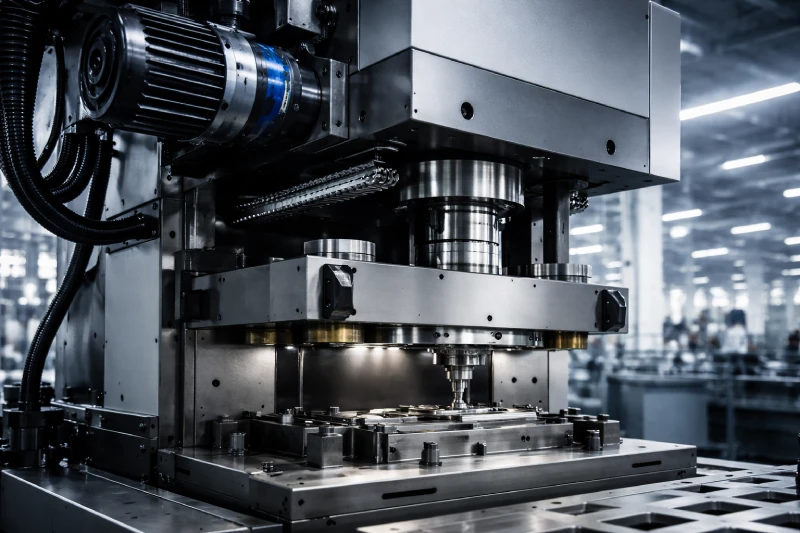
Servo Motors
At the heart of every servo press is a high-torque servo motor. Unlike traditional motors that operate at constant speeds, servo motors can precisely control rotational position, speed, and acceleration. In servo press systems, the motor drives the press slide through mechanisms such as ball screws, planetary roller screws, or link drive systems.
This allows the press ram to move according to programmable motion profiles rather than a fixed mechanical cycle.
Motion Controllers
Advanced motion controllers coordinate the movement of the servo motor with high precision. These digital control systems continuously monitor motor position, speed, and torque through feedback signals from encoders.
By processing this real-time data, the controller adjusts motor output to maintain the desired motion path throughout the forming cycle. This closed-loop control architecture enables extremely accurate positioning and repeatability.
Digital Forming Control
Servo press systems use digital forming control to manage complex forming operations. Engineers can program the press to vary speed, dwell time, and force at specific points during the stroke.
For example, a press may approach the workpiece quickly, slow down during the forming stage, and then accelerate again during the return stroke. This optimized motion profile improves product quality and reduces stress on tooling.
Programmable Stroke Profiles
One of the most significant advantages of servo press technology is programmable stroke capability. Manufacturers can design custom stroke profiles for different parts and processes without changing mechanical components.
Operators can store multiple programs for different products, allowing the same press machine to handle a wide variety of manufacturing tasks with minimal setup time.
Why Servo Technology Enables High Precision Forming
Precision forming requires tight control over position, force, and motion timing. Servo press systems achieve this level of control through integrated digital feedback and advanced motion algorithms.
Position Control
Servo presses provide extremely accurate slide positioning through encoder feedback and closed-loop control. The controller continuously tracks the ram position and adjusts motor output to maintain precise movement.
This capability is critical in applications where dimensional tolerances are very small, such as electronic connectors or precision metal components.
Force Control
Unlike mechanical presses that generate peak force near the bottom of the stroke, servo presses can regulate force throughout the entire forming cycle. By controlling motor torque and motion speed, the system can apply consistent force exactly where it is needed.
This helps prevent over-forming, reduces tool wear, and improves part consistency.
Repeatability
Repeatability is a key requirement in high-volume manufacturing. Servo press systems offer exceptional cycle-to-cycle consistency because the motion profile is digitally controlled rather than mechanically constrained.
The system can reproduce the same motion sequence thousands or millions of times with minimal deviation, ensuring stable product quality across large production runs.
Reduced Material Waste
Precise motion control also reduces material waste. When forming operations are carefully controlled, the risk of cracking, deformation, or dimensional defects is significantly reduced.
This is especially important when working with expensive materials or thin metal components where small process variations can lead to scrap.
Typical Manufacturing Processes Using Servo Press
Servo press technology is widely used in manufacturing sectors that require precise forming and controlled assembly operations. Its programmable motion capabilities make it suitable for a broad range of industrial processes.
Precision Stamping
In precision stamping applications, servo presses enable controlled forming of thin metal sheets and complex geometries. The ability to adjust speed during different phases of the stroke helps improve edge quality and reduce tool stress.
Electronic Assembly
Electronic manufacturing often involves delicate components that require accurate force control. Servo presses are used for tasks such as connector insertion, terminal crimping, and small component assembly.
Because the press motion can be precisely controlled, manufacturers can ensure consistent assembly quality without damaging sensitive parts.
Battery Component Forming
The rapid growth of electric vehicles has increased demand for precision battery components. Servo presses are used to form battery tabs, cell casings, and structural elements with tight tolerances.
Controlled motion profiles help prevent material deformation and maintain consistent component dimensions.
Small Metal Parts Production
Many industries rely on small metal components that require accurate forming and consistent quality. Servo presses are commonly used to produce springs, clips, micro-connectors, and miniature mechanical parts.
Their ability to combine high precision with flexible motion control makes them well suited for these applications.
Future Trends in Servo Press Technology
Servo press technology continues to evolve as manufacturers pursue greater automation, digitalization, and production efficiency.
One important trend is the integration of servo press systems into smart manufacturing environments. Modern press machines are increasingly connected to factory networks, allowing engineers to monitor performance, collect production data, and optimize processes in real time.
Industry 4.0 technologies such as machine sensors, data analytics, and predictive maintenance are also being integrated into servo press systems. These capabilities allow manufacturers to detect potential issues before they cause downtime and maintain stable production performance.
Digital monitoring systems can track parameters such as forming force, motor load, and cycle time, providing valuable insights into process stability. Engineers can use this data to refine forming programs, improve tool life, and enhance product quality.
As these technologies mature, servo press systems will play an even more significant role in automated and data-driven manufacturing environments.
Conclusion
Servo press technology represents a major advancement in industrial forming equipment. By combining servo motors, digital motion control, and programmable stroke profiles, these systems provide a level of precision and flexibility that traditional presses cannot achieve.
Manufacturers benefit from improved forming accuracy, better repeatability, and reduced material waste. Servo presses are now widely used in precision stamping, electronic assembly, and battery component manufacturing.
As smart manufacturing and Industry 4.0 technologies continue to develop, servo press systems will become even more integrated into modern production environments. Companies seeking higher process control and improved manufacturing efficiency increasingly view servo press technology as a key component of advanced industrial production.
