
Introduction
When evaluating industrial forming equipment, technical specifications provide the foundation for informed purchasing decisions. For servo press systems, specifications define the machine’s performance capability, precision level, and suitability for specific manufacturing applications. However, many buyers encounter specification sheets filled with parameters that are not always easy to interpret.
Understanding what these specifications actually mean in real production conditions is essential. Factors such as press capacity, stroke length, positioning accuracy, motor power, and control capability directly affect forming quality, cycle time, and operational reliability.
For manufacturing engineers and procurement teams, the goal is not simply to compare numbers but to understand how these parameters translate into real manufacturing performance. This guide explains the most important servo press specifications and how they should be evaluated when selecting equipment for modern production environments.
Press Capacity and Force Ratings
Press capacity is one of the most important specifications in any industrial press system. It refers to the maximum force the press can apply during a forming operation and is typically expressed in tons or kilonewtons.
In a servo press, press capacity determines whether the machine can perform the required forming, stamping, or assembly task without exceeding mechanical limits. For example, metal forming processes such as deep drawing or cold forging require significantly higher force compared to light assembly or press-fitting operations.
However, buyers should understand that rated tonnage alone does not tell the entire story. Traditional mechanical presses typically deliver maximum force only near the bottom of the stroke. In contrast, servo presses can apply force more precisely across different positions of the stroke due to programmable motion control.
This capability allows manufacturers to apply force gradually or hold force at specific positions, improving forming quality and reducing tool wear.
When evaluating press capacity specifications, buyers should consider several factors:
- Maximum rated force of the press
- Force available across the stroke
- Load distribution across the slide
- Safety margin for continuous operation
Selecting a press with insufficient capacity can cause premature equipment wear or production limitations, while oversizing the press can lead to unnecessary investment costs. Proper force matching is therefore a key part of selecting the right machine.
Stroke Length and Motion Range
Stroke length refers to the maximum vertical travel distance of the press slide during a forming cycle. It defines how far the slide moves from its top position to the bottom of the stroke.
In traditional presses, stroke length is usually fixed and determined by mechanical linkage design. Servo presses, however, offer significantly greater flexibility because the motion is driven by a servo motor rather than a crankshaft.
This flexibility allows engineers to optimize stroke profiles for specific manufacturing processes.
For example:
- Short strokes can increase production speed in high-volume stamping.
- Longer strokes may be required for deep forming or multi-stage operations.
- Controlled motion near the forming zone can improve part quality.
Servo presses can also pause, slow down, or accelerate at different points in the stroke. This capability allows precise control over forming pressure and material flow.
When reviewing stroke specifications, buyers should evaluate:
- Maximum stroke length
- Adjustable stroke settings
- Speed variation across the stroke
- Available forming window near bottom dead center
A machine with programmable stroke control can adapt to a wider range of production requirements. This flexibility is particularly valuable in manufacturing environments where multiple product types are produced on the same equipment.
Positioning Accuracy and Repeatability
Precision is one of the major advantages of servo press technology. Two key parameters define this capability: positioning accuracy and repeatability.
Positioning accuracy refers to how precisely the press slide can move to a commanded position during operation. Repeatability measures how consistently the press can return to the same position across repeated cycles.
In modern manufacturing processes such as electronics assembly, precision stamping, or automotive component forming, even small deviations in press position can affect product quality.
Servo presses typically achieve positioning accuracy within a few microns, depending on system design and sensor resolution. This level of control allows manufacturers to maintain consistent forming depth and avoid dimensional variation.
Repeatability is equally important in high-volume production. If the press cannot repeat the same motion cycle consistently, variations in part geometry or assembly force may occur.
Servo press systems use high-resolution encoders and closed-loop control systems to maintain consistent positioning. These systems continuously monitor slide position and adjust motor output to maintain accuracy.
When evaluating precision specifications, engineers should examine:
- Slide positioning accuracy
- Repeatability tolerance
- Encoder resolution
- Closed-loop feedback capability
Higher precision specifications are particularly important for industries such as electronics, medical devices, and precision metal forming, where small variations can lead to product defects.
Servo Motor Power and Drive System
The servo motor is the core power source of a servo press system. Unlike mechanical presses that rely on flywheels and crank mechanisms, servo presses use electrically driven motors to control slide motion.
Motor power directly affects the press’s ability to generate force, control speed, and maintain stable operation under varying loads.
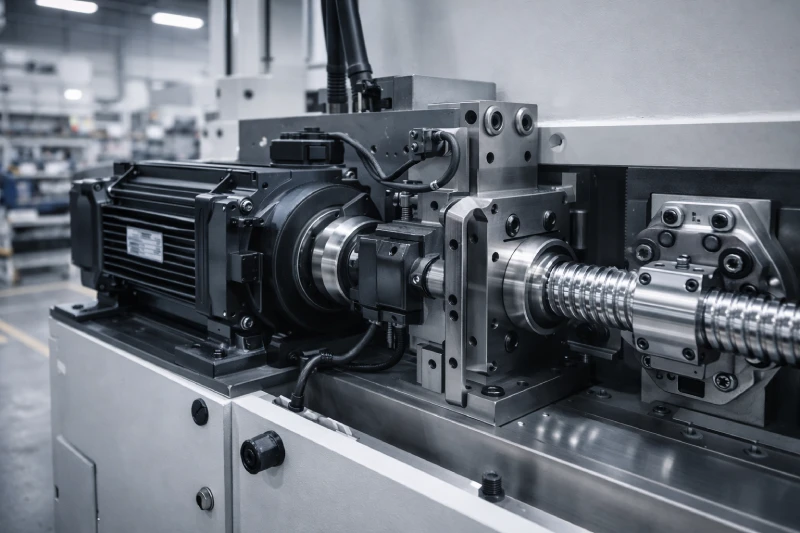
Higher motor power typically allows the press to perform more demanding forming operations while maintaining precise motion control. However, power alone is not the only factor that determines system performance.
The overall drive system—including gearboxes, ball screws, or direct drive mechanisms—plays a significant role in converting motor energy into press force.
Different drive designs provide different advantages:
- Ball screw systems offer high positioning precision.
- Direct drive systems provide fast dynamic response.
- Gear reduction systems increase torque output.
Servo motors also allow energy-efficient operation. Unlike mechanical presses that run continuously, servo motors consume energy primarily during active motion cycles.
When reviewing motor and drive specifications, buyers should evaluate:
- Motor rated power (kW)
- Peak torque capability
- Drive transmission type
- Thermal stability during continuous operation
A properly designed drive system ensures stable press motion while maintaining accuracy and durability in industrial environments.
Control System and Programmable Motion
One of the defining features of servo press technology is its programmable motion control capability. The control system determines how the press moves during each forming cycle.
Instead of a fixed mechanical motion curve, servo presses allow engineers to define custom motion profiles through digital control systems.
These profiles may include:
- Variable speed zones
- Dwell time at bottom dead center
- Multi-step forming motions
- Controlled acceleration and deceleration
This programmable motion capability provides several manufacturing advantages. For example, slowing the slide near the forming zone can reduce impact force and improve part quality. Holding the slide at a specific position allows additional forming or joining processes to occur.
Modern servo press control systems often integrate with factory automation platforms. Features may include:
- touchscreen human-machine interfaces (HMI)
- recipe storage for multiple products
- data monitoring and process feedback
- integration with robotic or automated production lines
For manufacturers seeking advanced forming flexibility, programmable control is one of the most valuable servo press specifications.
Conclusion
Understanding servo press specifications is essential for selecting equipment that meets production requirements. Key parameters such as press capacity, stroke length, positioning accuracy, motor power, and control capability determine how effectively a machine performs in real manufacturing environments.
Rather than focusing on a single specification, engineers should evaluate how these parameters work together to support forming processes, product quality, and operational efficiency.
A well-selected servo press not only delivers the required force but also provides the motion control, precision, and flexibility needed for modern manufacturing applications. By carefully reviewing these specifications, buyers can make more confident and technically sound equipment investment decisions.
