
Introduction
Metal stamping is one of the most widely used manufacturing processes for producing high-volume metal components with consistent dimensional accuracy. From automotive structural parts to small electronic housings, modern industries rely on stamping systems capable of maintaining tight tolerances while operating at high production speeds.
Traditional mechanical presses have long been used in stamping operations, but many manufacturers now require greater control over forming motion, force application, and cycle flexibility. This is where servo press technology has become increasingly important.
A servo press for metal stamping integrates servo-driven motion control with advanced press mechanics, allowing engineers to precisely adjust slide movement throughout the forming cycle. By controlling speed, position, and dwell time, manufacturers can optimize forming quality, reduce vibration, and improve production efficiency. As stamping processes become more complex and precision requirements increase, servo press systems are becoming a key solution for modern metal forming operations.
Metal Stamping Processes That Use Servo Press Technology
Metal stamping includes several forming operations used to shape sheet metal into functional parts. Servo press systems are particularly valuable in processes where controlled motion and forming accuracy are critical.
One of the most common operations is blanking and stamping, where flat sheet metal is cut and shaped using a die. A servo press allows the slide speed to be adjusted during the forming stroke, reducing impact forces and improving dimensional consistency.
Bending and forming processes also benefit from servo control. In traditional presses, slide speed remains constant throughout the stroke, which can cause excessive stress on the material during forming. Servo presses allow slower speeds during the critical bending stage, minimizing material cracking and improving shape accuracy.
Embossing and coining operations require precise force control to create detailed surface features or structural reinforcements. Servo presses provide programmable force application, ensuring uniform embossing depth across production batches.
In progressive die stamping lines, where multiple operations occur within a single press stroke, servo technology offers improved synchronization between feeding systems and forming stages. The ability to control slide motion precisely helps maintain alignment between the strip material and die stations.
Because of this motion flexibility, servo press stamping is increasingly used in high-precision metal forming environments where both productivity and part quality are essential.
Advantages of Servo Press in Metal Forming Operations
One of the most significant advantages of servo press technology is its programmable motion control. Unlike conventional mechanical presses that operate at a fixed motion profile, servo presses allow engineers to customize the slide motion throughout the forming cycle. Speed can be reduced near the forming point and increased during non-forming portions of the stroke, optimizing both accuracy and productivity.
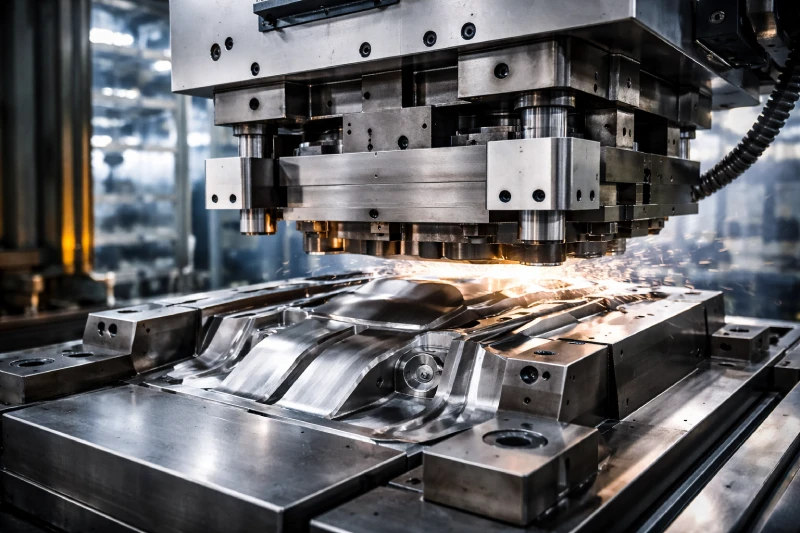
Another important benefit is reduced vibration and mechanical shock. Traditional stamping presses often generate strong impact forces when the slide reaches the bottom of the stroke. Servo-driven systems can slow the slide before contact with the die, significantly reducing vibration and extending tool life.
Improved part quality and dimensional stability is another key advantage. By controlling forming speed and force more precisely, servo press metal forming processes reduce material deformation inconsistencies. This is particularly important when producing thin metal parts or components requiring tight tolerances.
Servo presses also enable flexible forming cycles. Different products may require different motion profiles, dwell times, or forming speeds. With programmable control, operators can switch between production setups without major mechanical adjustments. This flexibility is especially valuable for manufacturers producing multiple component types on the same press line.
Additionally, servo press systems often integrate advanced monitoring functions that track force, position, and forming parameters during production. These capabilities help engineers identify process variations early and maintain consistent quality across large production volumes.
Typical Industrial Applications
Servo press systems are widely used in industries where metal stamping precision and production efficiency are critical.
In the automotive industry, servo presses are commonly used to produce structural and functional components such as brackets, reinforcement plates, and body panel parts. These components often require high strength and dimensional consistency. Servo press technology helps maintain accurate forming while reducing tool wear during high-volume production.
The electronics manufacturing sector also relies heavily on precision metal stamping. Small housings, shielding components, and connector parts must be formed with extremely tight tolerances. Servo presses provide the controlled motion necessary to prevent distortion of thin materials while maintaining high production throughput.
Another common application is the production of precision metal components used in appliances, industrial equipment, and consumer products. Parts such as springs, clips, and small stamped brackets require repeatable forming conditions to ensure proper function in assembled products.
Servo presses are also increasingly used in progressive die stamping systems, where multiple forming operations are performed sequentially within a single press cycle. The ability to precisely control slide movement improves synchronization between feeding systems and die stations, reducing production errors and improving overall efficiency.
As manufacturing industries continue to demand higher product quality and greater process flexibility, servo press stamping solutions are becoming a preferred choice for many metal forming operations.
Choosing the Right Servo Press for Stamping
Selecting the appropriate servo press for metal stamping depends on several key technical factors. Understanding these parameters helps manufacturers choose equipment that matches their production requirements.
One of the most important considerations is press tonnage. The press must provide sufficient forming force to shape the material without overloading the system. Engineers typically calculate required tonnage based on material thickness, part geometry, and die design. Selecting the correct tonnage ensures stable forming and prevents equipment damage.
Another critical factor is die compatibility. Different stamping dies require specific slide motions, shut heights, and force distributions. Servo presses with programmable motion profiles can adapt to a wide range of die configurations, making them suitable for complex forming operations.
Production speed and cycle time are also important. Some stamping operations prioritize maximum throughput, while others require slower forming speeds to maintain part quality. Servo presses allow manufacturers to balance these requirements by adjusting slide velocity and dwell time throughout the forming cycle.
Engineers should also consider process monitoring and control capabilities. Modern servo press systems often include sensors and software that monitor forming force, slide position, and cycle performance. These features help maintain consistent production quality and allow operators to detect process deviations early.
By evaluating tonnage, die requirements, and production speed, manufacturers can select a servo press system that provides both operational efficiency and long-term reliability.
Conclusion
Servo press technology is transforming modern metal stamping operations by providing greater control over forming motion and production parameters. Compared with traditional press systems, servo-driven presses allow engineers to adjust slide speed, dwell time, and force application throughout the forming cycle.
This flexibility improves part quality, reduces vibration, and extends tool life while maintaining efficient production speeds. Industries such as automotive manufacturing, electronics production, and precision metal component fabrication increasingly rely on servo press stamping systems to meet demanding quality standards.
As stamping processes continue to evolve, adopting advanced press technologies becomes essential for manufacturers seeking higher precision and more adaptable production systems.
