
Introduction
Electronics manufacturing requires highly controlled assembly processes where small components must be positioned, formed, or joined with exceptional accuracy. Many electronic products contain delicate connectors, terminals, and micro-mechanical parts that can be damaged if excessive force or uncontrolled motion is applied during assembly. For this reason, precision press systems are widely used in modern electronics production lines.
A servo press for electronics assembly provides controlled motion and force during pressing operations. Unlike conventional mechanical presses, servo-driven systems allow engineers to program motion profiles, monitor force in real time, and stop the process when target conditions are reached. This capability makes servo presses particularly suitable for assembling electronic components where tolerances are tight and repeatability is critical.
In industries such as consumer electronics, automotive electronics, and sensor manufacturing, servo press systems have become essential equipment for ensuring consistent and reliable assembly results.
Role of Precision Press Systems in Electronics Manufacturing
Electronics production often involves assembling miniature parts that require accurate positioning and controlled joining forces. Precision press systems are commonly used to perform these operations in a repeatable and reliable manner.
In many assembly lines, small components such as terminals, pins, or connectors must be inserted into housings or circuit board structures. These components may have tight dimensional tolerances, and improper pressing can lead to deformation or incomplete insertion. Precision presses provide controlled vertical motion and force monitoring, allowing manufacturers to maintain consistent assembly quality.
Another important application involves forming and staking operations. Certain electronic components require small metal tabs or posts to be formed during assembly. A press can precisely deform these features without damaging surrounding components. Servo-driven presses are especially useful because they allow engineers to define specific motion profiles tailored to each component design.
Precision press systems are also integrated with automated production equipment. In high-volume electronics manufacturing, presses are commonly installed within assembly cells or automated stations. Sensors and process monitoring systems track force-displacement curves during each press cycle to ensure that assembly conditions remain within acceptable limits.
By combining accurate positioning with controlled force application, precision press systems help electronics manufacturers achieve reliable component assembly and stable production quality.
Typical Electronics Assembly Applications
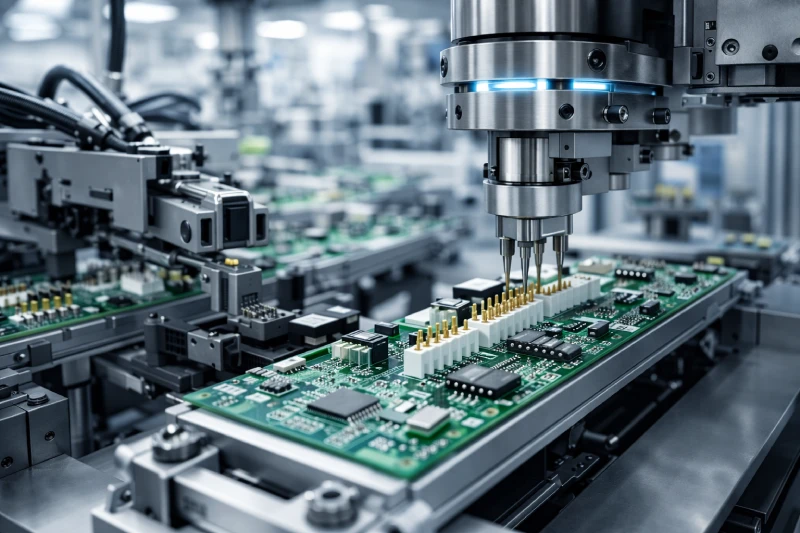
Servo press technology supports a wide range of assembly processes used in electronics manufacturing. Many electronic products contain small components that must be joined with high positional accuracy and controlled force. Servo presses are frequently used in the following applications.
Connector Assembly
Electrical connectors are widely used in electronic devices and control systems. During assembly, metal terminals are inserted into plastic housings and must be pressed to precise depths. Excessive force can damage the housing, while insufficient force can result in loose connections. Servo presses allow manufacturers to control insertion depth and monitor pressing force to ensure consistent connector assembly.
Terminal and Contact Pressing
Metal terminals and contacts often require precise insertion or forming during production. These components may be part of wire harnesses, printed circuit board connectors, or sensor interfaces. Servo presses provide smooth motion and programmable force limits, helping prevent deformation of delicate metal parts while maintaining electrical reliability.
Micro Component Assembly
Modern electronics frequently incorporate miniature mechanical components such as springs, shields, clips, and small housings. These parts require careful handling during assembly. Servo press systems allow manufacturers to apply small and repeatable pressing forces suitable for micro-scale components.
Sensor Module Assembly
Sensors used in automotive, medical, and industrial equipment often include small mechanical structures that must be assembled with precision. Servo presses can perform staking, insertion, or crimping operations required to secure these components within sensor modules. The ability to record force and displacement data during each cycle also supports quality traceability in sensor manufacturing.
Through these applications, servo press systems play a critical role in maintaining assembly precision across a wide range of electronic products.
Advantages of Servo Press Technology in Electronics Assembly
Servo press systems provide several advantages that make them particularly suitable for electronics assembly processes.
Micron-Level Positioning Accuracy
Electronics components are often extremely small, and assembly tolerances can be very tight. Servo-driven press systems provide high positioning accuracy, allowing manufacturers to control motion at a micron level. This precision helps ensure that connectors, terminals, and micro components are inserted to the correct depth without damaging surrounding structures.
Programmable Force Control
One of the key benefits of servo presses is their ability to control pressing force throughout the entire stroke. Engineers can program specific force limits or motion profiles depending on the requirements of each component. For example, a press may apply a low approach force when contacting a component and gradually increase force during insertion.
This level of control reduces the risk of component damage and ensures that each assembly operation follows the same controlled process.
Process Monitoring and Quality Consistency
Servo presses typically include integrated sensors that monitor force and displacement during every press cycle. The resulting force–distance curve provides valuable process data that can be used to verify correct assembly conditions.
If a component is missing, misaligned, or defective, the press system can detect abnormal force patterns and stop the process. This capability improves quality assurance and reduces the risk of defective assemblies reaching later production stages.
For electronics manufacturers operating high-volume production lines, these advantages translate into improved reliability, stable product quality, and better process control.
Selecting Servo Press Equipment for Electronics Production
Choosing the appropriate servo press system is an important step when designing electronics assembly equipment. Several factors should be considered to ensure the press meets production requirements.
Precision and Motion Control
Electronics assembly often involves delicate components and small tolerances. The press system must provide precise motion control and accurate positioning. High-resolution encoders and stable servo drives are important for achieving consistent results during micro-scale assembly operations.
Appropriate Press Capacity
Most electronics assembly operations require relatively small pressing forces compared to heavy industrial forming processes. Small-tonnage servo presses are commonly used for these applications. Selecting the correct press capacity helps maintain precise control while preventing unnecessary mechanical stress on components.
Force Monitoring Capability
Modern electronics production increasingly relies on data-driven quality control. Servo press systems with integrated force monitoring and process data recording allow manufacturers to verify that each assembly cycle meets defined specifications. This capability is especially valuable in industries such as automotive electronics and medical devices where traceability is required.
Integration with Automated Assembly Systems
Electronics manufacturing lines are typically highly automated. Servo presses should be compatible with robotic handling systems, PLC controls, and automated inspection equipment. Flexible control interfaces allow the press to be integrated into complex assembly cells while maintaining synchronized operation with other production equipment.
Selecting the right press configuration ensures stable operation and supports long-term production efficiency in electronics assembly environments.
Conclusion
Precision joining and forming operations are essential in electronics manufacturing. Components such as connectors, terminals, and sensor modules must be assembled with controlled force and accurate positioning to ensure product reliability.
A servo press for electronics assembly provides the motion control, force monitoring, and repeatability required for these processes. By enabling programmable pressing profiles and real-time quality verification, servo presses help manufacturers maintain consistent assembly results even when working with miniature components.
As electronic devices continue to become smaller and more complex, precision press technology will remain an important tool for supporting high-quality electronics production.
