
Introduction
The control system is the defining feature that differentiates a servo press from traditional mechanical or hydraulic presses. While conventional presses rely on fixed mechanical motion or hydraulic pressure cycles, a servo press uses digital motion control to manage the entire forming process with high precision.
In modern manufacturing environments, the ability to control speed, position, and force throughout the stroke is critical. A servo press control system enables programmable motion profiles, real-time feedback, and closed-loop positioning. This allows manufacturers to optimize forming processes for different materials, part geometries, and production speeds.
Because of these capabilities, servo presses are widely used in industries that demand high repeatability and process stability. From electronics assembly to automotive component production, precise control over the press stroke directly improves product quality, tooling life, and production efficiency.
Understanding how the servo press control system works helps engineers evaluate when this technology offers advantages over traditional press solutions.
What Is a Servo Press Control System?
A servo press control system is the digital control architecture responsible for managing motion, position, and force throughout the press cycle. Unlike conventional presses that operate with fixed mechanical motion, a servo press can dynamically adjust its stroke profile using programmable motion control.
At the core of the system is a servo motor that drives the press ram through a mechanical transmission such as a ball screw or crank mechanism. The motion of this motor is controlled electronically through a motion controller and servo drive.
The control system determines how the press moves during each stage of the forming process. Engineers can program parameters such as:
- stroke length
- approach speed
- forming speed
- dwell time
- return speed
This programmability allows the press to perform complex forming sequences that would be impossible with fixed mechanical systems.
Another key capability is digital positioning. The servo press control system continuously monitors the position of the ram using high-resolution encoders. This data allows the system to control movement with micron-level accuracy.
Because motion is digitally controlled, the press can adapt to different materials or production requirements simply by changing the control program rather than modifying mechanical components.
As a result, the control system becomes the central element that defines the flexibility and precision of servo press technology.
Key Elements of Servo Motion Control
The servo press control system consists of several integrated components that work together to manage motion and force. Each component plays a specific role in maintaining accuracy and stability during the press cycle.
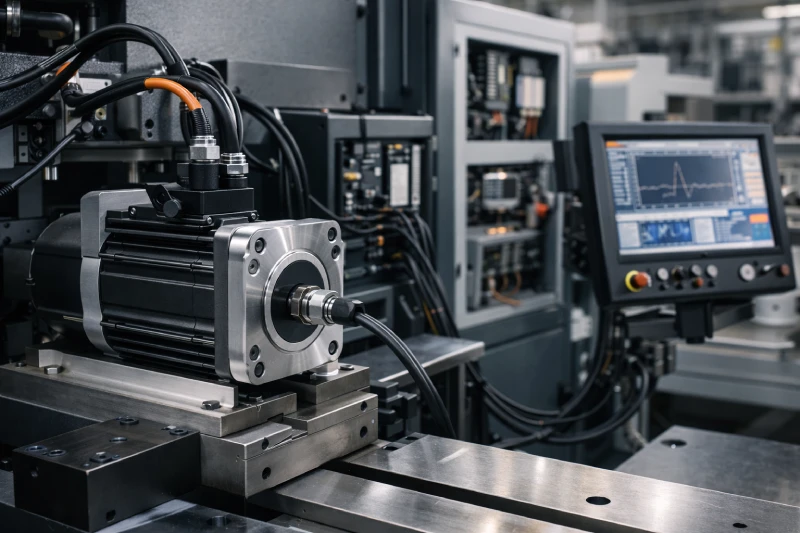
Servo Motor Drive
The servo motor is the primary power source of the press. It converts electrical energy into controlled rotational motion. Unlike traditional motors that operate at constant speed, a servo motor can precisely control acceleration, velocity, and torque.
This capability allows the press ram to move according to programmed motion curves rather than fixed mechanical cycles.
Motion Controller
The motion controller acts as the brain of the servo press system. It executes the programmed motion profile and sends commands to the servo drive.
The controller calculates the desired position, speed, and acceleration at every moment during the press cycle. These commands are updated continuously to ensure accurate execution of the programmed forming sequence.
Modern controllers often integrate with industrial automation networks and factory control systems, allowing the press to operate as part of a larger automated production line.
Encoder Feedback
Position feedback is essential for precise control. Encoders mounted on the servo motor or mechanical transmission measure the exact position and speed of the press ram.
High-resolution encoders can detect extremely small changes in position. This data is transmitted back to the motion controller in real time.
With continuous position feedback, the control system always knows the exact location of the press ram.
Closed-Loop Control
Servo presses operate using closed-loop control. In this system, the controller constantly compares the commanded position with the actual measured position.
If any deviation occurs, the controller immediately adjusts motor output to correct the motion. This feedback loop allows the system to maintain precise control even when external forces or material resistance change during forming.
Closed-loop control is the key reason servo presses can achieve high positioning accuracy and consistent repeatability.
Programmable Motion Profiles in Servo Presses
One of the most important features of a servo press control system is the ability to create programmable motion profiles. Instead of following a fixed mechanical stroke, the press movement can be tailored to the requirements of each forming process.
Adjustable Speed Curves
The speed of the ram can be controlled at different stages of the stroke. For example, the press may approach the workpiece at high speed to reduce cycle time. As the ram nears the material, the system slows down to ensure accurate contact.
After forming is complete, the ram can return quickly to the starting position.
Multi-Stage Forming
Servo presses can execute multiple forming stages within a single stroke. Different sections of the motion profile can apply different speeds, forces, or dwell times.
This capability is particularly useful for complex forming processes where gradual deformation is required to prevent material damage.
Slow Approach and Fast Return
A commonly used motion profile is slow approach combined with fast return. The ram moves slowly when approaching the workpiece to improve positioning accuracy and reduce impact force.
Once the forming operation is complete, the ram returns at higher speed to minimize idle time.
Force Control
In addition to position control, servo press systems can regulate force during forming. By monitoring motor torque or using load sensors, the system can maintain a specific forming force.
Force control is especially valuable in precision assembly and joining processes where excessive force could damage components.
Through programmable motion profiles, engineers can optimize each forming process for speed, precision, and tool life.
Advantages of Digital Motion Control in Manufacturing
Digital control is the primary reason servo presses are increasingly adopted in modern manufacturing. Compared with traditional press systems, servo motion control offers several operational advantages.
Improved Precision
Servo press control systems provide extremely accurate positioning of the press ram. Because motion is controlled digitally with encoder feedback, the system can maintain tight positional tolerances throughout the forming process.
This precision is critical in applications such as micro-forming, electronics assembly, and precision stamping.
High Repeatability
Consistency is essential in high-volume production. Closed-loop control ensures that every press cycle follows the same programmed motion profile.
Even when material properties vary slightly, the control system can compensate for these changes and maintain stable process conditions.
Energy Efficiency
Unlike mechanical presses that run continuously, servo presses consume energy only when motion is required. The motor can decelerate or stop during parts of the cycle, reducing overall power consumption.
Energy savings can be significant in production environments with frequent start-stop cycles.
Flexible Production
Digital motion control allows manufacturers to change press behavior through software rather than mechanical modification.
Different products may require different stroke profiles, forming speeds, or force limits. With a servo press control system, these parameters can be adjusted quickly through the control interface.
This flexibility supports modern manufacturing environments where product variations and short production runs are increasingly common.
Industries That Benefit from Servo Press Control
Servo press technology is used in a wide range of industries where precise forming or assembly processes are required.
Electronics Assembly
In electronics manufacturing, servo presses are commonly used for connector insertion, component assembly, and precision forming of small metal parts.
The ability to control force and position helps prevent damage to delicate components.
Automotive Manufacturing
Automotive production involves many precision forming operations, including stamping, riveting, and bearing insertion.
Servo press control systems allow manufacturers to maintain consistent quality while adjusting motion profiles for different materials or component designs.
Battery Production
Battery manufacturing requires careful handling of thin metal foils and sensitive components. Servo presses provide precise force and position control for processes such as tab welding preparation and cell component assembly.
Precision Metal Forming
Industries that produce small or complex metal parts often require gradual forming processes. Servo presses allow engineers to design motion profiles that reduce stress on materials and tools.
These capabilities make servo press technology suitable for advanced manufacturing applications where process stability and accuracy are critical.
Conclusion
The servo press control system is the core technology that enables modern programmable forming processes. By combining servo motors, motion controllers, encoder feedback, and closed-loop control, servo presses achieve precise control over position, speed, and force throughout the press stroke.
This level of control allows manufacturers to optimize forming processes for different materials and product designs. Programmable motion profiles improve precision, repeatability, and energy efficiency while supporting flexible production requirements.
For many industrial applications, the ability to digitally control the press cycle is the primary reason servo presses are replacing traditional mechanical and hydraulic press systems.
