
Introduction
Selecting the right servo press is a critical decision for manufacturers aiming to improve precision, production efficiency, and long-term equipment reliability. Unlike conventional mechanical or hydraulic presses, servo presses offer programmable motion control, precise force management, and flexible stroke profiles. These capabilities allow manufacturers to optimize forming processes for different materials and components.
However, choosing a servo press is not simply a matter of selecting a machine with sufficient tonnage. Engineers and procurement teams must evaluate multiple factors including production speed, motion control capability, stroke requirements, and control system integration with existing production lines.
A poorly matched press system can lead to production bottlenecks, inconsistent forming quality, and unnecessary equipment costs. This buying guide explains how servo presses work, the specifications that matter most, and the key factors manufacturers should evaluate when selecting a servo press for a production line.
What Is a Servo Press and When Is It the Right Choice?
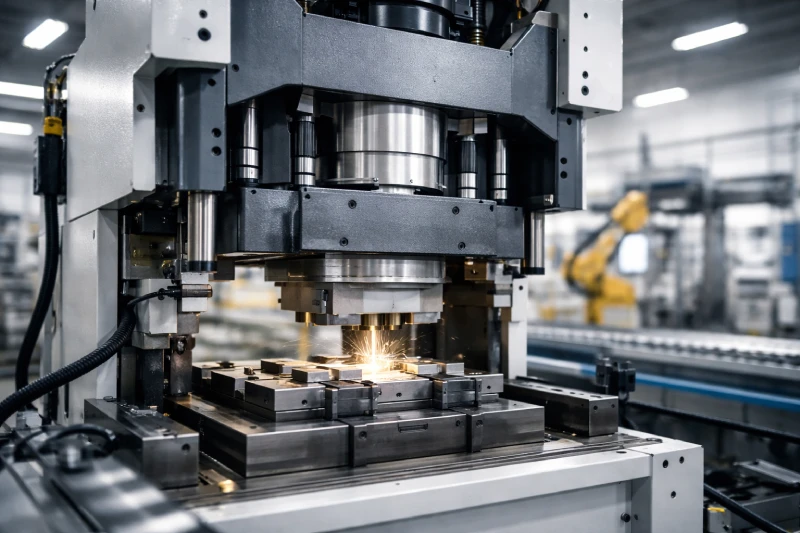
A servo press is a metal forming machine driven by a servo motor rather than a traditional flywheel or hydraulic system. The servo motor directly controls the motion of the ram, allowing precise control of position, speed, and force throughout the forming cycle.
Traditional mechanical presses typically operate with fixed motion profiles determined by the crank mechanism. Hydraulic presses allow adjustable force but generally lack high-speed precision control. Servo presses combine both advantages: they provide programmable motion profiles with high positioning accuracy.
Because the ram motion is digitally controlled, manufacturers can adjust pressing speed, dwell time, and forming force during different stages of the process. This flexibility allows engineers to optimize forming processes for specific materials or complex components.
Servo presses are commonly used in industries that require high precision forming or assembly processes, such as:
- automotive component manufacturing
- battery cell and module assembly
- electronics and semiconductor packaging
- precision metal forming operations
Manufacturers typically consider servo press systems when production requires precise force control, repeatable positioning accuracy, or flexible motion programming. These capabilities are particularly valuable in automated production lines where forming consistency and process control directly affect product quality.
For a broader overview of servo press technology and system architecture, see the guide on /servo-press/.
Key Factors to Consider When Buying a Servo Press
Selecting the right servo press requires evaluating several critical parameters that affect both machine capability and production efficiency. Engineers must ensure that the press specifications align with the forming process and the expected production volume.
Required Tonnage
Pressing force is the first parameter most buyers evaluate. The required tonnage depends on material strength, component geometry, and forming depth.
Undersizing a press can result in incomplete forming or excessive tool wear. Oversizing the machine increases equipment cost and energy consumption without providing operational benefits. Engineers typically calculate the forming force required for the specific process and then include a safety margin.
Stroke Length
Stroke length determines how far the ram can travel during each cycle. This parameter must match the tooling design and part geometry.
For shallow forming or assembly operations, shorter strokes are often sufficient and can improve cycle speed. Deeper forming processes require longer strokes, which may reduce overall production throughput.
Precision and Repeatability
Servo presses are often selected for applications that require consistent positioning accuracy. High-precision processes such as electronics assembly or battery component manufacturing require tight tolerances for both force and position.
Manufacturers should evaluate repeatability specifications, including position accuracy and force control stability across repeated cycles.
Programmable Motion Control
One of the main advantages of servo presses is programmable motion profiles. Engineers can control acceleration, deceleration, and dwell time during different phases of the forming cycle.
For example, a press may operate at high speed during the approach phase and then slow down during the forming stage to ensure precise force control. This capability can significantly improve forming quality for complex components.
Production Speed Requirements
Production throughput is another important consideration. Servo presses allow flexible motion programming that can reduce cycle times in certain operations.
However, the achievable speed depends on both the servo motor capability and the mechanical design of the press. Engineers should evaluate whether the press can maintain stable performance at the required production rate.
Balancing these factors helps manufacturers select a servo press that meets both process requirements and long-term production goals.
Understanding Servo Press Specifications
Servo press specifications describe the machine’s performance limits and operational capabilities. Understanding these parameters is essential when comparing different press models.
Pressing Force
Pressing force represents the maximum load the press can apply during forming. This value is usually expressed in tons or kilonewtons.
In servo presses, force can often be controlled dynamically during the stroke, allowing different force levels during various stages of the forming process.
Ram Stroke
Ram stroke refers to the total vertical movement of the press ram. This parameter must match the tooling configuration and part height.
Longer strokes increase flexibility for different tooling setups but may reduce maximum cycle speed due to longer travel distance.
Positioning Accuracy
Positioning accuracy indicates how precisely the press can control the ram position. Servo presses often achieve very high positioning accuracy because the motion is controlled by digital servo systems.
This parameter is especially important in assembly operations where precise insertion depth or component alignment is required.
Cycle Speed
Cycle speed determines how many forming cycles the press can complete within a given time period. Higher cycle speeds increase production capacity but may also increase mechanical stress on tooling.
Manufacturers should evaluate cycle speed together with motion control capability to ensure stable performance during continuous production.
Control System Capability
The control system determines how flexibly the press can be programmed and integrated with production equipment.
Modern servo presses typically support programmable motion profiles, force monitoring, and integration with factory automation systems. Advanced control systems may also provide real-time process monitoring to detect forming abnormalities during production.
More detailed technical information about servo press systems can be found on /products/servo-hydraulic-press/.
Matching Servo Press Systems to Industrial Applications
Different industries require different press characteristics. Understanding the relationship between application requirements and press capabilities helps buyers select the most suitable system.
Automotive Components
Automotive manufacturing often involves forming metal brackets, connectors, and structural components. These parts may require high forming force combined with precise dimensional control.
Servo presses allow manufacturers to adjust the motion profile to reduce material stress and improve forming consistency.
Battery Manufacturing
Battery production requires high precision assembly processes, such as electrode stacking or module assembly.
Servo presses provide accurate force control, which helps prevent damage to sensitive battery components during assembly operations.
Electronics Assembly
Electronic components often require delicate press-fit operations. Excessive force or incorrect insertion depth can damage connectors or circuit boards.
Servo presses allow engineers to precisely control the pressing force and stopping position, improving assembly quality.
Precision Metal Forming
For complex forming operations involving thin metals or specialized alloys, controlled ram motion can reduce material cracking and improve part quality.
Servo motion profiles allow the press to slow down during critical forming stages, providing better control over material deformation.
Common Mistakes When Selecting a Servo Press
Even experienced manufacturers sometimes encounter problems when selecting servo press equipment. Understanding common mistakes can help buyers avoid costly decisions.
Choosing Insufficient Tonnage
Underestimating the required pressing force is one of the most frequent issues. If the press cannot generate sufficient force, forming processes may become unstable or incomplete.
A proper force calculation based on material properties and tooling design is essential before selecting the machine.
Ignoring Control System Capability
Some buyers focus only on mechanical specifications such as tonnage and stroke. However, the control system plays a critical role in servo press performance.
Limited programming capability can restrict motion profile optimization and reduce the benefits of servo technology.
Overlooking Production Cycle Requirements
Another common mistake is selecting a press that cannot maintain the required production cycle rate.
Servo presses must be capable of delivering both the necessary force and the required cycle speed without compromising precision or equipment reliability.
Careful evaluation of process requirements and production goals helps manufacturers avoid these issues.
Conclusion
Selecting the right servo press requires a clear understanding of both production requirements and machine capabilities. Engineers must evaluate factors such as pressing force, stroke length, motion control flexibility, and production speed when comparing equipment options.
Servo presses provide significant advantages in precision manufacturing because they allow programmable motion control and accurate force management. When properly matched to the production process, these systems can improve forming consistency, reduce material waste, and increase manufacturing efficiency.
By carefully analyzing application requirements and press specifications, manufacturers can select a servo press system that supports reliable production performance and long-term operational stability.
