
When selecting a stamping press, most manufacturers narrow the decision down to two major options: mechanical stamping presses and hydraulic stamping presses. Both are widely used in metal forming, blanking, piercing, and deep drawing, but they are designed for different production goals.
A mechanical press is usually the better choice when you need high-speed, repetitive production with thin materials. A hydraulic press is often preferred when you need greater force control, thicker materials, or more flexibility for complex parts.
The challenge is that neither type is “better” in every situation. The right choice depends on your production volume, material thickness, tooling, budget, and long-term manufacturing plans.
If you are still comparing different types of presses in general, start with our stamping press guide before choosing between these two technologies.
Mechanical vs Hydraulic Stamping Press: Quick Comparison
| Factor | Mechanical Stamping Press | Hydraulic Stamping Press |
|---|---|---|
| Power Source | Flywheel and crank mechanism | Hydraulic cylinders and fluid pressure |
| Speed | Very fast | Slower |
| Maximum Force | Near bottom of stroke only | Full force throughout stroke |
| Stroke Control | Fixed | Adjustable |
| Best For | High-volume repetitive parts | Complex forming and thicker materials |
| Tooling | Progressive dies, blanking, piercing | Deep drawing, forming, custom tools |
| Material Thickness | Thin to medium sheet metal | Medium to thick materials |
| Energy Use | Lower in high-volume production | Higher, especially during idle periods |
| Maintenance | Bearings, clutch, lubrication | Hydraulic fluid, seals, hoses |
| Typical Industries | Automotive, electronics, appliances | Aerospace, heavy equipment, custom fabrication |
Quick Rule of Thumb
- Choose a mechanical press if you need maximum production speed and consistent high-volume output.
- Choose a hydraulic press if you need more control, flexibility, or the ability to form thicker and more complex parts.
For a broader overview of other press categories, see types of stamping presses.
How Mechanical and Hydraulic Presses Work Differently
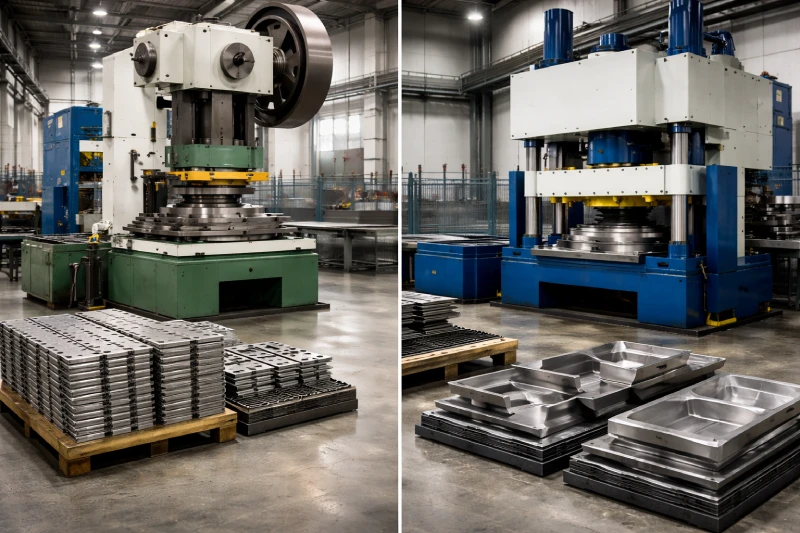
The biggest difference between these two machines is how they generate force.
A mechanical stamping press uses a motor-driven flywheel connected to a crankshaft. As the flywheel rotates, the ram moves up and down in a fixed motion. The press delivers its highest tonnage only near the bottom of the stroke.
A hydraulic stamping press uses pressurized hydraulic fluid to move one or more cylinders. Unlike a mechanical press, a hydraulic press can apply full tonnage at any point during the stroke.
This difference has a major impact on how each machine performs:
- Mechanical presses are optimized for speed and repeatability.
- Hydraulic presses are optimized for control and forming force.
- Mechanical presses usually have a fixed stroke length.
- Hydraulic presses allow operators to adjust stroke length, speed, and pressure.
If you want a more detailed explanation of how each system operates internally, visit mechanical stamping press or hydraulic stamping press.
Speed vs Force: Which Matters More?
For many manufacturers, the decision comes down to one question: do you need more speed or more forming force?
When Mechanical Presses Are Better
Mechanical stamping presses are designed for fast cycle times. In high-volume manufacturing, they can produce significantly more parts per hour than a hydraulic press.
Typical situations where a mechanical press is the better choice include:
- Large production runs
- Thin sheet metal parts
- Progressive die applications
- Repetitive blanking and piercing operations
- Automotive and electronics components
For example, if you are producing thousands of automotive brackets, electrical terminals, or appliance clips every day, a mechanical press usually delivers the lowest cost per part.
Mechanical presses are especially common in automotive stamping press applications because they combine speed, repeatability, and lower operating cost.
When Hydraulic Presses Are Better
Hydraulic presses run more slowly, but they provide much greater control over the entire forming process.
They are better suited for:
- Thick metals
- Deep-drawn parts
- Large or irregularly shaped components
- Jobs requiring variable pressure or stroke length
- Low-volume or custom production
For example, if you are manufacturing a deep-drawn appliance panel or a heavy-duty steel housing, a hydraulic press is usually the better option because it can maintain force throughout the stroke without damaging the material.
Material Thickness and Part Complexity
Material thickness and part complexity are two of the most important factors in press selection.
| Application Requirement | Best Choice | Why |
|---|---|---|
| Thin sheet metal under 3 mm | Mechanical Press | Faster cycle time and lower cost |
| Thick steel or aluminum | Hydraulic Press | Better force control |
| Simple blanking or piercing | Mechanical Press | More efficient for repetitive tasks |
| Deep drawing and forming | Hydraulic Press | Full tonnage throughout the stroke |
| Progressive die tooling | Mechanical Press | Works better with continuous operation |
| Custom or irregular shapes | Hydraulic Press | Flexible pressure and stroke adjustment |
Mechanical presses perform best when the part geometry is simple and the operation is repeated continuously. Typical examples include:
- Washers
- Brackets
- Connectors
- Small appliance parts
- Electronics housings
Hydraulic presses are preferred when the part is more difficult to form. Typical examples include:
- Large panels
- Heavy-gauge steel parts
- Deep-drawn containers
- Aerospace components
- Custom fabricated parts
If your production requires extremely tight tolerances, consider reviewing precision stamping press machines to understand how press design affects accuracy.
Cost Comparison: Equipment, Energy, and Maintenance
A lower purchase price does not always mean a lower total cost of ownership. Manufacturers should compare not only the machine price, but also energy use, maintenance, and long-term productivity.
Initial Equipment Cost
In many cases, a mechanical press has a lower purchase price than a hydraulic press with similar tonnage.
This is especially true in high-volume production environments where standard mechanical presses are widely available.
Hydraulic presses often cost more because they require:
- Hydraulic cylinders
- Pumps and fluid systems
- Additional controls
- Pressure regulation systems
However, if your operation requires multiple different part types, a hydraulic press may reduce tooling changes and improve flexibility, which can offset the higher purchase price.
Operating and Energy Costs
Mechanical presses are usually more energy-efficient during continuous production because the flywheel stores energy and releases it quickly during each cycle.
Hydraulic presses often consume more energy because the hydraulic pump may continue running even when the machine is idle.
| Cost Category | Mechanical Press | Hydraulic Press |
|---|---|---|
| Initial Purchase Price | Lower | Higher |
| Cost Per Part in High Volume | Lower | Higher |
| Energy Efficiency | Better in continuous runs | Lower in long runs |
| Flexibility for Mixed Production | Lower | Higher |
Maintenance Requirements
Mechanical presses generally require maintenance for:
- Bearings
- Clutch and brake systems
- Lubrication
- Flywheel and crank components
Hydraulic presses typically require maintenance for:
- Hydraulic fluid
- Seals and hoses
- Pumps and cylinders
- Fluid leaks and contamination
Hydraulic presses may have fewer moving mechanical parts, but hydraulic system problems can be more expensive and time-consuming to repair.
For a more detailed maintenance checklist, see stamping press maintenance.
Which Industries Prefer Each Type?
Different industries tend to favor different press technologies based on their production requirements.
| Industry | Preferred Press Type | Main Reason |
|---|---|---|
| Automotive Mass Production | Mechanical | Fast cycle times and high output |
| Consumer Electronics | Mechanical | Small, repeatable precision parts |
| Appliance Manufacturing | Hydraulic | Deep-drawn and formed panels |
| Aerospace | Hydraulic | Thicker alloys and controlled forming |
| Heavy Equipment | Hydraulic | Large parts and higher tonnage |
| Custom Fabrication Shops | Hydraulic | Flexible setup for short production runs |
Mechanical presses dominate industries where the same part is produced repeatedly in large quantities.
Hydraulic presses dominate industries where part complexity, thickness, or flexibility matters more than speed.
7 Questions to Ask Before You Choose
Before investing in either type of stamping press, ask these questions:
- What material thickness are you working with?
- How many parts do you need to produce each day?
- Do you need maximum speed or maximum force control?
- Will you use progressive dies, blanking dies, or deep-draw tooling?
- How often will your product design change?
- What is your available equipment budget?
- Can your maintenance team support hydraulic systems or complex mechanical systems?
If most of your answers involve high-volume, repetitive production, a mechanical press is probably the right choice.
If your answers involve flexibility, thicker materials, or complex shapes, a hydraulic press is likely the better investment.
You can also compare your production requirements against our /how-to-choose-a-stamping-press/ guide before making a final decision.
Mechanical vs Hydraulic Stamping Press: Final Recommendation
Mechanical and hydraulic stamping presses are both valuable, but they are designed for different manufacturing goals.
Choose a mechanical stamping press if your priority is:
- High-speed production
- Lower cost per part
- Thin materials
- Continuous, repetitive operations
Choose a hydraulic stamping press if your priority is:
- Greater forming force
- Adjustable stroke and pressure
- Thicker materials
- More complex or custom parts
The best press is the one that matches your material, tooling, and production volume—not necessarily the one with the highest tonnage or the lowest purchase price.
Need Help Choosing the Right Stamping Press?
If you are unsure whether a mechanical or hydraulic stamping press is the better fit for your application, speak with a press specialist before investing.
Provide details such as:
- Material type and thickness
- Part dimensions
- Daily production volume
- Required tolerances
- Tooling style
With the right information, you can choose a press that improves productivity, reduces downtime, and lowers your total manufacturing cost over the long term.
