
Mechanical stamping presses remain the backbone of high-speed metal forming in modern manufacturing. While hydraulic systems offer flexibility, mechanical presses dominate where speed, repeatability, and cost efficiency are critical.
In this guide, we’ll break down exactly how a mechanical stamping press works—from energy storage to force delivery—while helping you understand when it’s the right choice for your production environment.
What Defines a Mechanical Stamping Press
A mechanical stamping press is a power-driven forming machine that converts rotational energy into linear motion to shape metal parts.
Unlike hydraulic presses that rely on fluid pressure, mechanical presses operate using a flywheel-driven system combined with a crankshaft mechanism, enabling extremely fast and repeatable production cycles.
At its core, the mechanical press is optimized for high-speed, high-volume production, especially where consistency and cycle time matter more than force flexibility.
How a Mechanical Stamping Press Works
Understanding the working principle is essential for evaluating performance, tooling compatibility, and production efficiency.
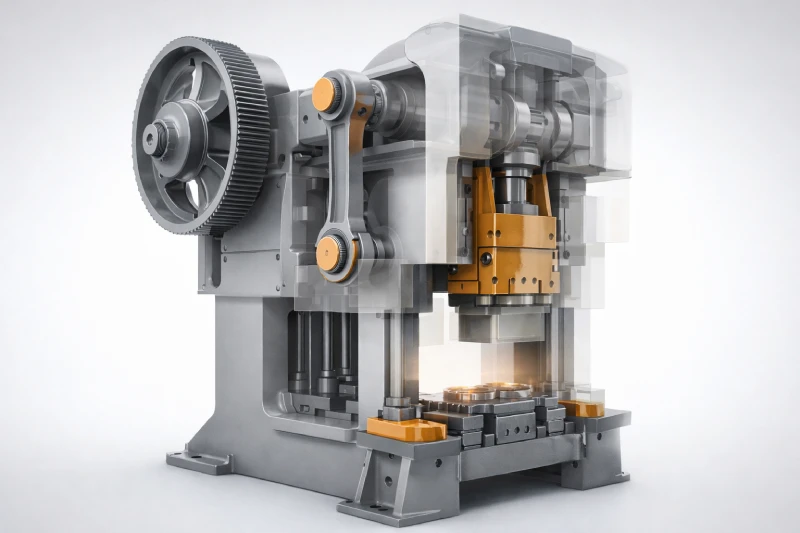
Energy Storage: Flywheel System
The process begins with an electric motor that continuously rotates a flywheel. This flywheel stores kinetic energy over time, ensuring that sufficient power is available during each stamping cycle.
Instead of generating force instantly, the system accumulates energy, making it highly efficient for repetitive operations.
Energy Transfer: Clutch and Brake Mechanism
When a stamping cycle is initiated, the clutch engages the flywheel with the crankshaft. This transfers stored energy into motion.
- Clutch: Activates the press cycle
- Brake: Stops motion precisely after each stroke
This system allows for accurate cycle control, especially important in automated production lines.
Motion Conversion: Crankshaft and Slide
The crankshaft converts the rotational motion into vertical (reciprocating) movement. This drives the slide (ram) up and down.
- Rotary motion → Linear motion
- Fixed stroke determined by crank geometry
This mechanical linkage is what defines the press’s speed and stroke limitations.
Bottom Dead Center (BDC) and Forming Moment
Maximum force is delivered near the Bottom Dead Center (BDC) of the stroke.
This means:
- The press is most powerful at a specific point
- Tooling must be designed around this force curve
For a deeper understanding of the full cycle sequence: stamping-press-operation
Core Components of a Mechanical Stamping Press
Each component plays a critical role in performance, accuracy, and durability.
Frame Structure (C-Frame vs H-Frame)
- C-frame: Easier access, lower rigidity
- H-frame: Higher strength, better for precision
Frame rigidity directly impacts part accuracy and tool life.
Flywheel and Drive System
The flywheel stabilizes energy delivery across cycles. A well-designed system ensures:
- Consistent energy output
- Reduced motor load fluctuations
- Improved efficiency in high-speed runs
Crankshaft / Eccentric Mechanism
This is the core motion converter:
- Determines stroke length
- Controls motion timing
- Limits flexibility (fixed geometry)
Slide (Ram) and Guide System
The slide transfers force to the die. Its guiding system ensures:
- Precise vertical movement
- Minimal lateral deviation
- Consistent forming accuracy
Clutch & Brake System
Critical for both safety and control:
- Ensures accurate start/stop timing
- Prevents overrun
- Enables integration with automation systems
Mechanical Press Motion Characteristics
Mechanical presses are defined by predictable and repeatable motion behavior.
Fixed Stroke Length
The stroke is determined by the crank design and cannot be easily adjusted.
This is ideal for:
- Standardized production
- Repeatable part geometry
But limiting for:
- Variable-depth forming
High-Speed Operation
Mechanical presses can reach hundreds of strokes per minute (SPM), making them ideal for:
- Progressive die stamping
- Mass production lines
Speed is their biggest advantage over hydraulic systems.
Tonnage Curve Behavior
Unlike hydraulic presses (constant force), mechanical presses:
- Deliver peak force near BDC
- Provide less force during the rest of the stroke
This creates a tonnage curve, which must be considered in die design.
Advantages of Mechanical Stamping Presses
Mechanical presses excel in environments where efficiency and consistency are key.
High Production Speed
- Extremely fast cycle times
- Ideal for large production volumes
Excellent Repeatability
- Fixed motion ensures consistent results
- Reduced variation between parts
Energy Efficiency in Mass Production
- Flywheel stores energy efficiently
- Lower energy cost per part in long runs
Lower Cost Per Part
When running high volumes, mechanical presses offer:
- Reduced operational cost
- Faster ROI
Limitations and Engineering Constraints
Despite their advantages, mechanical presses are not universally suitable.
Limited Stroke Flexibility
- Fixed stroke length
- Difficult to adapt to different forming depths
Force Only at Bottom of Stroke
- Peak force available only near BDC
- Limits forming versatility
Not Ideal for Deep Drawing
Processes requiring constant pressure throughout the stroke are better suited to hydraulic presses.
If you’re exploring alternatives: Hydraulic Stamping Press
Tooling Sensitivity
Mechanical presses require:
- Highly precise die design
- Tight alignment tolerances
Errors in tooling can significantly affect output quality.
Typical Applications of Mechanical Stamping Presses
Mechanical presses are widely used across industries where speed and consistency are essential.
Progressive Die Stamping
- Continuous feeding operations
- Multiple forming steps in one cycle
Blanking and Piercing
- High-speed cutting operations
- Minimal cycle time
Automotive Manufacturing
Used extensively in automotive production lines for:
- Body panels
- Structural components
- High-volume sheet metal parts
Electronics Components
- Small precision parts
- High repeatability requirements
When to Choose a Mechanical Press (Engineering Perspective)
Choosing the right press depends on your production priorities.
Mechanical presses are ideal when:
You Need High Volume Output
- Large batch production
- Continuous operation
Your Parts Are Thin and Repeatable
- Sheet metal forming
- Standardized geometries
Cycle Time Is Critical
- Fast turnaround requirements
- Automated production lines
Your Process Is Stable
- Minimal variation in part design
- Long production runs
Final Thoughts: Why Mechanical Presses Still Dominate High-Speed Manufacturing
Mechanical stamping presses remain the preferred solution for manufacturers focused on throughput, efficiency, and cost control.
While they lack the flexibility of hydraulic systems, their advantages in:
- Speed
- Consistency
- Energy efficiency
make them indispensable in industries like automotive, electronics, and mass production metal forming.
Need Help Choosing the Right Stamping Press?
Selecting the right press isn’t just about tonnage—it’s about matching motion characteristics, tooling, and production goals.
If you’re evaluating equipment or optimizing your production line:
👉 Explore our full guide: Types of Stamping Presses
👉 Or contact our engineering team for application-specific recommendations
