
In industrial puzzle manufacturing, the cutting press serves as the core forming equipment that determines the dimensional accuracy, structural consistency and finished surface quality of jigsaw puzzle products. The mechanical structure, power output mode and operating mechanism of jigsaw puzzle presses directly affect key product indicators such as puzzle piece interlocking tightness, edge flatness and batch stability. Manual and semi-automatic models are the two most widely used equipment types in low-to-medium volume puzzle production scenarios worldwide.
From a senior mechanical engineering perspective, the essential difference between the two devices lies in the power driving system, pressure output mechanism and cycle operation logic, rather than superficial operational differences. Many industry practitioners only perceive the gap in production efficiency, but ignore the fundamental technical distinctions in structural rigidity, pressure tolerance, material adaptability and long-term operational stability. This article focuses on core technical parameters, analyzes the mechanical performance characteristics of manual and semi-automatic jigsaw puzzle presses in depth, and objectively expounds their applicable technical scenarios, providing professional technical reference for puzzle production process optimization and equipment performance research.
1. Basic Structural & Power System Technical Parameters
The power system is the core factor that distinguishes manual and semi-automatic jigsaw puzzle presses, and it also determines the upper limit of equipment cutting performance and operational stability. The two models adopt completely different power transmission structures, forming obvious differences in parameter indicators.
1.1 Manual Jigsaw Puzzle Press Technical Configuration
The manual jigsaw puzzle press adopts a pure mechanical leverage transmission structure, with no motor, hydraulic or pneumatic power components. The entire cutting stroke relies on human mechanical force to drive the lever, screw or crank linkage mechanism to complete pressure output. The equipment is designed with a purely mechanical force amplification structure, which converts short-stroke manual force into high-pressure vertical cutting force through the lever principle.
In terms of fixed technical parameters, the standard effective cutting pressure of mainstream manual puzzle presses ranges from 0.8 to 1.5 tons, with a pressure output error of ±15% to ±25% in a single cutting cycle. The effective cutting bed size is concentrated in 400×300mm to 600×450mm, which matches the processing size of conventional small and medium-sized jigsaw puzzles. The equipment overall structure is bench-mounted, with a self-weight of 35kg to 80kg, and the guide mechanism adopts a simple sliding bearing structure, with a ram vertical runout tolerance of ≤0.3mm.
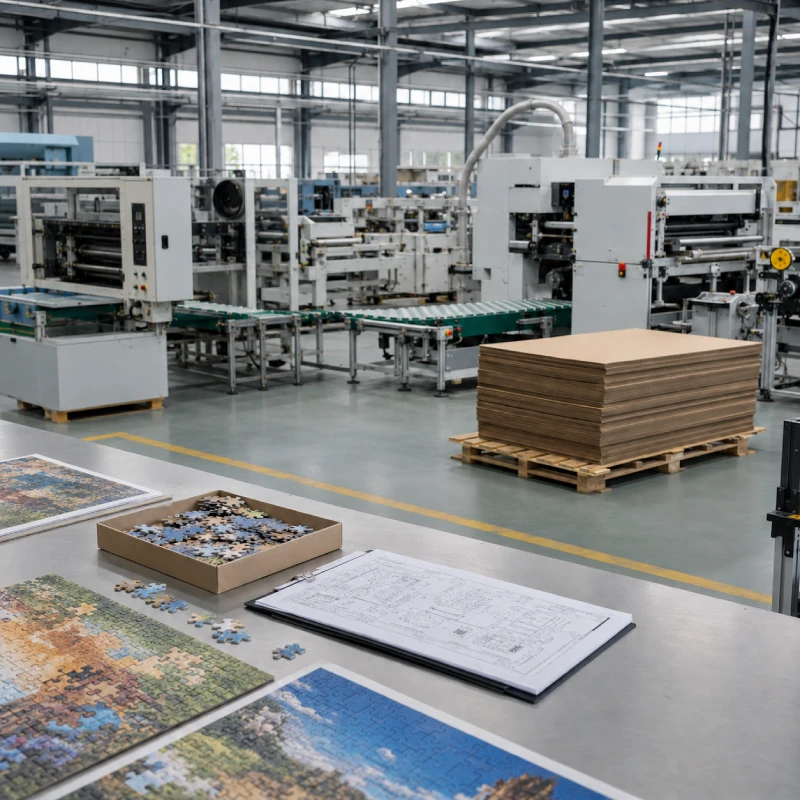
Due to the limitation of manual power input, the equipment has no fixed cycle parameters, and the cutting stroke length and pressure holding time are completely affected by manual operation habits. The whole machine has no electrical control components, zero power consumption during operation, and the mechanical transmission structure is composed of pure metal parts, with extremely low structural failure probability.
1.2 Semi-Automatic Jigsaw Puzzle Press Technical Configuration
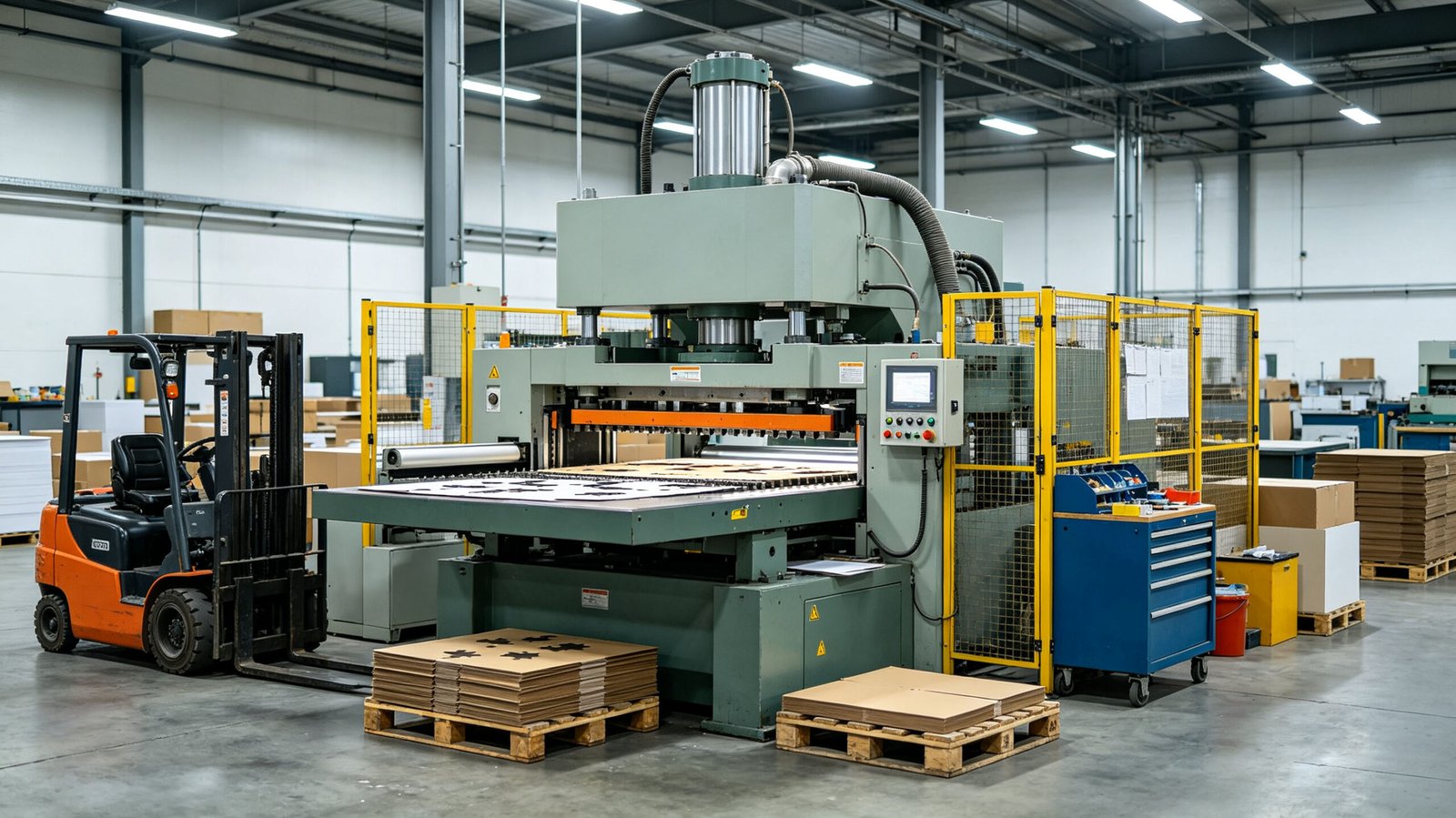
Semi-automatic jigsaw puzzle presses adopt electro-hydraulic or pneumatic servo power transmission systems, retaining manual material loading and positioning links, while realizing automated, fixed-parameter control of the core pressure cutting stroke. The power system is equipped with a constant-pressure output module, which can lock the cutting pressure, stroke and pressure holding time accurately, realizing standardized mechanical cutting.
Semi-automatic jigsaw puzzle presses adopt electro-hydraulic or pneumatic servo power transmission systems, retaining manual material loading and positioning links, while realizing automated, fixed-parameter control of the core pressure cutting stroke. The power system is equipped with a constant-pressure output module, which can lock the cutting pressure, stroke and pressure holding time accurately, realizing standardized mechanical cutting.
2. Core Cutting Performance Parameter Comparison
Cutting performance is the key technical index to evaluate jigsaw puzzle presses, including dimensional tolerance, edge cutting quality, batch consistency and material adaptability. These parameters directly determine the qualification rate of puzzle finished products and the stability of production processes.
2.1 Dimensional Tolerance & Form Accuracy
The manual jigsaw puzzle press is limited by fluctuating manual pressure and simple guide structure, resulting in unstable cutting tolerance. The overall dimensional error of puzzle pieces after cutting is between ±0.25mm and ±0.4mm, and local dimensional deviation is prone to occur in the edge and tooth slot positions of puzzles. In continuous operation, with the change of operator force, the unilateral tolerance of different batches of products will fluctuate significantly, resulting in inconsistent tightness of puzzle piece assembly.
Benefiting from constant-pressure power output and high-precision guide structure, the semi-automatic jigsaw puzzle press has extremely stable cutting tolerance. The overall dimensional error of puzzle pieces is controlled at ±0.10mm to ±0.20mm, the tooth slot and tenon structure are cut symmetrically, and the assembly gap of each puzzle piece is uniform. The batch tolerance fluctuation is less than 0.05mm, which can maintain consistent assembly accuracy of thousands of continuous cutting products.
2.2 Material Adaptability Parameters
Different puzzle substrates have different hardness and thickness, which put forward different requirements for equipment cutting pressure and structural rigidity. The effective cutting thickness of manual puzzle presses is limited to 1.0mm-2.0mm, which can stably process conventional gray board, coated paper and ordinary cardboard puzzle materials. For high-density materials such as 2.0mm+ thick cardboard, wood veneer and composite puzzle boards, the manual pressure cannot complete full penetration and clean shearing, and defects such as incomplete cutting and tooth slot crushing are easy to occur.
The semi-automatic press has adjustable high-power constant pressure, with an effective cutting thickness range of 1.0mm-3.0mm. It can adapt to all conventional puzzle substrates on the market, including high-hardness birch wood veneer, thick composite board and special craft puzzle materials. The equipment frame has high rigidity, no deformation under high pressure, and can ensure complete and smooth cutting of thick and high-density materials without structural vibration affecting precision.
2.3 Continuous Operation Stability
Continuous operation stability reflects the long-term mechanical performance of the equipment. The manual press has no thermal decay and mechanical fatigue of power components, but the artificial force attenuation leads to declining cutting stability in long-term continuous work. After 2-3 hours of continuous operation, the insufficient manual force will lead to a gradual increase in product defective rate.
The semi-automatic press is equipped with a power system heat dissipation and pressure stabilization device. Under 8-hour continuous working conditions, the pressure output, stroke and precision parameters have no obvious attenuation, the mechanical action consistency is high, and the product defective rate remains stable at a low level. The wearing parts operate stably in a fixed cycle, and the equipment performance attenuation presents a regular linear change, which is convenient for process monitoring and maintenance.
3. Mechanical Operation & Maintenance Technical Characteristics
From the perspective of mechanical operation logic and later maintenance technology, the two types of equipment have obvious differences in structural wear, failure mechanism and maintenance standards, which are important technical bases for equipment long-term operation management.
The manual jigsaw puzzle press has a pure mechanical linkage structure, with few wearing parts. The main wear parts are lever rotating shafts and sliding friction pairs. The maintenance technical standard is simple: only regular lubrication of friction parts and regular inspection of structural connection tightness are required. There is no need for professional mechanical technology for daily maintenance, and the structural failure rate is extremely low. The equipment has no electrical and hydraulic aging problems, and the long-term structural stability is excellent under light-load working conditions.
The semi-automatic jigsaw puzzle press integrates electromechanical and hydraulic/pneumatic structures, with relatively complex maintenance technical specifications. The core maintenance items include regular detection of hydraulic seal tightness, replacement of hydraulic oil and filter elements, calibration of pressure output parameters, and inspection of electrical control circuit stability. The wearing parts have a fixed service cycle, and regular parameter calibration is required to ensure cutting precision stability. Its maintenance is based on standardized mechanical operation specifications, which is suitable for standardized industrial production management.
4. Applicable Technical Scenarios of Two Types of Equipment
Based on the above technical parameter differences, manual and semi-automatic jigsaw puzzle presses have their own exclusive applicable technical scenarios in puzzle production, matching different process precision and production load requirements.
Manual jigsaw puzzle presses are suitable for low-load, low-precision fluctuation scenarios such as product prototype proofing, small-batch customized sample production, and craft puzzle trial production. Its pure mechanical structure, zero energy consumption and flexible operation characteristics can meet the technical requirements of intermittent and small-batch processing, and avoid equipment resource waste caused by large-scale mechanical equipment investment.
Semi-automatic jigsaw puzzle presses are oriented to standardized, stable and high-precision batch production scenarios. Its constant-pressure cutting, high dimensional consistency and wide material adaptability can meet the technical requirements of mass production of customized puzzles, branded promotional puzzles and high-grade wooden puzzles. The standardized mechanical cycle and stable precision output provide reliable technical support for the normalization and standardization of puzzle production processes.
Conclusion
The essential technical differences between manual and semi-automatic jigsaw puzzle presses stem from the power output system and mechanical structural design, which further differentiate the equipment in terms of cutting precision, material adaptability, continuous operation stability and process consistency. Manual presses rely on pure mechanical leverage structure, with simple parameters, flexible operation and low load resistance, adapting to light-duty and intermittent processing scenarios. Semi-automatic presses realize standardized constant-pressure cutting through electromechanical hydraulic integration, with superior precision parameters, stable batch performance and wide material compatibility, matching industrial standardized production technical requirements.
In actual puzzle production process design, equipment selection should be based on production process precision standards, material types and continuous operation load, and match the mechanical performance parameters of the two devices, so as to maximize the stability and rationality of the production process.
