
Hydraulic stamping presses play a critical role in modern metal forming, especially where precision, flexibility, and controlled force are more important than sheer production speed. While mechanical presses dominate high-speed manufacturing, hydraulic presses are the preferred solution for complex forming, deep drawing, and applications requiring consistent pressure throughout the stroke.
In this guide, you’ll learn how hydraulic stamping presses work from a functional standpoint, where they excel, their limitations, and—most importantly—how to determine whether they are the right choice for your production environment.
What Defines a Hydraulic Stamping Press?
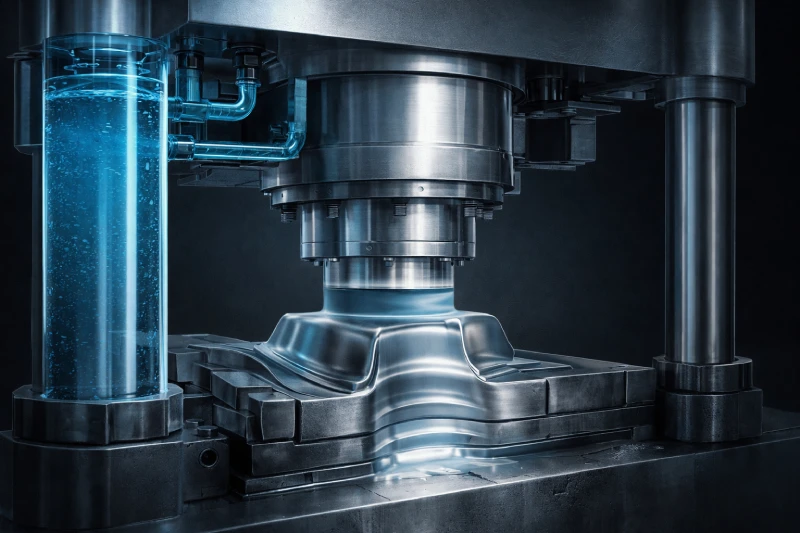
A hydraulic stamping press uses pressurized hydraulic fluid to generate force, rather than relying on a flywheel and crank mechanism like a mechanical press. This allows the machine to deliver full tonnage at any point during the stroke, which is a defining advantage in many forming applications.
Unlike conventional systems explained in the broader /stamping-press/ overview, hydraulic presses are designed for control rather than speed. Operators can precisely adjust:
- Ram speed
- Pressure levels
- Stroke length
- Dwell time at bottom dead center
This level of control makes hydraulic presses highly adaptable to varying materials and complex geometries.
From a production standpoint, they are best viewed as precision-driven forming systems, rather than high-throughput stamping machines.
Key Advantages of Hydraulic Stamping Presses
Full Force Throughout the Stroke
One of the most important advantages is that hydraulic presses can apply maximum force at any position in the stroke. This is critical for operations like deep drawing, where force requirements peak mid-stroke rather than at the bottom.
This capability ensures:
- Consistent forming quality
- Reduced risk of material tearing
- Better dimensional accuracy
Superior Precision and Control
Hydraulic systems allow fine-tuning of nearly every motion parameter:
- Adjustable ram speed (fast approach, slow forming)
- Programmable pressure curves
- Controlled dwell time
This level of control is essential for:
- Sensitive materials (aluminum, thin steel)
- Complex geometries
- Tight tolerance requirements
Flexibility for Complex Forming
Hydraulic presses are particularly well-suited for:
- Deep drawing
- Embossing
- Multi-stage forming
- Irregular part geometries
Unlike rigid mechanical systems, hydraulic presses can adapt to variable forming conditions, making them ideal for job shops or mixed production lines.
Built-In Overload Protection
Because force is generated hydraulically, the system inherently limits overload risk. If pressure exceeds the set limit, the system will relieve itself.
This results in:
- Reduced tooling damage
- Increased operator safety
- Lower maintenance costs over time
Longer Tooling Life
Hydraulic presses apply force more gradually compared to the impact-driven motion of mechanical presses. This reduces:
- Shock loads
- Vibration
- Tool wear
For high-value tooling, this can significantly extend lifespan and reduce replacement frequency.
Limitations You Must Consider
While hydraulic presses offer significant advantages, they are not the best choice for every application.
Slower Production Speed
Hydraulic presses are inherently slower due to:
- Fluid dynamics limitations
- Controlled motion cycles
They are not suitable for:
- High-speed blanking
- Mass production environments
If production speed is your top priority, a mechanical press will outperform.
Higher Energy Consumption
Hydraulic systems often require continuous operation of pumps and motors, leading to:
- Higher energy usage
- Increased operating costs
This is especially noticeable in long production runs.
Maintenance Requirements
Hydraulic systems introduce additional maintenance considerations:
- Hydraulic fluid management
- Seal wear and replacement
- Risk of leaks
Compared to mechanical presses, maintenance is more fluid-system dependent rather than purely mechanical.
Lower Efficiency for Simple Operations
For basic operations like:
- Piercing
- Blanking
- Simple stamping
A hydraulic press may be excessive. Mechanical presses can perform these tasks faster and more efficiently.
Typical Applications of Hydraulic Stamping Presses
Hydraulic presses are widely used across industries where precision and forming complexity are critical.
Deep Drawing Operations
One of the most common applications is deep drawing, where material is stretched into a die to form shapes like:
- Automotive panels
- Kitchen sinks
- Cylindrical containers
Complex Metal Forming
Industries such as aerospace and electronics rely on hydraulic presses for:
- Intricate geometries
- Tight tolerances
- Multi-stage forming processes
These applications benefit from the press’s ability to control force precisely.
Thick Material Processing
Hydraulic presses are ideal for forming:
- High-strength steel
- Thick metal sheets
- Structural components
Because full tonnage is available at any stroke position, they can handle demanding material requirements.
Low-to-Medium Volume Production
Hydraulic presses excel in flexible manufacturing environments where:
- Product variation is high
- Batch sizes are smaller
- Setup changes are frequent
Hydraulic vs Mechanical Stamping Press: When to Choose Each
Choosing between hydraulic and mechanical presses depends on your production priorities.
Choose a Hydraulic Press When:
- You need precise control over force and speed
- Your parts require deep drawing or complex forming
- You work with sensitive or variable materials
- Production volumes are moderate
Choose a Mechanical Press When:
- You require high-speed production
- Your operations are simple and repetitive
- Cost per part must be minimized
Key Performance Characteristics to Evaluate
When selecting a hydraulic stamping press, focus on the following critical parameters:
Tonnage Capacity
Hydraulic presses provide full tonnage across the entire stroke, but selecting the correct capacity is still essential.
- Undersized press → incomplete forming
- Oversized press → unnecessary cost
Stroke Length and Adjustability
A longer, adjustable stroke allows:
- Greater flexibility
- Compatibility with different dies
- Improved process control
Ram Speed Control
Look for systems that allow:
- Fast approach speed
- Slow forming speed
- Controlled return speed
This improves both efficiency and part quality.
Pressure Control and Dwell Time
Advanced hydraulic presses allow programmable pressure and dwell settings, which are critical for:
- Deep drawing
- Material flow control
- Surface finish quality
Bed Size and Working Area
Ensure the press can accommodate:
- Tooling dimensions
- Part size requirements
- Future scalability
When a Hydraulic Stamping Press Is the Best Choice
To simplify decision-making, use this framework:
Choose Hydraulic If:
- Your parts require complex forming or deep drawing
- You need consistent force control
- Your production involves multiple product types
- Material behavior varies significantly
Avoid Hydraulic If:
- You need ultra-high production speed
- Your parts are simple and repetitive
- Energy efficiency is a top priority
- Cost per unit must be minimized at scale
Conclusion: Is a Hydraulic Stamping Press Right for Your Operation?
Hydraulic stamping presses are not the fastest machines on the shop floor—but they are among the most versatile and precise. If your production demands controlled force, flexibility, and the ability to handle complex geometries, a hydraulic press is often the best investment.
On the other hand, for high-speed, high-volume production of simple parts, mechanical presses remain the more efficient choice.
The key is aligning your equipment with your production priorities. If you’re unsure which configuration fits your needs, evaluating your material, part complexity, and volume requirements is the best starting point.
