
Choosing the wrong stamping press can create expensive production problems: poor part quality, tool damage, low output, unnecessary energy costs, and future capacity limitations. Many manufacturers focus only on tonnage or price, then discover that the machine cannot support their dies, material thickness, or long-term production goals.
The right stamping press should match your material, part size, production volume, automation requirements, and budget. Whether you are buying your first press or upgrading an existing production line, this guide will help you evaluate the most important specifications and avoid costly mistakes.
Looking for a general overview first? Read our Stamping Press guide before comparing specific machines.
Before You Compare Machines, Define Your Production Requirements
Before you request quotations or compare brands, start by defining exactly what your production line needs. Two presses with the same tonnage can perform very differently depending on bed size, stroke, speed, and automation compatibility.
The following questions should be answered before you contact a supplier:
- What material are you stamping?
- How thick is the material?
- What are the dimensions of the finished part?
- How many parts do you need per hour or per day?
- Will you use a progressive die, transfer die, or single-station tooling?
- Will the line eventually need automation?
What Material Will You Stamp?
Material type and thickness are the first factors that determine the required press capacity.
| Material | Typical Difficulty | Recommended Press Type |
|---|---|---|
| Aluminum | Easy to form | Mechanical or Servo |
| Mild Steel | Medium | Mechanical |
| Stainless Steel | Higher force required | Hydraulic or Servo |
| Copper / Brass | Precision applications | Servo |
| Thick High-Strength Steel | Difficult to form | Hydraulic |
Thicker and harder materials require more tonnage and slower forming speeds. For example, a press suitable for thin aluminum brackets may be completely unsuitable for thick stainless-steel structural parts.
What Parts Are You Producing?
Small precision components require different equipment than large industrial panels or structural parts.
- Small electronic or precision parts often need high-speed mechanical or servo presses.
- Large appliance, agricultural, or structural parts require larger bed sizes and greater daylight.
- Automotive body panels usually require larger presses with transfer automation.
If you manufacture oversized components, you may also need to review a dedicated page about stamping press solutions for large parts.
What Is Your Required Production Volume?
| Production Requirement | Recommended Press Strategy |
|---|---|
| Prototypes / Low Volume | Flexible hydraulic or servo press |
| Medium Batch Production | Standard mechanical press |
| High-Speed Mass Production | High-speed mechanical press with automation |
If your production is expected to increase within the next 2–3 years, buy for future capacity rather than only for today’s jobs.
How to Choose the Correct Stamping Press Tonnage
Tonnage is the first specification most buyers review, but it is also one of the most misunderstood.
Press tonnage refers to the maximum force the machine can apply during forming. Choosing a press with insufficient tonnage can overload the machine, damage the die, and produce poor-quality parts. Choosing a press that is much larger than necessary increases capital cost and operating expense.
As a general rule, buyers should calculate the required forming force and then add a 20–30% safety margin.
| Application Type | Typical Tonnage Range |
|---|---|
| Light-Duty Stamping | 20–80 tons |
| Medium-Duty Production | 80–300 tons |
| Heavy-Duty Structural Parts | 300+ tons |
Signs the Press Is Too Small
A press with insufficient tonnage often creates the following issues:
- Incomplete forming or poor part consistency
- Excessive die wear
- Frequent overload alarms or shutdowns
- Reduced production speed
- Higher scrap rates
Signs the Press Is Too Large
An oversized machine is not always better. It can create:
- Higher initial investment
- Greater energy consumption
- Larger floor-space requirements
- Lower efficiency when running small parts
| Press Size Decision | Main Risk |
|---|---|
| Undersized Press | Machine overload and part defects |
| Oversized Press | Unnecessary cost and wasted capacity |
When in doubt, ask the supplier to verify your tonnage requirements using your actual part drawings and material specifications.
Which Type of Stamping Press Is Best for Your Application?
Most industrial buyers eventually choose between three major options: mechanical, hydraulic, and servo presses. The correct choice depends on your production speed, material thickness, precision requirements, and budget.
| Press Type | Best For | Main Advantage | Main Limitation |
|---|---|---|---|
| Mechanical Press | High-speed production | Fast and cost-effective | Less flexible |
| Hydraulic Press | Thick materials and deep drawing | High force and flexibility | Slower cycle speed |
| Servo Press | Precision and complex forming | Programmable motion | Higher purchase cost |
Choose a Mechanical Press If…
A mechanical press is usually the best choice if:
- You need high-speed, repeatable production
- You produce large volumes of similar parts
- Your material thickness is moderate
- Cost per part is a major concern
Mechanical presses are commonly used for appliance components, metal brackets, consumer goods, and many automotive applications.
Choose a Hydraulic Press If…
A hydraulic press is better when:
- Material is thick or difficult to form
- Deep drawing is required
- Production volume is lower
- You need longer stroke control
Hydraulic presses are commonly selected for heavy-duty industrial parts, structural components, and deep-formed products.
Choose a Servo Press If…
Servo presses are ideal when:
- You need high accuracy and repeatability
- The process requires programmable slide motion
- Material cracking or wrinkling is a concern
- Multiple product types run on the same machine
If you need a deeper technical comparison, create separate internal links to pages covering mechanical stamping presses, hydraulic stamping presses, and servo stamping presses.
Key Machine Specifications Buyers Often Overlook
Many buyers focus only on tonnage, but other machine specifications are equally important.
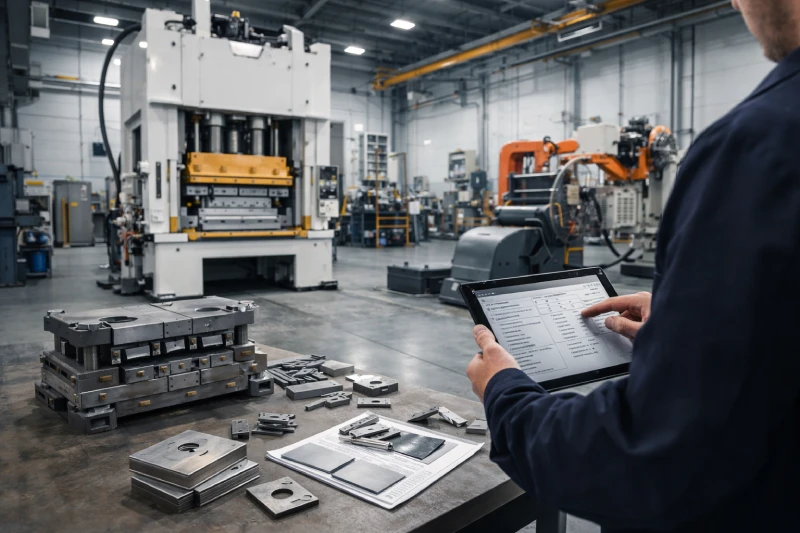
Bed Size and Bolster Area
The press bed must be large enough to support your current and future tooling.
If the bed is too small:
- The die may not fit correctly
- Future tooling options become limited
- Automation equipment may not integrate properly
Always consider future product sizes when selecting bed dimensions.
Stroke Length and Shut Height
Stroke length affects how far the slide travels, while shut height determines the maximum die height the press can accommodate.
| Specification | Why It Matters |
|---|---|
| Stroke Length | Determines forming depth |
| Shut Height | Determines die compatibility |
| Daylight | Allows easier die change and maintenance |
Large or deep parts often require longer strokes and larger shut heights.
Press Speed (SPM)
SPM, or strokes per minute, directly affects productivity.
| Production Goal | Recommended Speed |
|---|---|
| Large Heavy Parts | Lower SPM |
| Medium Production | Moderate SPM |
| Small High-Volume Parts | High SPM |
High-speed operation is not always the best solution. Thick materials often require slower forming to maintain part quality and protect the tooling.
Control System and Automation Compatibility
Modern presses should be ready for future automation.
Recommended features include:
- PLC control system
- Touchscreen operator interface
- Feeder compatibility
- Transfer system integration
- Remote diagnostics
- Production monitoring
If you plan to automate your line later, make sure the machine can support feeders, coil handling equipment, and robotic loading systems.
Should You Buy a Manual, Semi-Automatic, or Fully Automated Stamping Press?
The best level of automation depends on labor cost, production volume, and expansion plans.
| Machine Type | Labor Requirement | Output | Investment |
|---|---|---|---|
| Manual Press | High | Low | Lowest |
| Semi-Automatic Press | Medium | Medium | Moderate |
| Fully Automated Press | Low | High | Highest |
A manual press may be suitable for small workshops, prototype work, or very low production volume. Semi-automatic systems are often the best balance for growing manufacturers because they improve output without the cost of a fully automated line.
For large factories running continuous production, fully automated stamping lines offer:
- Lower labor cost
- More consistent quality
- Higher output
- Better operator safety
Although automation requires a larger initial investment, it often reduces total operating cost over time.
What Does a Stamping Press Cost?
Stamping press pricing varies widely depending on tonnage, press type, automation level, and country of origin.
| Machine Type | Typical Price Range |
|---|---|
| Small Manual or Basic Mechanical Press | $10,000–$50,000 |
| Medium Production Mechanical Press | $50,000–$250,000 |
| Large Hydraulic or Servo Press | $250,000–$1,000,000+ |
| Fully Automated Production Line | $500,000–$2,000,000+ |
The purchase price is only one part of the decision. Buyers should evaluate the total cost of ownership.
Total Cost of Ownership Matters More Than Purchase Price
A cheaper machine may ultimately cost more if it creates:
- Higher energy consumption
- More maintenance downtime
- Expensive spare parts
- Poor tooling compatibility
- Lower production efficiency
| Cost Category | Often Overlooked? |
|---|---|
| Initial Purchase Price | No |
| Installation and Training | Yes |
| Maintenance and Spare Parts | Yes |
| Energy Consumption | Yes |
| Future Automation Upgrades | Yes |
The best value is not always the cheapest press. It is the machine that delivers the lowest cost per finished part over its full service life.
7 Common Mistakes Buyers Make When Purchasing a Stamping Press
Many stamping press purchases fail because buyers overlook long-term requirements.
- Buying based only on current production
- Future jobs may require larger dies, different materials, or more automation.
- Choosing the cheapest machine
- Low-cost machines often have weaker controls, lower durability, and poor service support.
- Ignoring die compatibility
- Even if the press has enough tonnage, the die may not fit the bed, shut height, or stroke.
- Forgetting about factory limitations
- Always check floor space, power supply, and foundation requirements.
- Overlooking automation potential
- A press without automation compatibility may become obsolete sooner.
- Failing to evaluate supplier support
- Spare parts and technical service are critical after installation.
- Ignoring safety requirements
- Press safety systems are essential for protecting operators and meeting compliance standards.
For safety-related considerations, your site should include an internal link to a dedicated stamping press safety guide.
How to Evaluate a Stamping Press Manufacturer or Supplier
Choosing the right supplier is just as important as choosing the right machine.
A strong supplier should provide more than a quotation. They should understand your application and recommend the most suitable configuration.
Before selecting a manufacturer or supplier, ask the following questions:
| Supplier Evaluation Question | Why It Matters |
|---|---|
| Can they provide case studies? | Shows real industry experience |
| Do they offer installation and training? | Reduces startup problems |
| Are spare parts available locally? | Minimizes downtime |
| Can they test your part before purchase? | Reduces technical risk |
| Do they support future automation? | Protects long-term investment |
You should also request:
- Photos or videos of similar machines in production
- Customer references
- A factory acceptance test
- A complete list of included accessories and options
If possible, send the supplier your material details, part drawing, production target, and tooling information before requesting a quotation. The more information you provide, the more accurate the recommendation will be.
Final Checklist Before You Request a Quote
Before contacting a stamping press supplier, prepare the following information:
- Material type and thickness
- Part dimensions
- Required production volume
- Estimated tonnage requirement
- Preferred press type
- Required automation level
- Available factory floor space
- Power supply details
- Budget range
Providing this information will help suppliers recommend the correct machine more quickly and accurately.
Need Help Selecting the Right Stamping Press?
Choosing the correct stamping press is not simply about buying the largest or cheapest machine. The best press is the one that matches your material, part size, production volume, tooling, and future expansion plans.
If you are unsure which machine is right for your factory, contact our team with your drawings, material specifications, and production requirements. We can help you compare mechanical, hydraulic, and servo options and recommend the most cost-effective solution for your production line.
Request a free stamping press recommendation and quotation based on your actual production requirements.
