
Introduction
A servo press is a precision metal forming machine driven by a servo motor instead of a traditional flywheel or hydraulic pump. Unlike conventional presses that rely on fixed mechanical motion or hydraulic pressure, a servo press system uses programmable motion control to manage the movement of the press ram throughout the entire stroke.
This difference in drive technology fundamentally changes how the machine operates. Instead of delivering a single fixed motion profile, a servo press can control speed, position, and force at every point in the forming cycle.
Servo presses are widely used in industries that require high precision and repeatable forming processes, including automotive component manufacturing, battery production, electronics assembly, and precision metal stamping. Understanding the servo press working principle helps engineers and equipment buyers evaluate when this technology provides a real advantage over traditional press systems.
Core Components of a Servo Press System
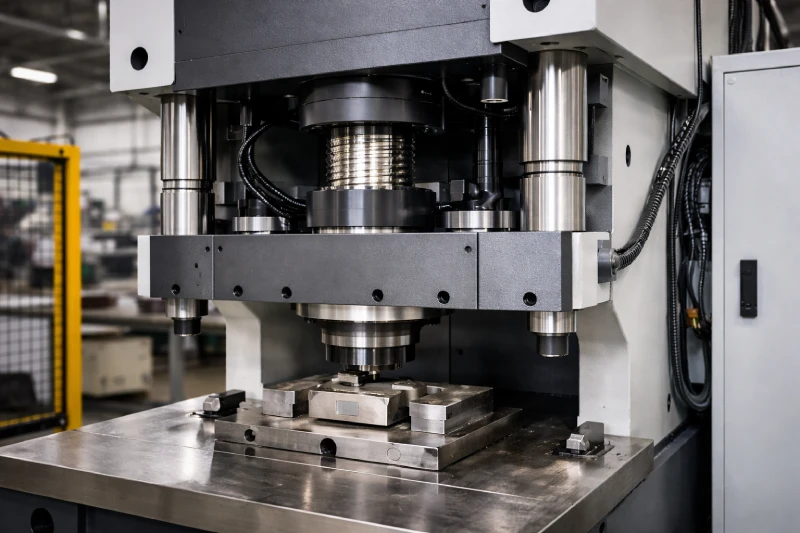
A servo press system consists of several integrated components that work together to convert electrical energy into precisely controlled linear forming motion.
Servo Motor
The servo motor is the primary power source of the press. Unlike conventional motors used in mechanical presses, servo motors allow precise control of rotation speed, torque, and acceleration. The motor receives motion commands from the control system and adjusts its output dynamically during each forming cycle.
Ball Screw or Drive Transmission
The rotational motion generated by the servo motor must be converted into linear movement. This is typically achieved through a ball screw mechanism or another high-precision drive transmission. The ball screw converts the motor’s rotational motion into vertical movement of the press ram while maintaining high mechanical efficiency and minimal backlash.
Motion Controller
The motion controller is the core of the servo press control system. It manages the motion profile of the press stroke by sending commands to the servo motor. Engineers can program different motion curves, such as slow approach, controlled forming speed, dwell time, and rapid return.
This programmable control is what differentiates servo presses from mechanical or hydraulic presses.
Position Feedback System
Servo presses rely on continuous feedback from sensors such as encoders or linear scales. These devices monitor the exact position and movement of the ram. The controller uses this feedback to make real-time adjustments, ensuring precise positioning and repeatability.
Press Frame Structure
The press frame provides the mechanical rigidity required to maintain accuracy during forming. High-precision applications require a rigid structure that minimizes deformation under load so that the controlled motion of the servo system translates directly into consistent forming results.
Together, these components form an integrated servo press system capable of highly controlled and repeatable forming operations.
The Working Principle of a Servo Press
The servo press working principle is based on precisely controlling the motion of the press ram through programmable servo motor movement. Unlike traditional presses that follow a fixed mechanical motion, a servo press allows the motion profile to be defined by software.
The operation typically follows several steps.
1. Servo Motor Rotation
The process begins when the motion controller sends commands to the servo motor. The motor rotates according to the programmed motion profile, which specifies speed, acceleration, and position targets.
Because servo motors respond instantly to control signals, the machine can precisely adjust its motion throughout the cycle.
2. Motion Transmission
The rotational motion of the servo motor is transferred through a transmission system—commonly a ball screw mechanism. This system converts rotation into vertical linear movement while maintaining high efficiency and positional accuracy.
The quality of the transmission system directly affects the machine’s positioning precision and load capacity.
3. Ram Movement Control
As the transmission system moves, it drives the press ram downward toward the workpiece. The servo press motion control system continuously adjusts motor output to maintain the programmed speed and force profile.
Unlike mechanical presses, the ram speed does not have to follow a fixed curve.
4. Programmable Stroke Control
One of the most important features of a servo press is programmable stroke control. Engineers can define how the ram behaves at different stages of the forming process.
For example, the machine can:
- approach the workpiece quickly
- slow down before contact
- maintain a constant forming speed
- dwell briefly at the bottom of the stroke
- return rapidly to the starting position
This flexibility allows the forming process to be optimized for specific materials or part geometries.
5. Precision Positioning
Throughout the process, the position feedback system continuously measures the ram position and sends data back to the controller. The controller then adjusts motor output in real time.
This closed-loop control ensures extremely high positioning accuracy and repeatability, which is critical in precision manufacturing environments.
How Servo Motion Control Improves Precision
The biggest advantage of servo press technology lies in its ability to precisely control motion throughout the forming cycle. This is achieved through advanced servo press motion control capabilities.
Programmable Motion Curves
Traditional presses follow a fixed mechanical motion profile determined by crank geometry. In contrast, servo presses allow engineers to design custom motion curves.
This means the press can slow down during forming, pause at specific positions, or adjust speed depending on material behavior.
Adjustable Speed
Servo systems allow speed to be adjusted dynamically during the stroke. For example, the ram can approach the workpiece quickly but slow down during the forming stage to reduce shock and improve dimensional accuracy.
This is particularly useful when working with delicate or high-precision components.
Force Control
Many servo press systems can monitor and control applied force during the forming process. This allows manufacturers to maintain consistent forming pressure and detect abnormal conditions such as part misalignment or tooling issues.
High Repeatability
Because servo presses rely on closed-loop control and precise feedback systems, they offer extremely high repeatability. Each forming cycle follows the same programmed motion profile with minimal variation.
This level of consistency is essential in industries where even small deviations can lead to product defects or assembly problems.
Servo Press vs Traditional Press Operation
Understanding how servo presses operate becomes clearer when comparing them to traditional press technologies.
Mechanical Press
Mechanical presses use a flywheel and crank mechanism to generate motion. The ram follows a fixed sinusoidal motion curve determined by the crank geometry.
While mechanical presses are efficient for high-volume stamping, they provide very limited control over ram motion. Speed and position cannot be adjusted independently during the stroke.
Hydraulic Press
Hydraulic presses use hydraulic cylinders to generate force. These machines provide more flexibility than mechanical presses because ram speed can be adjusted through hydraulic flow control.
However, hydraulic systems typically have slower response times and lower positioning accuracy compared to servo systems.
Servo Press Advantages
A servo press combines the advantages of both systems:
- precise programmable motion
- high positioning accuracy
- flexible speed control
- energy efficiency
Because motion is controlled electronically rather than mechanically, the press can adapt to different forming processes without changing mechanical components.
For manufacturers evaluating modern forming equipment, understanding the servo press working principle helps clarify why this technology is increasingly replacing traditional press systems.
Typical Industrial Applications
Servo presses are commonly used in manufacturing processes where precision, repeatability, and process control are critical.
Automotive Components
In automotive production, servo presses are used for forming precision parts such as sensor housings, connectors, and safety components. The ability to control forming speed and force improves dimensional accuracy and reduces material stress.
Battery Manufacturing
Battery production requires highly controlled assembly processes. Servo presses are often used for operations such as battery cell pressing, terminal forming, and module assembly where precise force control is required.
Electronics Assembly
Electronics manufacturing frequently involves delicate components that can be damaged by uncontrolled forming forces. Servo presses allow controlled insertion and forming operations that protect sensitive parts.
Precision Metal Forming
Servo presses are also widely used in precision stamping and forming operations. Their programmable motion profiles allow manufacturers to optimize forming processes for complex geometries or advanced materials.
These applications demonstrate why servo presses are increasingly adopted in modern production environments where process control and product quality are critical.
Conclusion
The servo press working principle is fundamentally based on programmable motion control driven by a servo motor system. By replacing traditional mechanical or hydraulic drive systems with electronically controlled motion, servo presses offer far greater flexibility and precision.
Through integrated components such as servo motors, motion controllers, ball screw drives, and feedback systems, the machine can precisely control speed, position, and force throughout the forming cycle.
For manufacturers producing high-precision components, this level of control leads to improved product quality, better process consistency, and greater adaptability in production. As manufacturing continues to demand tighter tolerances and smarter automation, servo press technology is becoming an increasingly important solution in modern metal forming systems.
