
Introduction
Servo-driven press technology has become increasingly common in modern manufacturing because it offers higher control accuracy and programmable motion compared with traditional mechanical or hydraulic presses. Among these technologies, two major configurations are widely used in industry: electric servo presses and servo hydraulic presses.
Although both systems use servo motors for motion control, their underlying force generation mechanisms are fundamentally different. Electric servo presses rely on motor-driven mechanical transmission systems such as ball screws or planetary roller screws, while servo hydraulic presses combine servo motors with hydraulic pumps and cylinders to generate force through fluid pressure.
Because these technologies provide different performance characteristics in terms of precision, force capacity, speed control, and application flexibility, manufacturers often evaluate both options before investing in new equipment. Understanding the engineering differences between these press types helps engineers select the most appropriate system for their production requirements.
What Is an Electric Servo Press?
An electric servo press is a mechanically driven press system powered by a servo motor that converts rotational motion into linear pressing force through a mechanical transmission mechanism. The most common drive components include ball screws, roller screws, or crank mechanisms, which translate motor rotation into controlled vertical movement of the press ram.
In this design, the servo motor directly controls the press motion through a digital control system. The position, speed, acceleration, and force applied during the press stroke can all be programmed through motion control software. Because the mechanical drive system provides rigid force transmission, electric servo presses can achieve very accurate positioning and repeatable motion profiles.
One of the main characteristics of electric servo presses is their high motion precision. The closed-loop servo control system continuously monitors position and force feedback, allowing the machine to stop at extremely precise points during the stroke. This capability is particularly useful in assembly processes where components must be pressed together with controlled force and displacement.
Electric servo presses typically operate within moderate force ranges, commonly from a few kilonewtons up to several hundred kilonewtons depending on the mechanical design. Since they do not rely on hydraulic fluid systems, they also require relatively simple maintenance and produce cleaner operating environments.
For this reason, electric servo presses are widely used in industries that demand high accuracy and repeatability, such as electronics assembly, automotive component installation, and precision forming processes.
What Is a Servo Hydraulic Press?
A servo hydraulic press combines traditional hydraulic press technology with modern servo motor control. Instead of using a constant-speed electric motor driving a hydraulic pump, the system uses a servo motor to directly control the hydraulic pump, allowing precise regulation of oil flow and pressure.
In this configuration, the servo motor adjusts pump speed in real time according to the required press motion. The hydraulic pump delivers pressurized oil into a hydraulic cylinder, which generates the linear force needed to move the press ram. By controlling pump speed and oil flow, the system can regulate both the pressing force and the motion profile of the ram.
The key advantage of servo hydraulic systems is their ability to generate very high force levels while maintaining programmable motion control. Hydraulic cylinders can produce large pressing forces without requiring large mechanical drive components, making servo hydraulic presses suitable for heavy-duty forming operations.
Modern servo hydraulic presses use advanced sensors and control algorithms to monitor pressure, position, and force throughout the press stroke. This allows manufacturers to program different motion stages such as approach speed, pressing speed, and return speed.
Because of their high force capability and flexible motion control, servo hydraulic presses are commonly used in applications such as metal forming, deep drawing, stamping, and large component assembly, where significant pressing force is required.
Key Differences in Force Generation and Motion Control
The most important difference between electric servo presses and servo hydraulic presses lies in how they generate and transmit pressing force.
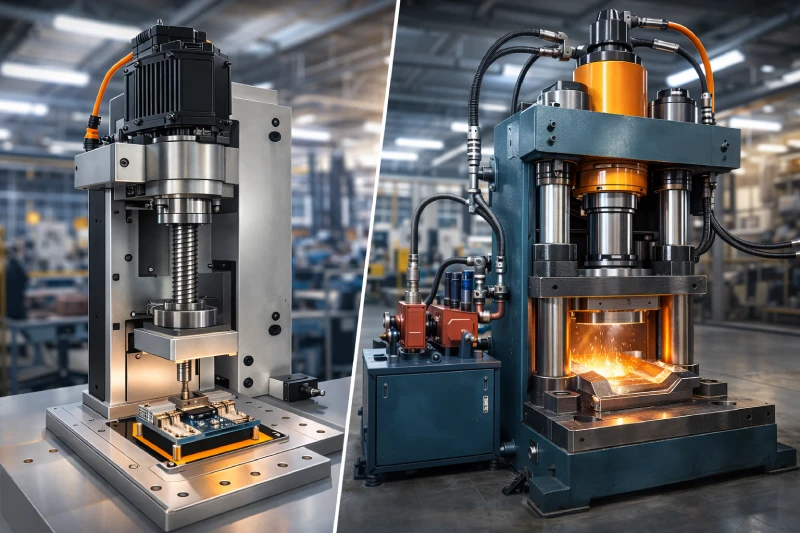
In electric servo presses, force is generated directly by the servo motor and transmitted through a mechanical drive system. Components such as ball screws or roller screws convert the rotational torque of the motor into linear force. Because the transmission system is mechanical and rigid, the movement of the press ram is highly predictable and directly linked to motor position.
This design enables precise control of displacement and repeatable force application. However, the maximum force output of the system is limited by the mechanical strength of the screw mechanism and the torque capacity of the servo motor. As press force requirements increase, the mechanical components must become significantly larger and more robust.
In contrast, servo hydraulic presses generate force through hydraulic pressure. The servo motor controls a hydraulic pump, which moves pressurized fluid into a hydraulic cylinder. The cylinder then converts hydraulic pressure into linear force acting on the press ram.
Hydraulic systems offer a major advantage in terms of force multiplication. Large forces can be generated without requiring large mechanical drive components because hydraulic pressure distributes force across the piston area of the cylinder. This allows servo hydraulic presses to achieve significantly higher tonnage compared with most electric servo presses.
However, hydraulic force transmission behaves differently from mechanical systems. Fluid compression and hydraulic circuit dynamics introduce a degree of elasticity into the system. As a result, motion response and stiffness can differ from the rigid mechanical transmission used in electric presses.
From a control perspective, both technologies use modern servo control systems. Electric presses typically achieve very precise position control, while servo hydraulic presses prioritize high force capability combined with programmable motion profiles.
Precision, Speed and Control Comparison
When evaluating press technologies, engineers often compare three key performance factors: precision, motion speed, and control flexibility.
Electric servo presses generally provide very high positioning accuracy. Because the ram position is directly linked to servo motor rotation through a mechanical drive system, the machine can control displacement with extremely fine resolution. This makes electric presses well suited for applications where the final position of the ram must be controlled within tight tolerances.
Servo hydraulic presses also use closed-loop control systems, but their motion response is influenced by the behavior of hydraulic fluid and system pressure dynamics. While modern servo hydraulic systems achieve good accuracy, they typically prioritize force control and load capacity rather than ultra-fine positional precision.
In terms of speed, both systems can achieve programmable motion profiles. Electric servo presses often deliver fast acceleration and deceleration, which allows short cycle times in assembly operations. Because the servo motor directly drives the mechanical system, motion response can be highly dynamic.
Servo hydraulic presses can also control speed effectively, but their cycle characteristics depend on hydraulic flow rates and system pressure. In heavy forming applications, slower but controlled pressing speeds are often preferred to maintain forming quality.
Overall, electric servo presses tend to excel in precision motion control and fast assembly operations, while servo hydraulic presses are designed to handle higher force loads with flexible stroke programming.
Typical Industrial Applications
The choice between electric servo presses and servo hydraulic presses often depends on the nature of the manufacturing process and the required pressing force.
Electric servo presses are widely used in precision assembly operations where accurate displacement and controlled pressing force are critical. For example, in automotive electronics production, electric servo presses are used to install connectors, bearings, or bushings with tightly controlled force-displacement curves. The system can detect abnormal assembly conditions by monitoring force feedback during the press cycle.
In the electronics industry, electric servo presses are also used for tasks such as connector insertion, PCB assembly, and small component forming, where high repeatability and programmable motion profiles are required.
Servo hydraulic presses, on the other hand, are commonly used in heavy-duty forming and stamping operations. Their ability to generate large pressing forces makes them suitable for forming metal sheets, structural components, and thick materials.
Typical applications include automotive structural part forming, deep drawing processes, and metal stamping operations that require large tonnage presses. Servo hydraulic systems are also used in industries such as aerospace, appliance manufacturing, and heavy equipment production.
Another important application area for servo hydraulic presses is large component assembly, where high pressing force is necessary to install parts such as gears, shafts, or structural elements.
Because each technology addresses different performance requirements, manufacturers often select the press type based on the specific force, precision, and production characteristics of their process.
Which Servo Press Type Should You Choose?
Selecting the appropriate servo press technology depends primarily on the force requirements, precision needs, and type of manufacturing process.
Electric servo presses are generally preferred for operations that require high positional accuracy, controlled motion profiles, and moderate pressing forces. Processes such as precision assembly, electronic component installation, and small metal forming operations benefit from the rigid mechanical transmission and accurate displacement control provided by electric servo presses.
Servo hydraulic presses are typically chosen for applications requiring higher tonnage and larger working envelopes. Their hydraulic cylinders can generate significant force without requiring large mechanical drive systems, making them suitable for heavy forming operations such as deep drawing, stamping, and structural component assembly.
Another consideration is production flexibility. Servo hydraulic presses often support a wide range of press forces and stroke configurations, allowing manufacturers to handle different forming processes with a single machine.
In practice, many factories use both technologies depending on their production needs. Electric servo presses are frequently installed in precision assembly lines, while servo hydraulic presses are used in forming and stamping departments.
Evaluating the required press force, motion precision, and application type will help determine which servo press system best fits a particular manufacturing environment.
Conclusion
Electric servo presses and servo hydraulic presses both represent modern approaches to controlled press motion, but they are designed for different industrial requirements.
Electric servo presses use mechanical drive systems to deliver highly precise motion control and repeatable positioning, making them well suited for precision assembly and moderate force applications.
Servo hydraulic presses generate force through hydraulic pressure controlled by servo motors, allowing them to handle high-tonnage forming and heavy-duty manufacturing processes.
For manufacturers evaluating press technology, the decision ultimately depends on the required press force, motion precision, and production application. Understanding these differences helps ensure the selected press system matches the demands of the production process.
